A new working paper of mine, forthcoming in JPE: Macroeconomics, makes a simple point with data. The point is old and well understood, but easy to forget.
When output is supply-constrained, or close to it, with a steep aggregate supply curve, a central bank can engineer rapid disinflation at little cost to output. Raising rates aggressively does nothing more than withdraw the excess aggregate demand.
Many missed this during COVID and the recent energy shocks. A central bank that accommodates when output is supply-constrained is pushing on a string.
The same withdrawal of excess demand can come through fiscal policy, and in some circumstances, that is the better tool. This was Keynes’ central insight in his 1940 essay, “How to Pay for the War.”
My read is that many central banks drew the wrong lesson from the late 2000s and early 2010s. Expansionary monetary and fiscal policy did not raise inflation then, but only because output was demand-constrained. Accommodation buys output cheaply when demand is the constraint. It buys inflation when supply is.
There is an equivalent reading through the FTPL. For space, we set it aside in the paper, but we are really making a statement about the real value of government debt. When output is supply-constrained, an excess of nominal claims chasing a fixed bundle of goods shows up as inflation: the price level rises until the real value of outstanding nominal liabilities equals the present value of the primary surpluses that back them. Disinflation then requires raising that present value, either through higher future surpluses or by retiring claims today, which is exactly what an absorption of excess demand does. Keynes’ compulsory saving scheme and the central bank’s rate hike become two routes to the same revaluation.
An ungated copied can be found here:
https://t.co/wy4J6g4sLV
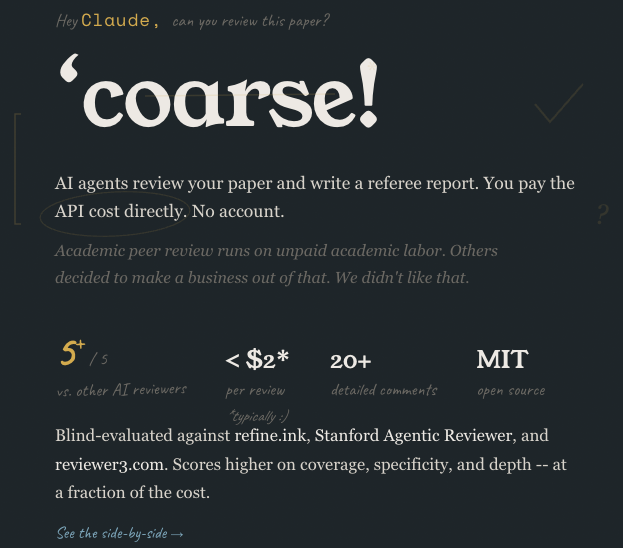
I coded up an open-source, not-for-profit AI paper reviewer that rivals the performance of @reviewer3com, @RefineInk, and Stanford Agentic Reviewer (according to @GeminiApp). Costs <$2!
Live @ https://t.co/5m1Srky4H8. Plug in paper, @OpenRouter key, and email. #econtwitter.
Just realizing that Kydland-Prescott (1977) is such a good paper to teach from. You can learn about optimal control, rational expectations, Lucas critique, Markov feedback rules, dynamic programming, time inconsistency, policy evaluation......all in less than 20 pages.
Advice for PhD students in economics about using AI, from the brilliant Isaiah Andrews. This should probably be circulated to all PhD cohorts
https://t.co/07xEbmx5n5
3️⃣ Central banks tend to attribute global financial conditions more to broad U.S. macroeconomic developments than to @federalreserve actions alone.
4️⃣ Statement sentiment appears to predict the Global #Financial Cycle, rather than merely react to it.
🧵 4/7
My previous post on LLMs for self-study has sparked considerable debate about the role of “traditional” higher education.
In response to some of the comments, I want to enumerate the arguments supporting the survival of “traditional” higher education. In my next post, I will assess how each might be affected by AI. Think of today's post as a taxonomy of arguments that I will review tomorrow in terms of their strength and robustness.
I count twelve.
First, signaling. The value of, let’s say, a degree from MIT is that you were smart enough to get into MIT and survive the grueling workload. The best example of signaling was the old way the British civil service selected its high-flyers: students with a first from Oxford in Literae Humaniores, not because they learned anything particularly useful there, but because it was hard to get in and hard to master all the Greek and Latin.
Second, credentialing. Societies, for a variety of reasons (some justified, some not), have decided that a degree is required to perform certain tasks. Sometimes, the requirement is statutory. For example, I cannot teach economics in a high school in Pennsylvania because I do not have a teacher’s certificate. Sometimes, the requirement is a social norm. Many firms insist that their recruits for many positions have a B.A.
Third, networking. The friendships, relationships, and (often) sentimental partnerships formed at a university are very valuable, as they occur at a key moment in life when students transition from adolescence to adulthood. Personally, networking was the most valuable component of my undergraduate education.
Fourth, peer effects in learning. This is distinct from networking. Being in a room with other smart students who challenge your thinking in real time, study groups, and classroom debate: the value is in the interaction during the learning process, not in the connections formed afterward. This was the most valuable aspect of my graduate education.
Fifth, commitment. Most students suffer from some form of time-inconsistency, and, in the absence of a formal degree, they would not complete more than a small fraction of the required work. Abysmal completion rates at Coursera courses illustrate the importance of this channel.
Sixth, curation of topics. Universities curate the topics and content that a well-balanced degree requires.
Seventh, skill acquisition. Students learn accounting, marketing, or biochemistry, and these skills are valued by the market.
Eighth, cultural capital. Students learn social norms and preferences that are valuable for positioning games in society and might have value in themselves (for example, university graduates tend to exhibit healthier behavior, even after controlling for selection and higher lifetime income).
Ninth, a “hold-out” period. Students are parked at universities while they mature, break links with their parents, and figure out what to do with their lives.
Tenth, proximity to the research frontier. The professor who teaches you monetary economics is also producing monetary economics. There is something qualitatively different about learning from someone working at the boundary of knowledge versus learning from someone, or something, that transmits existing knowledge well. This is not skill acquisition. It is exposure to how knowledge gets made.
Eleventh, assessment and feedback. The structured loop of writing, receiving criticism, and revising is a distinct mechanism from the discipline of showing up or the curation of content.
Twelfth, physical infrastructure. For many fields (chemistry, biology, engineering, medicine), the university provides labs, equipment, and supervised access to materials that cannot be replicated at home.
Some of these arguments are strong. Some of them are weaker than universities would like to believe. And some of them are about to be tested in ways they have never been tested before. Next time, I will go through each one.
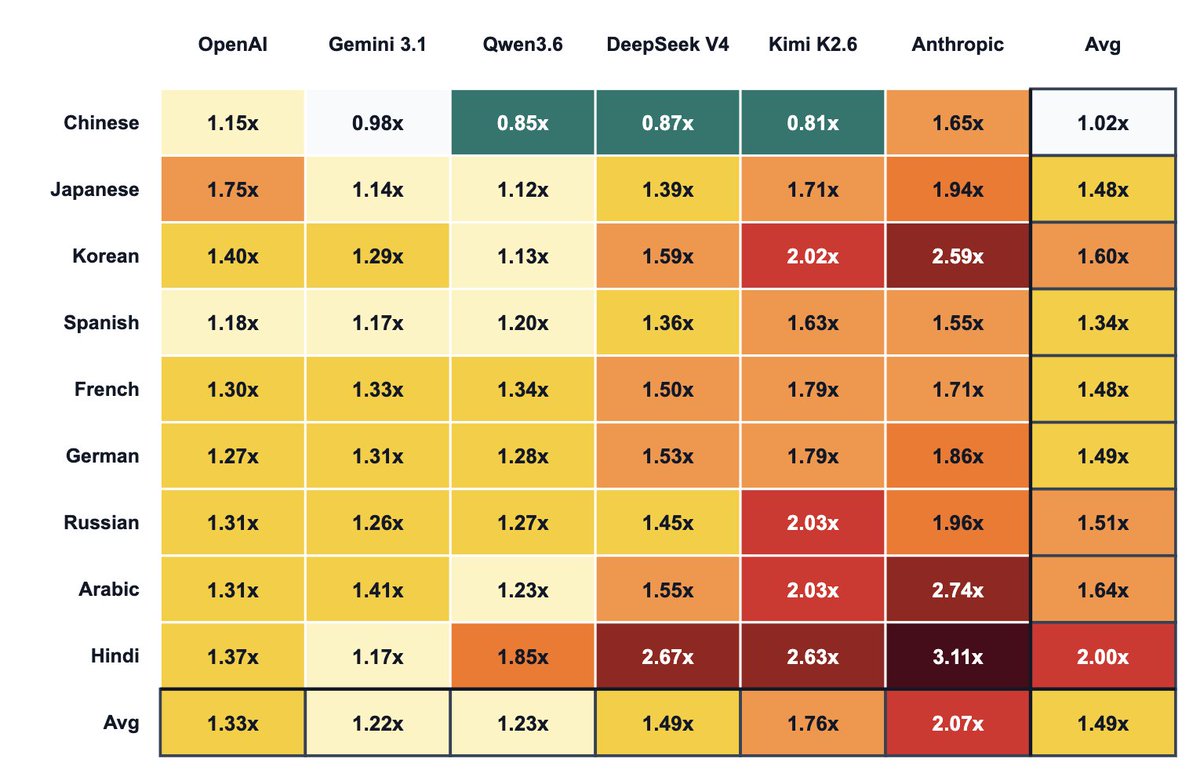
Follow-up on non-English token-inefficiency with more model-language pairs:
- Chinese is cheaper than English on major Chinese models
- Gemini and Qwen provide least non-English tax
- Anthropic has the highest tax by far; Kimi is next
- Hindi is the worst-covered language here, despite its massive speaker base
The same job transformation process is unfolding today:
- Legal associates spend more time with clients as AI takes care of document review (https://t.co/vurV4aXh1c)
- Radiologists concentrate on patient consultation as AI handles routine image analysis (https://t.co/Oj77FlgRVC)
- Software engineers focus on program design as AI churns out code (https://t.co/CfcQi1aw2g)
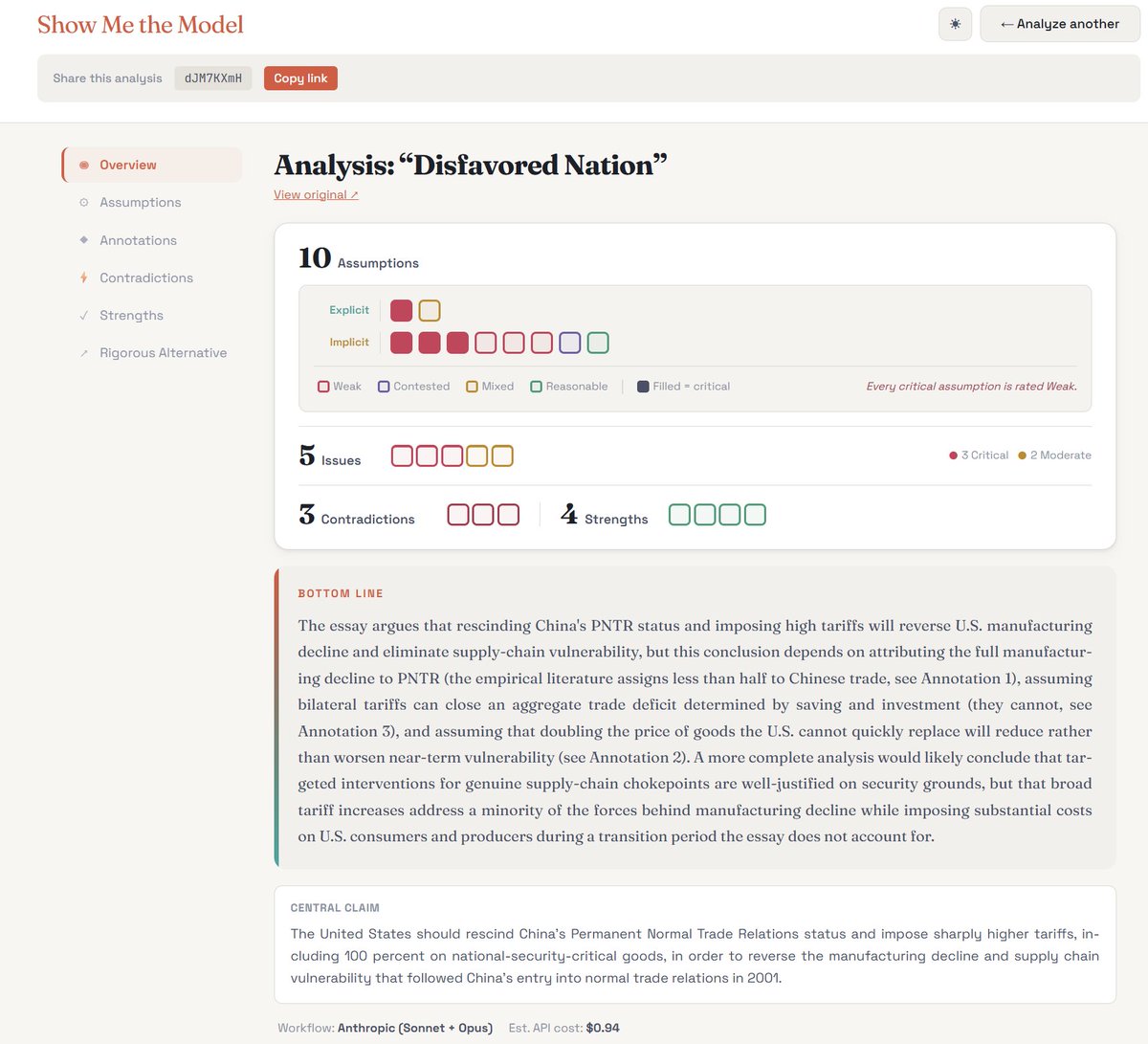
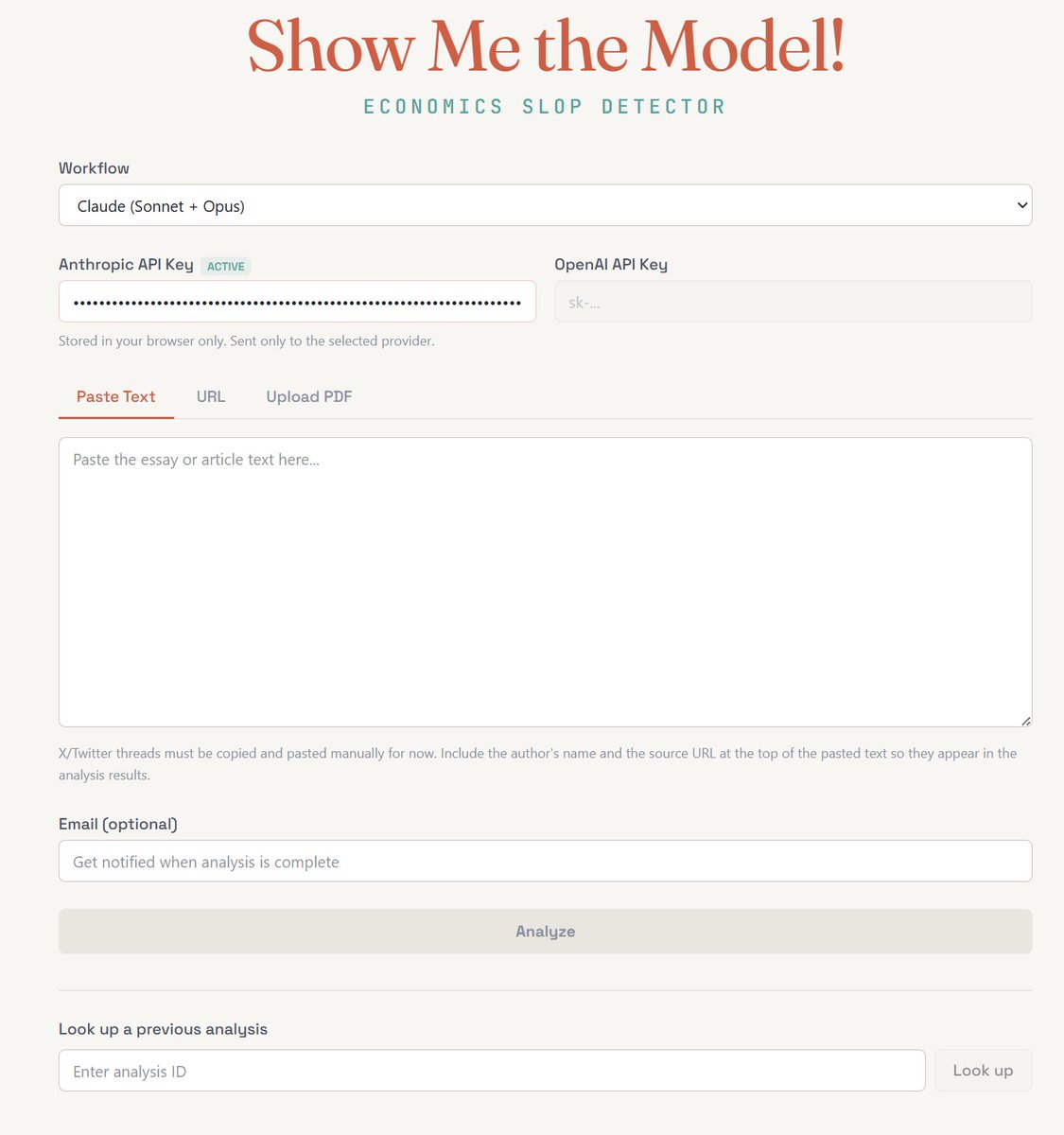
I spend way too much time on social media debunking "economic slop" promulgated by lawyers pretending to be economists, so I built Show Me the Model: a tool that uses AI to check whether the economic reasoning in an essay actually holds up.
https://t.co/cfhWs6MI27
Give it a URL or paste some plain text, and the tool flags hidden assumptions, internal inconsistencies, and other problem areas, and tells you how a real economist would think through the issue.
Right now, it has 4 "personas:" macro, trade, IO/price theory, and labor. The tool first figures out which persona is right for the job, and then uses a parallelized prompt scaffold specific to that persona to process the source text.
Here are some example outputs based on some essays that triggered me hard:
Citrini Research's viral essay on how AI could trigger a self-reinforcing financial crisis rivaling the GFC:
https://t.co/ZNUFHqyEFT
American Compass on the harms of trade deficits:
https://t.co/Nasfvr36iY
@oren_cass on why Built-to-Rent should be banned:
https://t.co/niie7bVRoK
American Compass on the "China Shock:"
https://t.co/nZvoEaTdTv
@michaelxpettis on why China's trade surplus reduces global output:
https://t.co/LqocDslRrH
Try it yourself at https://t.co/cfhWs6MI27. You'll need to bring your own API key (OpenAI or Anthropic), and a typical analysis costs $0.50–$1.50.
It's super preliminary and will probably break on you. I'd love feedback about both the functionality as well as the quality of the output.
As AI lowers the cost of producing papers, asking the right question matters more.
I built Frontier Graph: an open-source tool to explore open questions in economics, drawing on 240K papers across 300 journals.
Many of us are trying to figure out where the AI labor market transition may be going. But that's fundamentally unknowable. So instead of trying to predict the future we can instead look back to try to figure out what may be coming...by reading 19th c english literature 1/
➡️ In gig markets, unlike "standard" labor markets, there is no distinction between people who are employed and unemployed: *everyone* looking for work queues for delivery tasks, which get distributed across the whole group.
8/
New paper out w/ my excellent co-author (and friend) @gabrielpfritsch : “High-frequency fiscal shocks”.
We use LLM’s to construct a daily time-series of expectations about US fiscal deficits (1947-2025) and thereby identify “fiscal shocks” in the historical record.
Thread:
4w ago I was a Claude Code skeptic. I'm not a coder. None of the use cases were relevant. I managed teams & projects, drowning in email & overdue reminders. So I tried creating tools that would help me and... holy crap.
Now I'm sharing the tools I built:
https://t.co/5z9nDcwVno
In all of the discussion of AI, r, and the Citrini post, I have not seen mention of Ricardo Caballero's recent paper on AI, r, and valuations. Some quick thoughts:
Ricardo's model captures the second force @ojblanchard1 mentions, namely lower r from wealth concentration. Higher wealth concentration among the wealthy who have a higher propensity to save (as in work by @ludwigstraub, @AtifRMian, @profsufi) leads to a lower required return. Here is the mechanism:
Optimism about AI => higher valuations (Tobin's q) => higher investment => higher capital => higher capitalist wealth => lower required return (nonhomothetic preferences over wealth) => high valuations (q) justified
A key assumption is that AI capital is "labor-like" and so does not have diminishing returns over some range of capital.
Another interesting feature: during the AI deployment, wages and worker consumption stagnate, and the labor share is lower (workers don't own claims to AI).
What about a recession? The model doesn't have sticky prices/demand-determined output. But it does highlight the simple point that a recession is more likely if the AI boom crashes (drop in q). If there is no crash and the optimistic AI boom is realized, then (*speculating here*) it depends on whether the rise in investment and consumption of capitalists offsets the stagnant worker wages. But investment demand would likely be strong given the high valuations, which will push against a shortfall of demand. Also, my sense is that a recession would be relative to the rising potential output (a "growth recession"), not the counterfactual without AI. Again, this latter part is speculation...
Here's a link to Ricardo's interesting paper: https://t.co/Y1aZe1jeJ9
NEW PAPER🚨
“Fiscal Theory of The Price Level in Small and Open Economies”, with @juanpdiiorio
Monetary&Fiscal interactions are central in policy debates. FTPL provides a useful framework, but is mostly studied in closed economy. Does the logic simply extend to open economies? /1
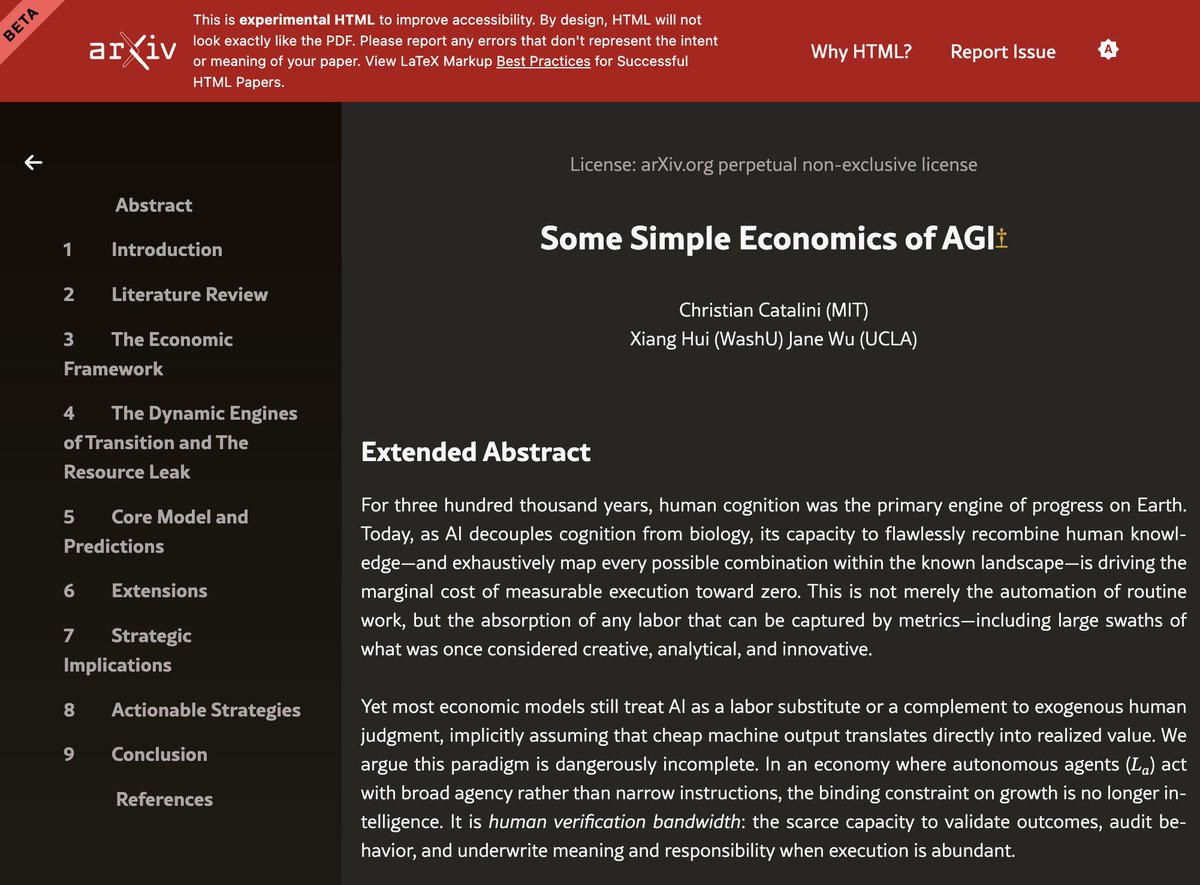
1/ Some Simple Economics of AGI—🔥🧵
Right now, there is a low-grade panic running through the economy. Everyone is asking the same anxious question: what exactly is AI going to automate, and what will be left for us?
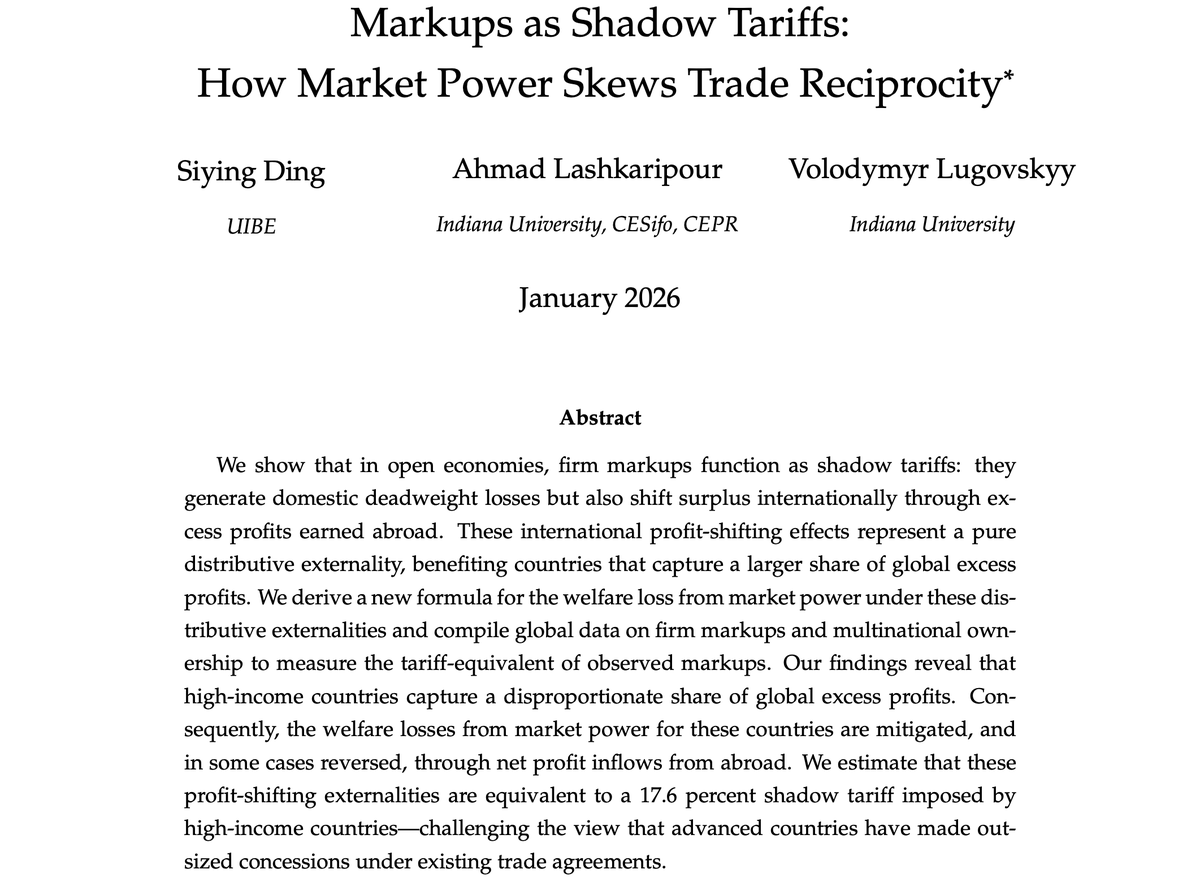
Our new paper argues that the "tariff reciprocity" debate rests on a mistaken premise.
The common narrative that the U.S. conceded too much in past trade deals and now needs higher tariffs to restore reciprocity gets it backwards.
1/ A thread 🧵