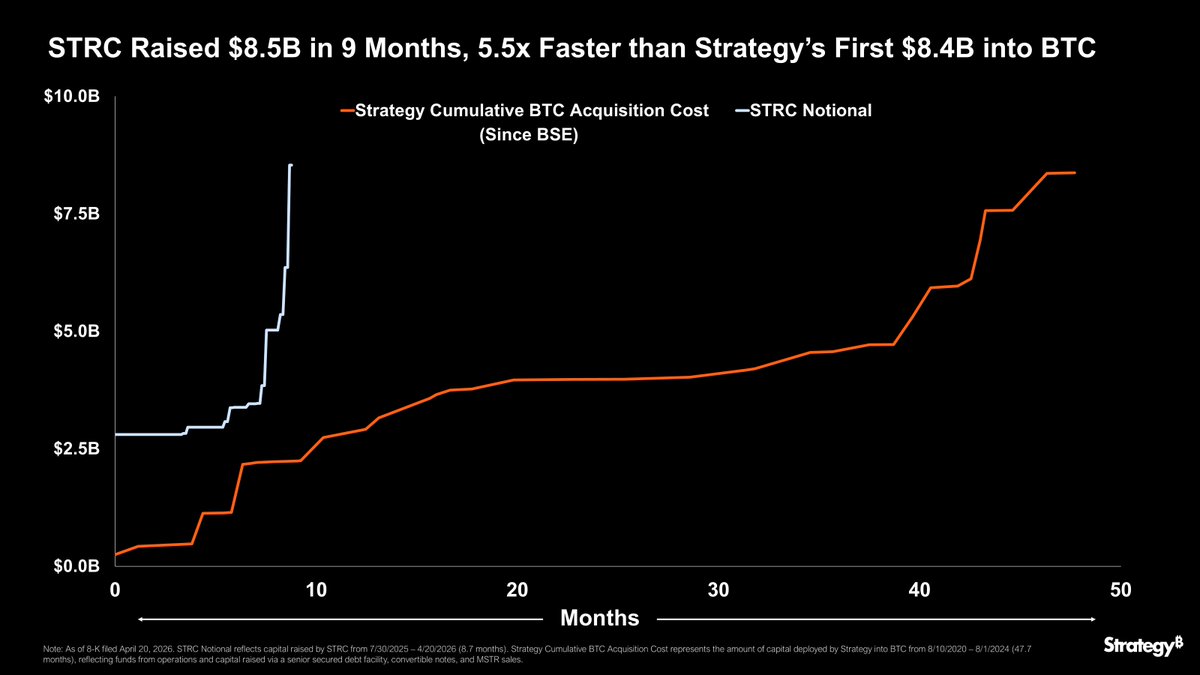
Updated $STRC facts from March to July.
Retail ownership declined from 78% to 71% as institutional adoption accelerated.
Average institutional holdings increased 105% to $3.5 million.
The institutions are coming.
At Strategy, we value theory but focus on phenomenology: observing market behavior, learning, and refining our approach.
Our objective is for $STRC to trade at $99–$100 over time. We continuously evaluate its performance and use empirical observations to inform our decisions.
This week at Goldman Sachs’ Digital Assets Conference in London, I discussed Bitcoin, Digital Credit, and the future of capital markets. Extraordinary venue. Exceptional audience.
Bitcoin has won. Global consensus is that $BTC is digital capital. The four-year cycle is dead. Price is now driven by capital flows. Bank and digital credit will determine Bitcoin’s growth trajectory. The biggest risk is bad ideas driving iatrogenic protocol changes.
Why is Saylor saying he’s going to sell $BTC?
You should see this like Trump / Bessent tweeting about negotiations at strategic times to liquidate oil futures traders. It’s jawboning.
You have to start reorienting your entire understanding of $MSTR around $STRC, which will drive the entire bitcoin market within 2-3 years.
Buyers of $STRC are (digital) creditors. In exchange for an 11.5% dividend, they are lending capital to management to buy $BTC on behalf of the $MSTR shareholders.
Buyers of the $MSTR are debtors. They are taking the capital from $STRC lenders and buying bitcoin with it, betting that $BTC will appreciate more than 11.5% and they come out ahead.
But here’s the rub: by committing NEVER to sell $BTC, this leaves only one mechanism for the debtor ($MSTR) to pay the creditor ($STRC), which is to sell $MSTR.
Now in theory even selling $MSTR should be accretive, as long as the market values the common stock above a certain mNAV, which, given the performance of $STRC, it SHOULD.
But $MSTR doesn’t trade at a fixed exchange rate to $BTC, and, with $STRC driving $BTC up and putting dilution pressure on $MSTR, a short seller can fairly reliably go short $MSTR / long $BTC, artificially driving down mNAV, and suppressing the $MSTR / $BTC exchange rate.
This forces management sell $MSTR to cover $STRC dividends even when this results in dilution to $MSTR shareholders. Until recently this has been de minimis compared to the amount of $BTC $STRC is acquiring for the shareholders.
BUT
As $STRC scales and $MSTR adds another, say 500,000 $BTC, which is achievable in the relatively near term, two things happen:
1) the scale of the dividend obligation grows relative to the market cap is the company, putting downward pressure on $MSTR / $BTC.
2) the forward expectation for $BTC yield diminishes compared to current holdings, also putting downward pressure on $MSTR / $BTC.
Now, the net function of the system is still very accretive to the common stock, but less so than if the short pressure artificially driving down $MSTR relative to $BTC could not reliably do so. Saylor is currently giving this trade a free lunch by saying, “we’ll never sell $BTC.” It’s like Trump saying “no Iran deal.” Saylor needs the market to think, at all times, that there “might be, maybe, a very promising deal.”
It’s less about Saylor selling $BTC than the market knowing he can and would, if the $MSTR / $BTC ratio were to drop artificially low.
In that scenario, he could sell some $BTC to pay $STRC dividends issue new $STRC to buy back $MSTR common stock.
This would put direct upward pressure on the $MSTR / $BTC ratio closer to its “natural” market mNAV, squeezing short sellers out of their positions and returning equity capital to common stock shareholders in the process.
It’s less important that he does this regularly than that the market believes he can and will do this to defend the mNAV, which makes the “Chanos trade” riskier and less profitable, like Trump’s jawboning liquidates oil futures traders.
This is about adding a lever he can pull to raise and deploy capital, even if he rarely or never pulls it.
@ChrisMMillas 1M BTC on balance sheet, $500k BTC, mNAV of 5 & 500M shares outstanding. $5000 per share. It’s a stretch (pun intended!) but it’s doable. Always fun to calculate MSTR stretch goals !
Strategy is proposing to pay semi-monthly dividends on $STRC, instead of monthly. No change to the annual dividend obligations or dividend rate. These proposed changes are intended to stabilize price, dampen cyclicality, drive liquidity, and grow demand.
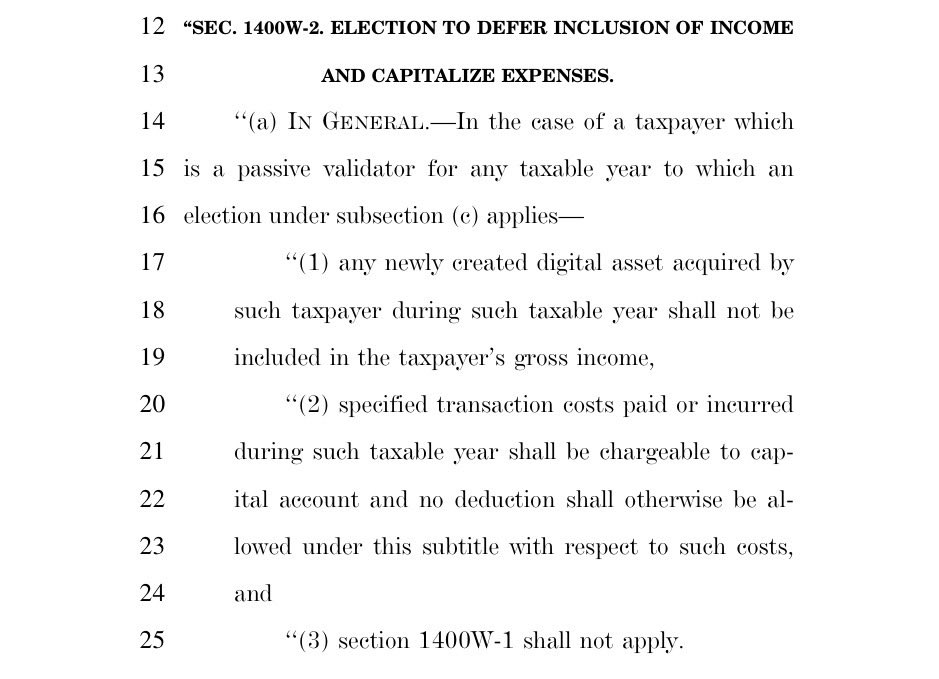
Even more concerning news today on the Bitcoin tax front. We’re going to need the Cyber Hornets for this one. 👇
Today’s new draft **leaves the double taxation on bitcoin mining in place** and only provides relief to staking.
So now the proposal is:
- De minimis for stablecoins but not Bitcoin
- Fixing tax treatment for “passive validation” (I.e. staking) but not Bitcoin mining
This contradicts all prior proposals on this issue. This is not tech neutral and picks winners and losers for no reason.
Full statement from BPI coming soon about @RepHorsford and @RepMaxMiller’s draft.
We need strong community push back to show that this language sets America and Bitcoin back.