Story time! Introducing the first of several new flavors of DropSynth #genesynthesis we have been working on, cooked up by @AlkynesOfSci and Sam Hinton. TLDR: We show multiple gene variants assembled per barcoded droplet and 1 kbp lengths. 1/n
https://t.co/8n8qiQA1ik
We’re proud to announce a strategic collaboration with Prevail Therapeutics, a subsidiary of @EliLillyandCo, that will leverage Scribe's #CRISPR X-Editing (XE) technologies to accelerate novel in vivo therapies for neurological and neuromuscular diseases. https://t.co/gHxrvTUgwq
Excited to join this @SFBusinessTimes panel to share my career path from academia to industry. It’s an honor to represent @scribetx as one of #SFBTwomenwholead in the life sciences.
Incredibly excited to share our paper ‘Somatic mutation rates scale with lifespan across mammals’ now published @nature.
https://t.co/a68IkkTt33
An illustrated & updated tweetorial… [1/24]
A Berkeley homeowner who spends half his time at his second home in New Zealand used a California environmental law passed by Ronald Reagan to cut enrollment at one of the best universities in the world.
This sentence is unbelievable, yet somehow entirely factually accurate.
Today we report in @CellCellPress an engineered virus-like particle (eVLP) platform that mediates efficient in vivo delivery of therapeutic proteins, including base editors and Cas9 nuclease, resulting in therapeutic editing in multiple mouse organs. 1/14
https://t.co/v1yBl296L6
The ability of molecular biologists to control DNA has relied on enzymes derived from the phage-microbe arms race. In this new work, we systematically mined thousands of new serine integrases (LSRs) and developed them for human genome editing. 🧬
https://t.co/tjJKBvRPYc
Thrilled to announce that the @PlesaLab has received a New Innovator Award from @NIH_CommonFund to fund three crazy ideas mixed into one, with the ultimate goal of making antibodies.... lots of antibodies! #NIHHighRisk@UOKnightCampus 1/n
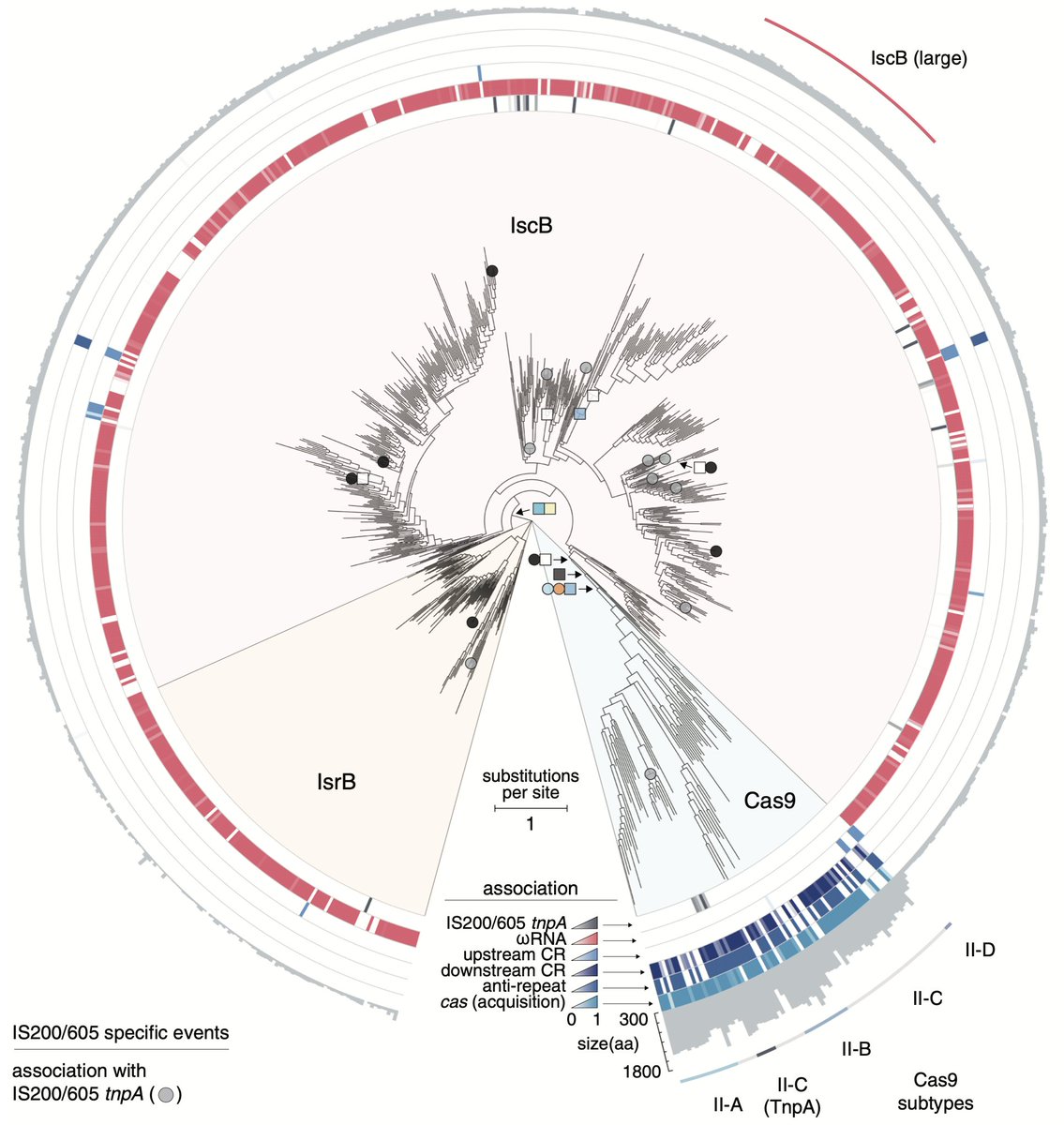
CRISPR technologies are powerful gene editing tools because they are programmable. We are excited to describe 3 new programmable systems, IscB, IsrB, and TnpB, some of the most abundant genes on the planet, with potential for gene editing. @ScienceMagazine https://t.co/dY8FXBYIM8
🚨I wrote a big piece about how Delta affects the pandemic endgame.
Many folks are upset & confused by the last month. Here's an attempt to reset expectations, lay out our goals, map the near-term future, & show how the pandemic ends--which it will. 1/
https://t.co/4Ukv7zs91X
The advance is being hailed not just for amyloidosis patients but also as a proof-of-concept that CRISPR could be used to treat many other, much more common diseases. https://t.co/mw8VN2cA8i
In a new study, I identify and recover a deleted set of #SARSCoV2 sequences that provide additional information about viruses from the early Wuhan outbreak: https://t.co/1zdeiOQ0vo (1/n)
Yes!!! This is the COOLEST of the cool - evolution of virus-like features in capsid protein and packaging by a non-viral protein cage https://t.co/Z6xypGq8jG
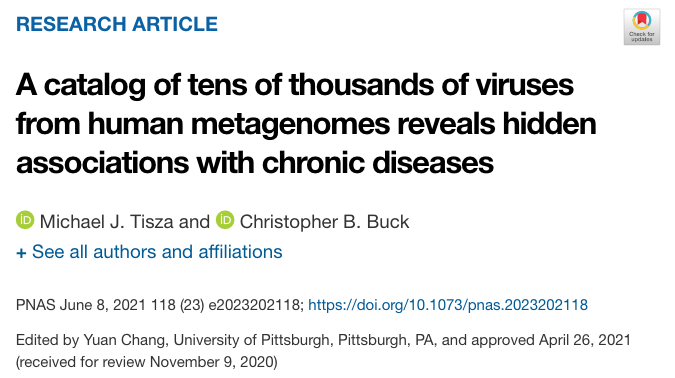
The pandemic has been bleak, but a great thing just happened. I'm excited to say that the manuscript I put together with my PhD mentor @ChrisB_Buck is now published in @PNASNews! Featuring tens of thousands of viruses from human metagenomes. (1/n)
https://t.co/Ui4sjl31CA
The questions I get most often from PhD students are about what’s is like working in biotech. So, here are some of my observations on the industry that I wish I’d known in grad school (Note that everyone’s experience is different, so YMMV). #biotech#career (1/)


![ATJCagan's tweet photo. Incredibly excited to share our paper ‘Somatic mutation rates scale with lifespan across mammals’ now published @nature.
https://t.co/a68IkkTt33
An illustrated & updated tweetorial… [1/24] https://t.co/o8BLsIXH7x](https://pbs.twimg.com/media/FQPMMCCWYAIybBt.jpg)