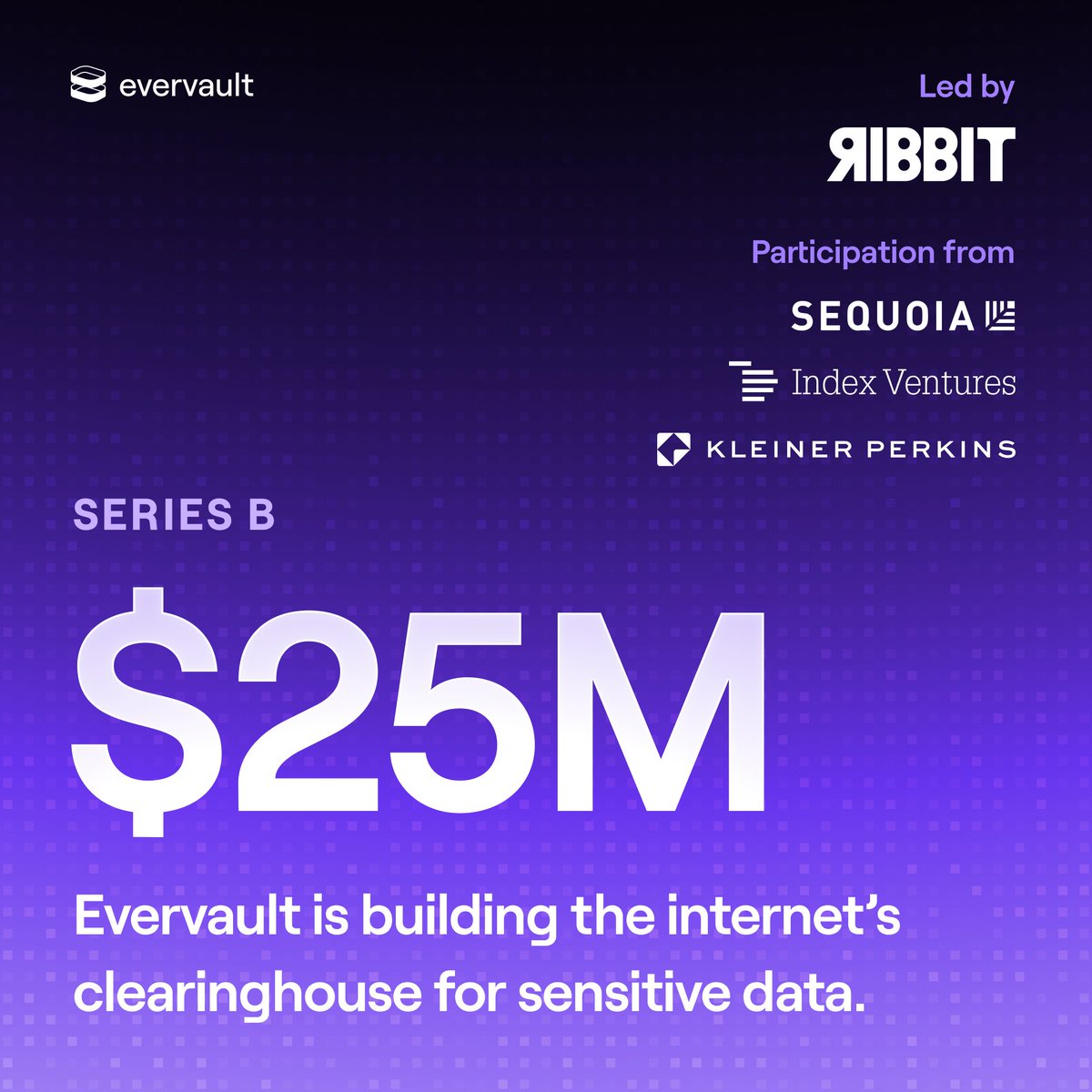
Today, we’re excited to announce @Evervault's $25M Series B, led by Ribbit Capital with continued support from @sequoia, @IndexVentures, @kleinerperkins, and @nextplayVC.
This round comes at a time when sensitive data exchange on the web is going parabolic. Since 2019, we’ve been focused on building durable infrastructure for engineering teams to collect, process, share, and enrich sensitive data -- while keeping it encrypted at all times.
We thought we were making good progress in encrypting the web, helping customers like @tryramp, @Rippling, @finix, @TheOverwolf, @Uniswap, @CarTrawler, and hundreds of others secure more than $5bn/year in payment flows and 100m+ unique tokens per month. But the past year has shown that our enemy -- plaintext data -- is getting stronger and more pervasive.
Our vision is to build the clearinghouse for sensitive data, helping companies exchange sensitive data in a secure and encrypted way. This round helps us encrypt more of the web by further refining our developer experience, building deeper integrations with trusted third-parties, and increasing the value we can offer our customers for more data types.
First and foremost, thank you to our customers. You trusted Evervault to sit directly in the flow of your most sensitive data (payments, identity, financial information, and more) and that trust is not something we take lightly. Your feedback, your requirements, and the problems you bring to us every day are what shape the product and push us forward.
Thank you to the Evervault team. What you’ve built is genuinely special: infrastructure that lets developers process sensitive data without ever having to see it in plaintext. The pace, craft, care, and ambition you bring to work every day are what makes this company what it is.
And thank you to our new investors for believing in the vision of making security architectural rather than procedural. We’re grateful to have partners who understand both the scale of the problem and the opportunity ahead.
The internet still assumes that sensitive data must exist in plaintext somewhere. We’re building the infrastructure to change that.
Onwards!
More here 👉 https://t.co/djNIWoQbGM
PCI is not government legislation (though e.g. Nevada mandates PCI DSS compliance, and states like WA and MN attach breach liability to it) but that doesn’t mean these companies can just act like they have no liability. If the company has any agreement with a PSP, such as Stripe, then they are a network participant and generally accept full liability for any cardholder data processed, stored, or transmitted even outside of Stripe. Visa/MC would simply fine the acquiring bank who would in turn go after the PSP, which in turn collects from the merchant for reissuance costs and other damages.
@clairevo The "no good ideas" point reminds me of this great post from @paulg (which even uses the upstream/downstream framing) https://t.co/0FmO4AkVdF
If all the downstream issues get resolved then the good ideas should start to come!
@adcock_brett please integrate with @evervault before it’s too late!
a million dollars of vc money would be better spent on payment compliance experts and engineers than (failed) pizza deliveries!!
all love tho, @hark_labs has got the best ui. but i’ll never pay using it unless this changes (nor should anyone who cares for their card security)
On the PCI compliance point, even if the providers you mentioned have PCI compliant architectures, so long as they are passing the raw PAN/CVV into a headless browser run by a third party then they become part of your cardholder data environment and so those flows are *not* PCI compliant (because none of these platforms are)
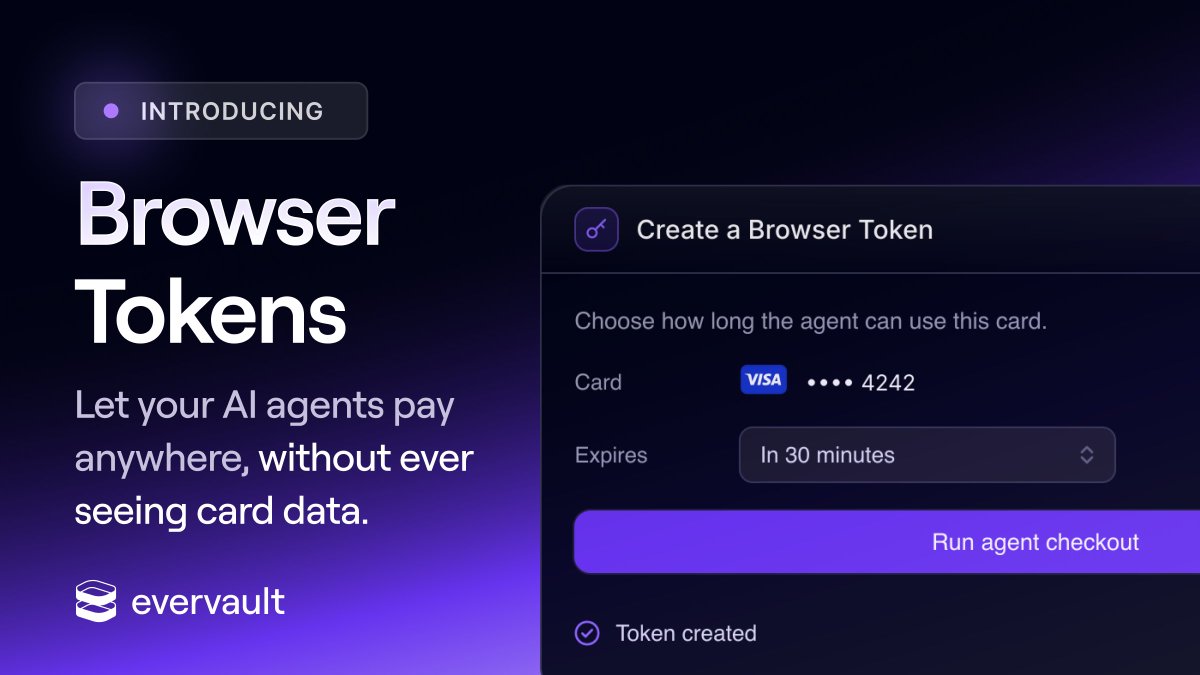
That’s why we built Browser Tokens
https://t.co/9IQvURGtjY
A stolen card never even becomes a payment on @paywithsoap .
We run 3D Secure by @evervault on every single card transaction.
Result: 0.2% chargeback rate.
Visa’s threshold is 1.5%.
Fraud disputes automatically shift to the issuer. Card testing gets blocked the moment someone tries to save the card.
Most processors treat fraud as a cost of doing business. We treat it as optional.
#Fintech #Payments #FraudPrevention #3DSecure #Chargebacks
Option 1.5 is Browser Tokens — a revocable token that gets swapped for the raw PAN by our browser proxy. Agentic tokens can then be layered on top where it’s supported (e.g. VIC is currently US consumer only, and issuers have been opting out).
So it works on any website (what agent builders care about the most today) without the PCI headaches
https://t.co/9IQvURFVuq
The team at @evervault is cracked and their product solves a huge problem our customers run into whenever credentials are involved (which the highest value workflows and products typically involve)
Super pumped to see Browser Tokens live in the wild :)
don’t trust your agent with your card data? give them Browser Tokens!
start building here: https://t.co/6ADC7PeUPs
so excited for this partnership! great seeing you on stage today @arcurn@browserbase x @evervault
Agentic payments are just payments.
As we delegate more and more sensitive workflows to agents, like booking flights, buying products, and logging into third-party services, the security of credentials like cards and passwords has become a huge challenge.
Until today, agent builders were lift with janky integrations with card network agentic tokens, virtual card issuance, or less-than-compliant in-house vaults.
Using Browser Tokens, developers can generate stand-in tokens for things like credit cards and passwords that look and feel like the real thing (so they pass validation and are accepted at checkout/login).
These tokens are then swapped by Evervault at the network layer between the browser and the website -- meaning no untrusted services ever need to touch the raw credential, and solving the PCI DSS headaches that many agents are facing today.
Introducing @Evervault Browser Tokens -- solving the problem of "how do agents use our sensitive credentials on the internet today?"
In partnership with @browserbase, we're humbled to be powering leaders in agentic commerce like @tryramp and @naturalpay -- so they can build agent-driven browser automations without needing to deal with PCI compliance or leaking sensitive data to the harness, model, or browser platform.
Try it out with your agent today: https://t.co/9IQvURGtjY
1/2 Today at @Money2020, @evervault launched Browser Tokens on stage.
Your AI agent checks out with stand-in card details. Evervault swaps in the real card on the way to the merchant, so the agent never sees it.
Live with @browserbase. Start building: https://t.co/zGyUVICReo
Dots agents from @OpenAI can buy things for you, from stores where you've already saved a card (so the agent only shops where you already shop)
The problem though (with this, and a lot of “agentic commerce”) are that the errands worth handing off to an agent are at stores that have never seen your card (or maybe that you’ve never even heard of). Single use payment credentials -- bound to a specific merchant <> cart <> consent combo -- are the approach likely to win out long-term
A Brazilian debit card starting 6505 came back from our BIN Lookup API as "Discover Credit". Even though Discover holds the whole 65xxxx range, Elo has ranges inside it and runs on Discover's rails abroad. The first six digits can't tell you which one you're processing. Getting accurate BIN data is 𝗵𝗮𝗿𝗱
On Wednesday, a customer asked if our card collection iframe could support WebMCP. Their ideal timeline was the end of October.
We shipped it on Thursday.
Evervault Card Collection now has an opt-in agentTools option. It registers three WebMCP tools inside the card iframe, so browser agents can fill in card details through the same validation and encryption flow as a person:
- get-form-status: which fields are filled, valid or erroring, and whether the form is complete
- focus-field: moves focus to a field
- set-field-value: enters a value, validates it and returns the updated status
Each tool maps to something a user can already do, and nothing more. Card data only leaves the iframe encrypted, and never in a tool result.
The tools are only exposed to origins you allowlist, and white-label customers can name them after their own product.
We've been seeing an explosion in agent-driven commerce through our platform in recent months, and are excited to be releasing more functionality to help solve the trust, security and consent challenges that appear when agents buy things for us.
@HarryStebbings Getting to spend time with people like @Joshuabrowder and being part of WhatsApp groups with extremely talented people working on the most batshit crazy (in a good way) projects/companies!