MATHEMATICS
By Snezana Lawrence
“If you want a readable whistle-stop tour of the past 32,000 years of mathematics, I can think of nothing better.”
— Ian Stewart
“Reading is discovering one's own riches and one's own possibilities through the words of others.”
(Jarosław Iwaszkiewicz)
Art: Edward Hopper
1882-1967
American realism painter.
“Reader on the Train,” 1965.
Around 240 BCE, Eratosthenes of Cyrene produced one of the most remarkable measurements in the history of science: he estimated the circumference of the Earth using sunlight, shadows, geometry, and the known distance between two Egyptian cities.
He had heard that in Syene, near modern Aswan, the Sun shone almost directly overhead at noon on the summer solstice, illuminating the bottoms of deep wells and leaving little or no shadow.
At the same moment in Alexandria, farther north, a vertical stick, or gnomon, did cast a shadow.
That difference was the key.
In Alexandria, Eratosthenes measured the relation between the height of the gnomon and the length of its shadow. From that right triangle, he deduced that the Sun’s rays there made an angle of about 7.2 degrees from the vertical, equivalent to one fiftieth of a full circle.
Since sunlight reaches Earth from such a great distance that its rays are effectively parallel, the angle measured in Alexandria could be interpreted as the angle between Syene and Alexandria at Earth’s centre.
If the distance between the two cities represented one fiftieth of a full circle, then Earth’s total circumference had to be fifty times that distance.
Eratosthenes multiplied the estimated distance from Syene to Alexandria by 50 and obtained a value of about 250,000 stadia.
The exact modern equivalent remains debated because the ancient stadion was not a single fixed unit, but his result was still remarkably close to the true circumference of Earth.
The importance of the calculation lies not only in the numerical result, but in the reasoning behind it.
Eratosthenes transformed a local observation, the length of a shadow in one city and the reported absence of one in another, into a measurement of the entire planet. Without telescopes, satellites, or modern instruments, he showed that the size of Earth could be inferred through careful observation and geometry.
It remains one of the clearest examples of how science can reveal a global truth from simple, ordinary evidence.
Yann Lecun published the most heretical AI paper of the year.
He opens by arguing Magnus Carlsen isn't good at chess and only gets more unhinged from there.
The Turing Award winner and his co-authors dropped a paper demanding the AI industry abandon its biggest obsession, AGI.
Right now, everyone from Silicon Valley CEOs to politicians assumes AGI is the ultimate goal. A machine that can do everything a human can do.
LeCun argues that this entire concept is a biological illusion.
Humans do not possess "general" intelligence. We are highly specialized biological machines, tuned by evolution simply to survive in the physical world.
We only think our intelligence is "general" because we are completely blind to the millions of cognitive tasks we are incapable of comprehending.
Which brings us to the chess argument.
Magnus Carlsen is the greatest human chess player in history. But compared to a modern computer? He is fundamentally terrible.
Our belief that Carlsen is "good" at chess is pure human-centric bias. He isn't objectively good. He's just better than the rest of us, who are biologically awful at it.
LeCun says we need to stop building AI to mimic human generality.
Instead, he proposes a new North Star: SAI.
Superhuman Adaptable Intelligence.
Instead of trying to build a machine that mimics our flawed, biologically-limited brains, we need to embrace extreme specialization.
SAI is about the speed of adaptation.
It is an intelligence that can learn to exceed humans at any specific, economically important task.
More importantly, it is designed to fill the vast skill gaps where humans are fundamentally incapable.
Things like managing global energy grids in real-time. Or predicting complex molecular structures.
The entire AI industry is obsessed with building a digital reflection in our own image.
LeCun's paper is a brutal wake-up call.
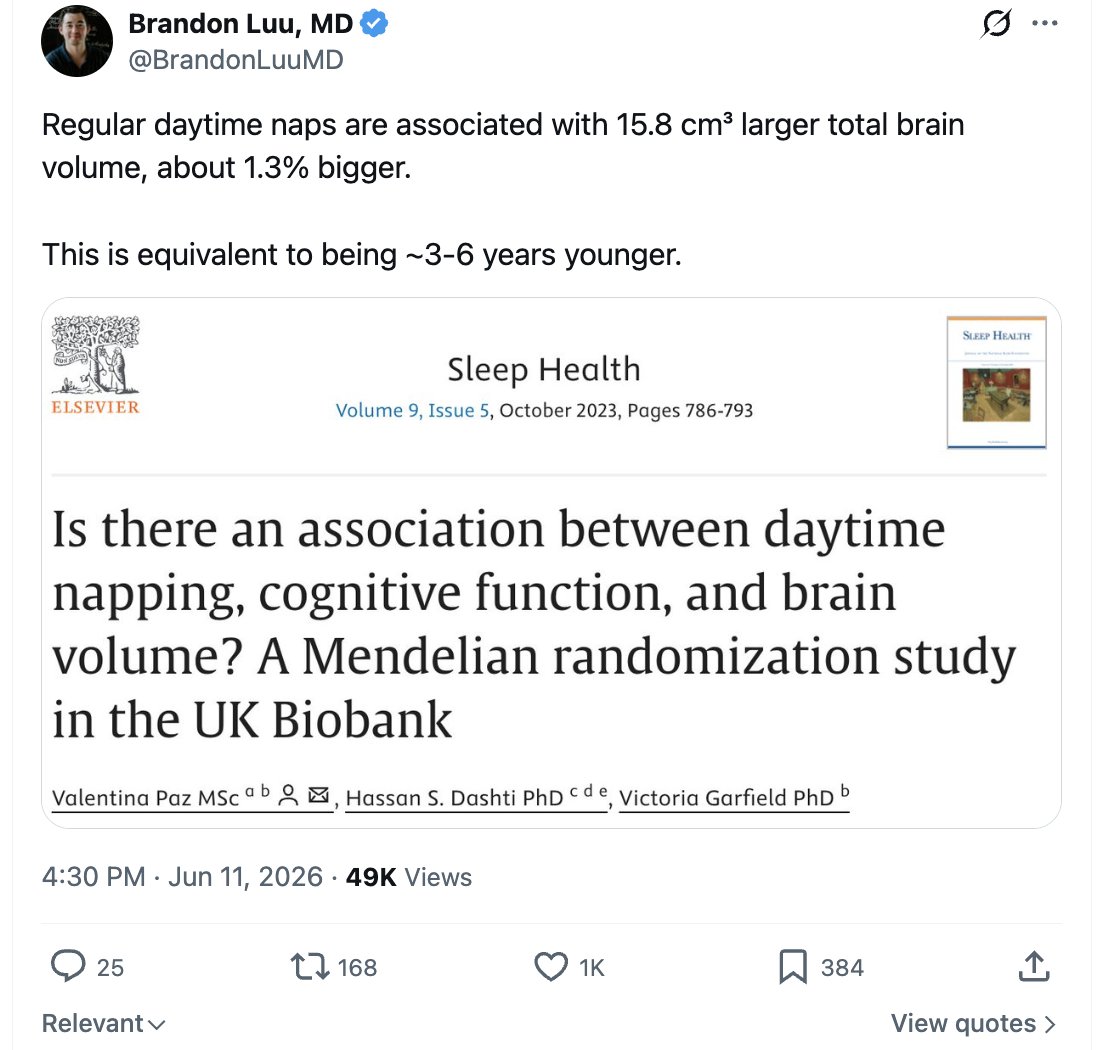
Modern sleep studies show that if a daytime nap exceeds 20-30 mins, we enter deep, slow-wave sleep. Waking up from this causes sleep inertia, leaving us groggy, destroying our night sleep & messing up our insulin sensitivity.
Ancient India prevented this through a mandatory post-lunch ritual called Vama-Kukshi.
Vama means left & Kukshi means womb/side. The protocol mandates that after a midday meal, we must lie down specifically on our left side for a short duration (traditionally calculated as the time it takes to take 8 to 16 deep breaths, ~15-20 mins).
Lying on our left side keeps the stomach below the esophagus, preventing acid reflux. More importantly, it activates the Pingala Nadi (the right nostril breathing channel, connected to the sympathetic nervous system), which stimulates digestion, while keeping the brain in a state of light, restorative rest rather than letting it plunge into a deep, heavy slumber.
The Sushruta Samhita explicitly warns that long, heavy sleeping during the day destroys metabolic health (causes Kapha & Meda/fat accumulation). But a short Vama-Kukshi, a quick, left-sided power nap was prescribed to restore mental clarity, relieve stress & preserve vitality (Ojas).
It is the exact ancient counterpart to the modern 15 min "power nap."
Amal Kumar Raychaudhuri (1923–2005) was one of India's most distinguished theoretical physicists and a pioneer of modern gravitational physics. Born in Barisal (now in Bangladesh), he studied at University of Calcutta and spent much of his career teaching and conducting research in Kolkata. Despite working with limited resources and often outside the major international research centers, Raychaudhuri produced ideas that profoundly influenced modern cosmology and general relativity.
His most celebrated contribution is the Raychaudhuri Equation, derived in 1953. This fundamental equation describes how nearby geodesics in spacetime converge or diverge under the influence of gravity. It provides a mathematical framework for understanding gravitational focusing and the formation of singularities.
The Raychaudhuri equation later became a cornerstone of the singularity theorems developed by Roger Penrose and Stephen Hawking. These theorems established that singularities, such as those associated with black holes and the Big Bang, are generic predictions of Einstein's theory of general relativity rather than mathematical curiosities.
Beyond its role in cosmology, the Raychaudhuri equation remains central to gravitational theory, black hole physics, relativistic fluid dynamics, and modern studies of spacetime geometry. Raychaudhuri's work demonstrated how a single deep mathematical insight can reshape an entire field. Today he is remembered not only for a remarkable equation but also as a symbol of scientific excellence achieved through perseverance, originality, and intellectual rigor.
Image Courtesy: @ictstifr
Here are 10 open source VPN GitHub repos worth bookmarking:
1. WireGuard
https://t.co/bANUMlsdLW
The fastest and most modern VPN protocol. Built into the Linux kernel. Minimal code, maximum speed. The gold standard for 2026.
2. OpenVPN
https://t.co/hpgki4b6hH
The original and most widely used open source VPN daemon. 25 years of battle-tested security. GPL v2 licensed. Stable release April 2026.
3. Tailscale
https://t.co/rzDrTr5Szx
WireGuard-based mesh VPN that connects all your devices with zero configuration. Works behind NATs and firewalls automatically. Used by hundreds of thousands of teams.
4. Netbird
https://t.co/kBjpdoHzTW
WireGuard overlay network with Zero Trust access controls. SSO, MFA, device posture checks, and granular policies. Self-hostable. Trusted by 20,000+ organizations.
5. SoftEther VPN
https://t.co/4Nu5SizPuW
Supports every major VPN protocol in one server. WireGuard, OpenVPN, IPsec, L2TP, SSL-VPN, and more. AES 256-bit encryption. Works on Windows, Linux, Mac, Android, and iOS.
6. ProtonVPN Linux App
https://t.co/b4qWyXz4pB
Official open source ProtonVPN Linux client. 658 stars. Actively maintained by the ProtonVPN team. GPL licensed.
7. PiVPN
https://t.co/zFFFPufDH1
The simplest way to set up a personal VPN server on a Raspberry Pi or any Linux machine. Supports WireGuard and OpenVPN. 15.6K stars.
8. Algo VPN
https://t.co/0m9g11fJ1J
Set up a personal WireGuard or IPsec VPN in the cloud in under 10 minutes. Designed by security researchers at Trail of Bits. Automated setup on DigitalOcean, AWS, Azure, and more.
9. Streisand
https://t.co/KplCcjfDFt
Sets up a server with multiple VPN protocols automatically. WireGuard, OpenVPN, Shadowsocks, and more. Designed specifically to bypass censorship.
10. Xray-core
https://t.co/5YbFodizgZ
The most powerful open source proxy and VPN platform. Supports VLESS, VMess, Trojan, WireGuard, and XTLS. 40.9K stars. Penetrates even the strictest firewalls.
You only need to read four books to truly get what’s going on in data science and AI:
• Designing Machine Learning Systems by Chip Huyen
• AI Engineering by Chip Huyen
• Practical Statistics for Data Scientists by Peter Bruce, Andrew Bruce, and Peter Gedeck
• Hands-On Machine Learning with Scikit-Learn, Keras, and TensorFlow by Aurélien Géron
If you read these four technical books and then read these four books on business value and leadership, you’ll be well on your way to career success:
• The Lean Startup
• Good Strategy Bad Strategy
• The First 90 Days
• The Hard Thing About Hard Things
Any more you'd add?
Do not use your energy to worry. Life is too short to worry about stupid things. Have fun. Fall in love. Regret nothing and do not let people bring you down.
Study, think, create and grow. Teach yourself and teach others.
—Professor Richard Feynman
One more Euler beauty to please the eye—with all the e’s staring back at us! How can a simple integer like 2 be expressed in such a complex way, as the quotient of two infinite products involving fractional powers of the irrational constant e?
It took a genius like Euler to discover it.
😲After 9 years… and 3 BILLION miles… this is what we found 😳
For decades, Pluto was just a blurry dot in the sky.
But everything changed when NASA’s spacecraft finally arrived…
🚀 After an incredible journey across the Solar System,
we got our first close-up look at Pluto’s frozen world ❄️
🏔️ Massive ice mountains
🌌 Vast frozen plains
🌫️ A thin, mysterious atmosphere
This isn’t just a rock…
it’s a complex, active world at the edge of our Solar System.
✨ And the craziest part?
This data was sent back from billions of miles away…
taking hours just to reach Earth.
From a tiny dot… to a breathtaking world.
That’s the power of space exploration 🚀
#Pluto #NASA #SpaceExploration #NewHorizons #SolarSystem #Astronomy #Universe #Science #SpaceFacts #DeepSpace
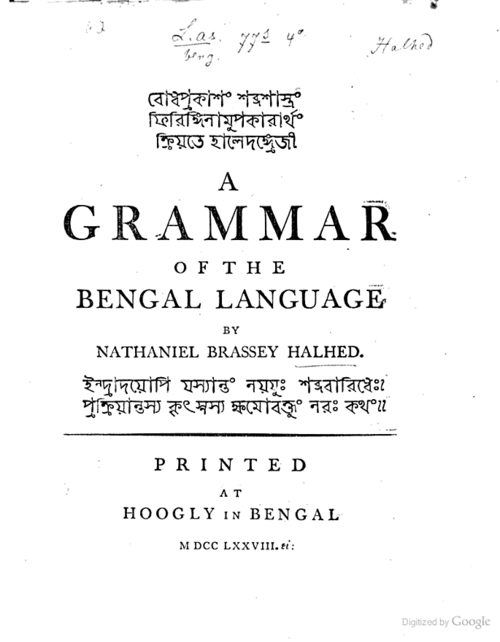
In the freezing, mist-heavy winter of 1778, inside a highly guarded colonial foundry in Hooghly, a group of elite British linguists stood paralyzed. The East India Company desperately needed to print the world's 1st comprehensive grammar of the Bengali language to codify their administrative laws, but Western punch-cutters confidently declared it a structural impossibility claiming that the looping, intricate geometry of Eastern scripts could never be cast into rigid metallic moveable type until an uneducated, native blacksmith stepped up to the forge, hacked through the steel & manually carved the literal typographic spine of modern Asian printing.
In the late 18th century, typography was the ultimate instrument of imperial control. The British Empire could easily print English books using standardized European typefaces. But when it came to complex, cursive, and conjunct-heavy Indian scripts like Bengali/Sanskrit, the tech hit a vertical wall.
Unlike the distinct, standalone blocks of the Latin alphabet, Indian scripts feature 1000s of unique typographical combinations, intricate top-hanging lines & delicate sub-script modifications. The elite type-founders of London openly mocked the idea that these languages could ever be adapted to mass-production printing presses. They assumed India would remain permanently dependent on slow, manual scribes, keeping the native population intellectually fragmented.
The man who staged a total mechanical intervention was Panchanan Karmakar. Born into a traditional lineage of ironsmiths & goldsmiths in Serampore, Panchanan possessed an instinctive, hyper-precise grasp of metallurgy & micro-carving. He had no formal engineering degree & spoke no English. Yet, his reputation as an absolute wizard of metals caught the eye of the rogue British orientalist Charles Wilkins.
Panchanan looked at the stiff, crude attempts of European punch-cutters & realized they were approaching the script all wrong. Operating out of a crude, smoky workshop with self-improvised files, steel punches & copper matrices, he executed a masterclass in typographical engineering.
He manually reverse-engineered the entire structure of the Bengali alphabet. He invented an entirely new technique for hardening steel punches, slicing away fractions of a mm from metal blocks to create the 1st elegant, visually perfect & highly legible moveable typefaces for an Indian language.
In 1778, his metal types successfully printed Nathaniel Brassey Halhed's A Grammar of the Bengal Language. It was an absolute civilizational milestone.
Panchanan did not stop there. He went on to join the legendary Serampore Mission Press, where he spent the rest of his life cutting typefaces for 14 different Asian languages, including Devanagari (Hindi/Sanskrit), Marathi & even the intensely complex logograms of Chinese. He single-handedly democratized literacy across Asia, taking printing out of the exclusive hands of imperial authorities & giving it to the masses.
Yet, because the history books primarily credited his British supervisors, his name completely dissolved from global industrial memory. Today, as billions of people read digital texts/print documents across India, the name of the blacksmith who forged those very letters is entirely dead.
The modern multi-billion-dollar digital font foundries & software empires continue to launch hyper-slick, automated typographic layouts across glowing screens, tracking user metrics with bloodless algos, yet every single time an Indian character is stamped onto a page/rendered flawlessly on a digital interface, the silent, hand-filed steel punches of Panchanan Karmakar hold the form, proving that while a foreign empire can try to landlock our language, it takes the unyielding, fire-tested genius of a native smith to cast the letters that write our freedom.
Google has published a paper that might end the transformer era.
For the last 7 years, every major AI, ChatGPT, Claude, Gemini, has been built on the exact same architecture: The Transformer.
But Transformers have a fatal flaw.
To remember context, they have to process every single word against every other word. It’s called quadratic complexity. As your prompt gets longer, the compute cost explodes.
The alternative is the old-school RNN (Recurrent Neural Network). RNNs are incredibly cheap and fast, but they have a fixed memory size. If you give them a long document, they get amnesia.
Until today.
Google researchers published Memory Caching: RNNs with Growing Memory.
And it fixes the biggest bottleneck in AI.
Instead of an RNN having a fixed, rigid memory that constantly overwrites itself, Google gave it a "save" button.
The technique allows the RNN to cache checkpoints of its hidden states as it reads.
The memory capacity of the RNN can now dynamically grow as the sequence gets longer.
They built four different variants, including sparse selective mechanisms where the AI actively chooses exactly which checkpoints matter most.
The results rewrite the rules of efficiency.
On long-context understanding and recall-intensive tasks, these new Memory-Cached RNNs closed the gap with Transformers.
They achieved competitive accuracy without the explosive, quadratic compute cost. It perfectly bridges the gap between the cheap efficiency of an RNN and the massive capability of a Transformer.
We have spent billions scaling Transformers because we thought they were the only way an AI could remember a long conversation.
But Google just proved we don't need to process the whole history every single time.
We just needed a smarter cache.
This is the most detailed view of a human brain to date.
A team of researchers used electron microscopy (EM) to image a cubic millimeter-sized piece of human brain tissue at high resolution and this is a single neuron with 5,600 of the nerve fibers that connect to it.