CNAME cloaking is a tracking method most people, including many developers, don’t know about. Today, it’s used on some of the largest websites. It was built to avoid detection by the privacy tools you rely on.
Let’s break down how it works.
Adblockers usually stop requests to well-known tracker domains like google-analytics[.]com, doubleclick[.]net, and oracle-bluekai.[]com. But if a tracker convinces a website to set up a DNS alias, the site’s subdomain points to the tracker’s server. For example, oracle-bluekai[.]com can appear as analytics[.]yourbank[.]com. Both your browser and adblocker trust it, but the tracker gets through.
It gets even trickier. Since the request appears to come from the website itself, any cookies it sets are trusted like your bank’s own cookies. These cookies last longer, have more access, and are harder to delete. You don’t have to click anything; just loading the page is enough.
Companies like Adobe, Oracle BlueKai, Criteo, and Eulerian Analytics all use this method. These are not small ad networks, their code is used by some of the world’s biggest organizations.
As major browsers phase out third-party cookies, the industry has promoted this as a privacy improvement. Meanwhile, CNAME cloaking was quietly developed to replace them. The tracking continues with a new approach.
Now, let’s look at the defenses. @windscribe ROBERT feature blocks CNAME cloaked trackers at the VPN server level before the request reaches your browser.
At the browser level, @Brave checks CNAME records before blocking. It was the first browser to do this and is still the only one that does it by default.
uBlock Origin on Firefox blocks about 70%, since Firefox is the only major browser that lets extensions access the DNS API. On Chrome, no extension can detect CNAMEs because the platform blocks this access.
People want to learn AI tools but never bother to use that AI tool to learn, really blows my mind!
If anyone's interested, here's an article explains Boris Cherny's CLAUDE.md 👇👇👇 https://t.co/xAXxweN1LU
10 GitHub repos that should be illegal — they're killing $50 billion in corporate revenue
make sure to bookmark it before it gets lost in your feed
1. Ollama
Run GPT-4-class AI on your laptop. No API costs. Developers spend $500 a month on OpenAI for what Ollama runs offline for $0.
Repo → https://t.co/8O6hedF7dN
2. Whisper
OpenAI's transcription model, open-sourced. Otter charges $20 a month for what Whisper does for free, in 99 languages.
Repo → https://t.co/D6on6mvLLi
3. n8n
Open-source Zapier. Zapier Pro costs $600 a month for a real workflow. n8n self-hosted runs unlimited automations for $0.
Repo → https://t.co/UkxzrA3XUr
4. yt-dlp
Downloads any video from YouTube, X, TikTok, Instagram, anywhere. YouTube Premium charges $14 a month to do less than this. It is 100% free.
Repo → https://t.co/LpuVl3fhd5
5. Fooocus
Midjourney-quality image generation on your own GPU. Midjourney charges $30 a month. Fooocus runs unlimited generations for free.
Repo → https://t.co/w66NpXcjS6
6. Bitwarden
Open-source 1Password. Password managers charge $8 per user. Bitwarden is unlimited, forever, free.
Repo → https://t.co/k4O4LRkkTA
7. Cal .com
Open-source Calendly. Calendly Teams costs $16 per user per month. Cal. com is free for individuals and open source for teams.
Repo → https://t.co/YQwdhTRNFi
8. Plausible Analytics
Privacy-first Google Analytics replacement. Google Analytics 360 costs $150,000 a year for enterprises. Plausible self-hosted costs $0.
Repo → https://t.co/Rpio5OCBJk
9. Penpot
Open-source Figma. Figma charges $45 per editor per month. Penpot does the same job, self-hosted, free forever.
Repo → https://t.co/5GIsz0aLfh
10. AppFlowy
Open-source Notion. Notion charges $20 per user per month for teams. AppFlowy runs unlimited users on your server for free.
Repo → https://t.co/EBvVua0PfN
all of this is for free at $0/month
save this. share it with the person in your life still paying for what's been free this whole time
100% free. 100% open source
🚨Michael Burry just said Elon Musk and Nvidia's deal is built on fake numbers.
Burry published a detailed breakdown calling the entire structure "Fugazi", his word for fake.
He is alleging that billions of dollars in Nvidia chips are being hidden off balance sheets, and that American retirees are unknowingly funding the whole thing.
Nvidia, the world's largest AI chip company sold $5.4 billion worth of its most advanced GPUs, the GB200, to a company called Valor.
Valor is not a real operating business. It is a special purpose vehicle, a shell company created specifically to hold these chips and nothing else. Nvidia also invested $1.9 billion of its own money directly into Valor on top of the sale.
Those 100,000+ chips are now physically inside xAI's data center. xAI is Elon Musk's artificial intelligence company, the one that builds Grok. xAI is using every single one of those chips right now to run its AI models.
But here is what Burry is flagging.
Neither Nvidia nor xAI owns those chips on paper. Valor, the shell company holds legal title. That means $5.4 billion in GPU assets do not show up on Nvidia's balance sheet as inventory.
They do not show up on xAI's balance sheet as assets. They are legally invisible to both companies.
Nvidia gets to book the $5.4 billion as a completed sale and record it as revenue. xAI gets full use of the chips without owning them. And the risk disappears into a shell company in the middle.
Now here is where American retirees enter the picture.
Valor needed $3.5 billion in debt to fund this structure. Apollo provided it. Apollo is one of the largest asset managers on earth with $1.03 trillion under management and $834 billion specifically in private credit.
Apollo raised the $3.5 billion, packaged it into debt securities, and sold those securities to Athene.
Athene is Apollo's own insurance company. It sells fixed and indexed annuities, retirement savings products, to ordinary Americans.
When a retiree buys an Athene annuity, they believe their money is sitting in safe, stable investments. That money is now inside a structure funding Elon Musk's AI data center.
The numbers inside Athene are most alarming.
Athene holds $74.2 billion in reserves. It has moved $217 billion in assets into a captive insurer based in Bermuda, meaning those assets sit outside normal US insurance regulation and oversight.
Of the entire portfolio, 34.7%, equal to $103 billion, is classified as Level 3 assets.
Level 3 is an accounting classification that means there is no observable market price for these assets. No outside party can independently verify what they are actually worth.
The leverage sitting on top of those unpriced assets is 16 times.
Burry's says:
Every step of this structure is technically legal and publicly disclosed. But the entire thing was deliberately engineered across 8 to 12 steps to move credit risk off balance sheets and away from any market pricing.
- Nvidia books the revenue.
- Apollo collects the fees.
- xAI gets the computing power.
- And retirees sitting at the bottom of a 16x leveraged Bermuda insurance structure, holding $103 billion in assets with no market price carry the risk without knowing it exists.
Ryan Lopopolo leads a team at OpenAI where the PM writes a PRD on Monday and ships a pull request by Friday. No human writes the code.
@_lopopolo broke it all down:
0:00 - "Code is a liability"
3:23 - Why your most expensive asset is now free
6:01 - "What's the point of roles anymore?"
8:04 - What replaces the PM/design/eng triangle
13:10 - 1M lines of code, zero written by humans
16:05 - Engineers can't touch the keyboard
18:13 - First month was 10x slower than solo
20:07 - Recursing 8 levels deep for one primitive
20:47 - PM writes PRD Monday, ships PR Friday
25:06 - The feature they had to trash
28:02 - How designers ship UI without a backend
31:40 - What's actually inside the harness
37:03 - Failing the build over curly quotes
40:02 - Inside Ryan's actual Codex setup
46:25 - The codebase that grades itself
50:49 - "A billion tokens a day or you're negligent"
52:19 - 350M tokens on a single PR
53:46 - GPT 5.2 changed everything overnight
57:00 - Every engineer is now a staff engineer
59:19 - The ego problem nobody talks about
1:00:39 - Monday morning roadmap for normal teams
1:08:19 - One skill to build this weekend
1:10:57 - Why one agent beats multi-agent
the most dangerous (and annoying) thing about Claude:
it's the world's most convincing YES-MAN
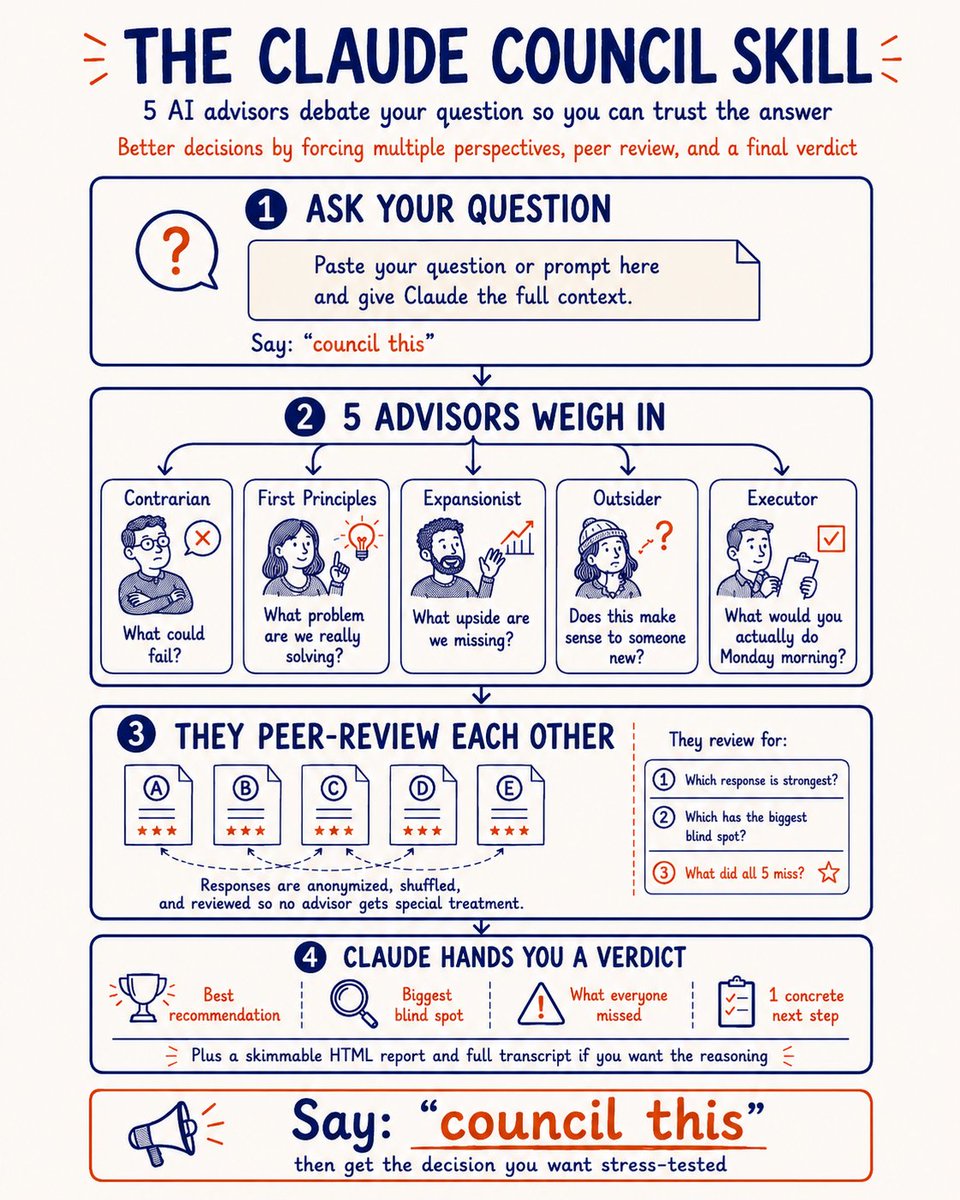
a new Stanford study found Claude takes your side 49% more than a real human would. even when you're clearly wrong.
so i built a "board of advisors" skill that makes 5 agents attack your idea from 5 different angles:
• one assumes your idea will fail and tries to prove it
• one strips away your assumptions and rebuilds the problem from scratch
• one hunts for the bigger opportunity you're too close to see
• one has zero context about you and responds like a complete stranger
• one only cares about what you actually do next
then...
1. all 5 responses get anonymized and peer-reviewed blind
2. a chairman agent reads everything and synthesizes the final verdict
after a few minutes, you get one recommendation you can *actually* trust.
free skill + full breakdown:
🚨 SHOCKING: An ex-Anthropic researcher just leaked the exact internal prompting framework the team uses.
Most people treat Claude like a basic chatbot and leave 60–70% of its reasoning power on the table.
These 10 prompts are how the pros actually use it — tested internally for maximum clarity, honesty, and depth.
Copy-paste ready. Zero fluff.
Save this thread. Your Claude game is about to change forever.
(Pro tip: use them in order for compound results)
YOU DO NOT NEED LIGHTROOM OR PHOTOSHOP TO RESTORE A LOW QUALITY IMAGE ANYMORE.
NO EDITING SKILLS. NO SOFTWARE. JUST PASTE THIS PROMPT AND WATCH IT WORK.
Enhance this image to ultra-high definition with maximum clarity and realistic detail. Remove blur, noise, grain, color fading, and compression artifacts while preserving the subject's exact identity, proportions, and natural appearance.
Restore sharp focus with refined micro-details in skin. hair strands. fabric texture. and background surfaces. Maintain authentic skin texture with natural pores and tonal variation, avoiding over-smoothing, artificial sharpening halos, or plastic effects.
Correct color balance to restore natural skin tones and accurate hues while preserving the original mood.
Improve exposure, dynamic range, and contrast subtly to add depth and realism without altering the lighting direction Retain the original framing, composition, camera angle, posture, facial expression, background elements. and overall atmosphere.
Hard rule: Do not modify facial structure. facial features, expression, hairstyle, body shape, pose, clothing, age, or identity in any way. The face must remain exactly the same as the original image, only clearer, sharper, and more detailed.
Say goodbye to old photos, poor phone pictures, compressed screenshots and low quality memes.
https://t.co/WfJGCpSz09 charges $17 a month to transcribe your meetings.
Fireflies charges $19 a month.
Descript charges $24 a month.
Here is the part none of them tell you:
Most of them were built on the same free model that OpenAI open sourced in 2022. Free to download. Free to run. On your laptop. Offline.
It's called Whisper. 85,000+ stars on GitHub.
→ 100+ languages
→ Runs entirely on your laptop. No internet needed.
→ Your audio never leaves your device.
→ Punctuation, timestamps, speaker detection. Automatic.
→ Transcribe meetings, podcasts, lectures, interviews, voice memos.
→ Generate subtitles. SRT and VTT output.
→ MIT licensed. Personal or commercial use.
Two lines to start:
pip install openai-whisper
whisper meeting.mp3
Your transcript appears. No account. No API key. No credit card.
https://t.co/WfJGCpSz09: $204/year.
Fireflies: $228/year.
Descript: $288/year.
Whisper: $0. Unlimited. Offline. Your laptop. Forever.
Most paid transcription apps are a subscription wrapped around this free model.
Your voice. Your transcript. No middleman.
100% Open Source.
Microsoft just banned its own engineers from using AI.
The tool was literally costing MORE than the humans it was supposed to replace.
They lied to you about AI adoption and now the whole narrative is blowing up:
Microsoft gave thousands of engineers access to Claude Code six months ago and encouraged them to use it.
Engineers loved it and adoption exploded. But then the invoices arrived.
Token-based pricing means every query, every code review, every debugging session costs money. At scale across 100,000 engineers, the numbers became so large that Microsoft issued an internal order to cancel nearly all Claude Code licenses by end of June and force everyone onto their own cheaper tool instead.
The company that invested $5 billion in Anthropic just told its own people to stop using Anthropic's product because it costs too much.
Uber's story is even worse...
Their CTO Praveen Neppalli Naga told The Information that the budget he planned for the full year was "blown away already" by April.
Uber had rolled out Claude Code in December 2025. By March, 84% of their 5,000 engineers were using it with 70% of all committed code coming from AI systems.
Heavy users were burning $500 to $2,000 per month each. Naga himself spent $1,200 in a single two-hour demo session.
The company had even built internal leaderboards ranking engineers by how much AI they used. They literally gamified the spending and then ran out of money.
Now look at what Nvidia's own VP of applied deep learning Bryan Catanzaro said to Axios last month. Direct quote:
"For my team, the cost of compute is far beyond the costs of the employees."
This is a VP at the company that SELLS the chips saying that using AI is more expensive than paying humans.
Think about what this means for the entire AI narrative.
Every CEO on every earnings call for the past two years has said the same thing:
AI will make us more efficient, reduce headcount, and cut costs.
The stock market rewarded every company that said it.
Fired workers, stock goes up. Announced AI adoption, stock goes up.
But the actual companies deploying AI at scale are discovering the math doesn't work. The MORE employees use AI, the HIGHER the bill.
Goldman Sachs forecasts a 24x increase in token consumption by 2030 as companies adopt AI agents. Gartner just published a report showing that even though individual token prices will drop 90% by 2030, total enterprise AI costs will go UP because agents consume exponentially more tokens per task than basic tools.
Meta built an internal dashboard called "Claudeonomics" to track which employees use the most AI. Amazon started pushing engineers to "tokenmaxx," their internal term for consuming as many AI tokens as possible.
Both companies are spending hundreds of billions on AI infrastructure this year alone.
And Microsoft, the company that bet its entire future on AI, just told 100,000 engineers to stop using the tool they liked best because the per-token bills got out of control.
The companies building AI are telling investors it saves money. The companies using AI are finding out it costs more than the humans it was supposed to replace. And even the company that makes the chips just admitted it through its own VP.
This is the gap nobody on Wall Street is pricing in.
$725 billion in AI infrastructure spending this year across Big Tech. And the first companies to actually deploy these tools at scale are already pulling back because the economics don't work.
What do you think?
Prompting is the worst way to use Claude in 2026.
Here's what the top 1% do instead:
They set up these 5 files once.
Then they barely prompt again.
File 1: about-me .md (Your identity)
Who you are, how you write, how you think.
Open Cowork. Use Opus 4.7 + Adaptive thinking.
Prompt: "Build my about-me .md. Interview me with 20 questions via AskUserQuestion.
To download mine, go to https://t.co/psB7XxB2Y4.
Don't pay anything. It's free in the welcome email.
File 2: anti-ai-writing-style .md (Your boundaries)
Every word you ban, the structure you reject, tone you hate. 80% of this file is what you're NOT.
Go to https://t.co/psB7XxB2Y4 to download anti AI guide.
Don't pay .Open the email. Click on Notion.
Open '.md files' Download 'ANTI AI STYLE .md'.
File 3: my-company .md (your goals & hard nos)
Same Cowork session as about-me.
Prompt: "Build my my-company .md. 6-8 questions on goals and decisions. Under 1,000 tokens."
Cover: yearly targets with numbers, quarterly focus.
File 4: global-instructions .md (persistent rules)
Settings → Cowork → Global Instructions.
Paste this: "Before every task, read every file in ABOUT ME/. Never touch OUTPUTS/ or TEMPLATES/ unless I point you to a file. Save deliverables in OUTPUTS/. If unclear, use AskUserQuestion."
Claude follows them before every task.
File 5: /47 skill (your prompt automation)
Download directly from https://t.co/psB7XxB2Y4.
Upload it via Customize → Skills.
Type /47 + your bad prompt.
Claude rewrites it with action verbs, and "go beyond the basics" on creative work.
The secret was always these 5 files behind it.
I wrote 2 guides so you can copy my exact system:
✦ My full 5-file setup: https://t.co/psB7XxB2Y4
✦ My Cowork folder walkthrough: https://t.co/uWTpOI3Woc
(save this to never write a long prompt to Claude)
Everyone wants to “learn AI.”
Almost nobody wants to understand how it actually works.
That’s why most people can prompt a model…
…but can’t explain attention, tokenization, RLHF, agent loops, or what happens under the hood when an LLM calls a tool.
This repo fixes that.
“AI Engineering From Scratch” is basically a full open-source AI engineering university on GitHub:
• 435 lessons
• 20 phases
• ~320 hours
• Python, TypeScript, Rust, Julia
• Agents, MCP servers, transformers, RLHF, swarms, infra, multimodal AI
But the best part isn’t the size.
It’s the philosophy.
You don’t just watch tutorials.
You build everything yourself:
• backprop
• tokenizers
• transformers
• agent loops
• memory systems
• autonomous workflows
• production infra
from scratch.
Then every lesson ships an actual reusable artifact:
• prompts
• skills
• agents
• MCP servers
So by the end, you don’t just “know AI.”
You’ve built an entire AI engineering toolkit with your own hands.
This is one of the highest-signal open-source repos I’ve seen in a long time.
100% open source
Link in comment