According to their data - these five disciplines in science over-represent the majority of Nobel prizes -
1. Particle physics
2. Cell biology
3. Atomic physics
4. Neuroscience
5. Molecular chemistry
The 2026 Nobel Prizes are awarded next week! We crunched the data on the winners in scientific fields to see who is most likely to win
Accurate based on data 1901-2023
https://t.co/oZQbTBQd6y
A brilliant new @Nature synthesis of what we know about Alzheimer's disease pathogenesis, which is non-linear, with discrete phases (Figure), and notable inflection and transition points. Also helps to explain why symptoms do not correlate with underlying pathology.
https://t.co/QTYGqhZkxT
My point is that AI can already do incremental life science research. It can readily extend an established research program, which is a large part of what the NIH system does.
What I have not seen is AI independently creating a new scientific paradigm or making a major discovery that changes how we understand biology. Those are the advances we need to make big leaps forward. I mean discovering biological molecules and functions that reveal something fundamental, or developing new frameworks for understanding something like human aging. I do not think AI will replace the rare one-in-ten-million scientific talent capable of those paradigm-shifting insights anytime soon. Extending what we already know is different from recognizing what we have fundamentally misunderstood, what we are missing, and which questions could reveal it.
That is why I am optimistic that AI will not replace humans at the scientific frontier anytime soon. As more incremental research becomes routine, the importance of rare human scientific talent should become clearer. We should use this moment to identify and nurture that talent, give it the freedom and resources to pursue unconventional ideas, and enable it with AI. The opportunity is to build a research ecosystem that puts more of its effort into the people and questions capable of changing our understanding of biology.
“The false ‘hard problem of consciousness’ assumes upfront that there exists a metaphysical gap between mind and body. This contradicts everything we have learned about nature.”
Carlo Rovelli for @NoemaMag
https://t.co/gGJijJkRm5
How does a placebo reduce pain?
Our analysis of 16 studies and 409 participants is just out in Nature Communications and suggests that placebo analgesia induced by verbal suggestion and direct experience relies on partly distinct neural mechanisms.
Link in the comments.
Are brain rhythms a steady hum or a brief buzz? Both. Alpha/beta is relatively sustained, helping maintain ongoing brain state, supporting its role in top-down control.
Universal rhythmic architecture uncovers two modes of neural dynamics
https://t.co/NzGXRrbJDb
#neuroscience
New paper!
Electric fields generated by groups of neurons also feed back onto those neurons, creating a two-way interaction that may help organize activity patterns involved in memory.
https://t.co/dnT7KgU4LQ
Work by @dimitrispp#neuroscience
Preserved across mammalian connectome is the rhythmic nature of infra-slow waves that nests phases of internally driven and externally driven attention and possibly functional integration and segregation correspondingly (1/3)
I know very little about basketball but I do know a bit about public speaking and I can say without any hyperbole that @ZohranKMamdani is one of the greatest public speakers alive on planet earth right now.
Chills.
Nature Human Behaviour
Thalamic oscillations distinguish natural states of consciousness in humans
This study shows that oscillatory activity in the human thalamus can distinguish between natural states of consciousness such as wakefulness, NREM sleep, and REM sleep.
Using intracranial recordings, the researchers found distinct thalamic activity patterns associated with different conscious states. The results suggest that the thalamus is not just a passive relay center, but may play a central role in regulating arousal and consciousness.
https://t.co/xQ4ecKtRuk
Brains seem to be wired so that signals are “just right”. This paper argues that there is a special “sweet spot” in how the brain is organized that keeps activity balanced.
https://t.co/kIIAqCbYAM
#neuroscience
'Thermodynamics of Mind Framework' is an interesting take on brain hierarchy
"turbulence is spatiotemporal chaos and can produce stochastic features similar to what some may classify as noise’"
Would be interesting to explore w/EEG + neuromodulation
https://t.co/PfvfefnDOV
🔴NEW PAPER🔴
Are you interested in analysing M/EEG signals recorded while applying tES? Then check out our new paper:
An artifact-robust framework for measuring tES effects during stimulation
By N. Noury, F. Damiani & M. Siegel @siegull
https://t.co/9tY7c1cixG
👇1/6
🎉 Excited to share our new paper in Nature: “Active Dissociation of Intracortical Spiking and High Gamma Activity.” 🧠
Huge thanks to my advisors first: @SlutzkyLab@joshuaiglaser
Paper link: https://t.co/awTJn2uLTf
Here are some digests that walk you through the results 👇🏼
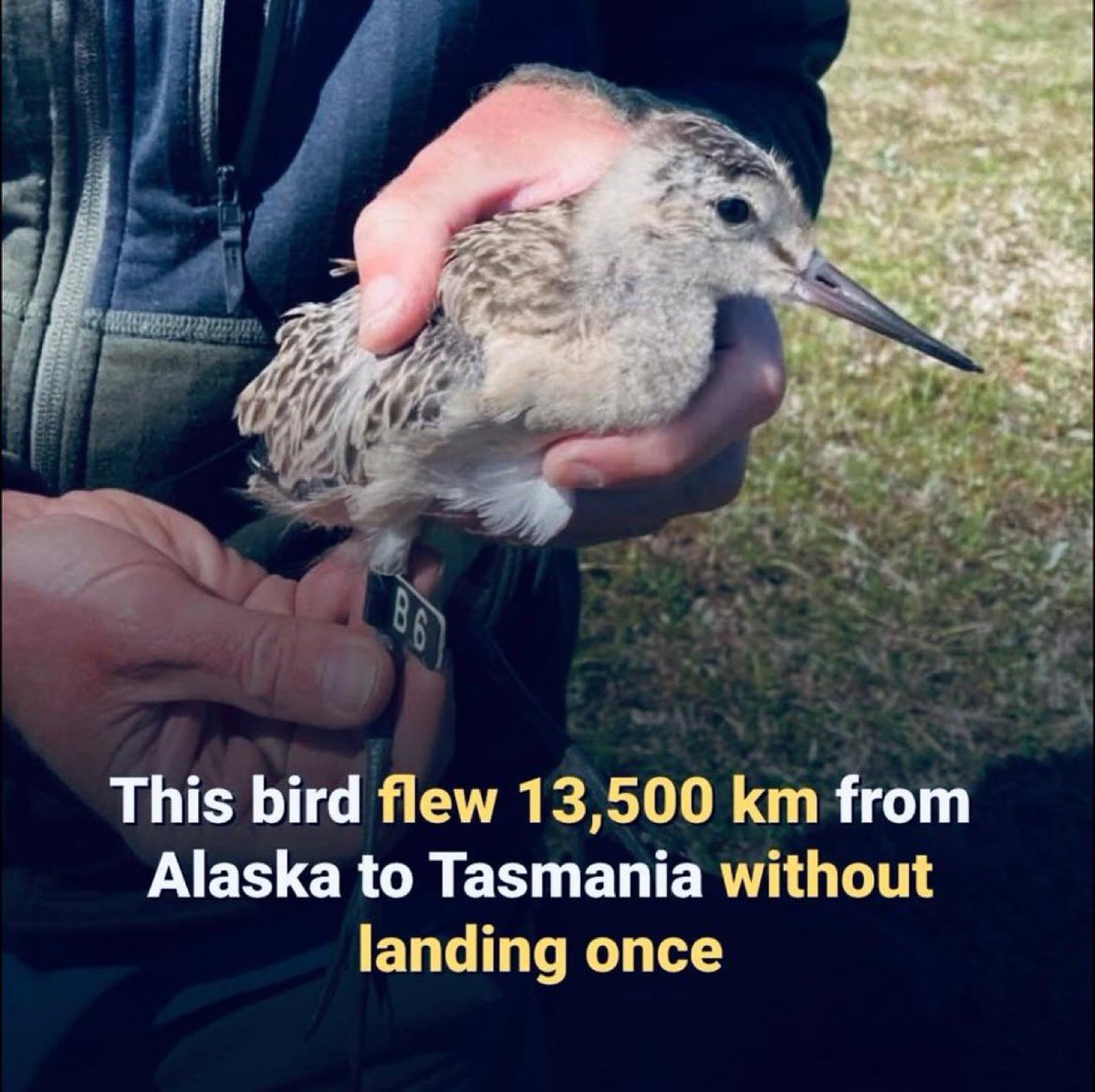
🚨 JUST IN: A migratory bird just shattered world records — flying 8,425 miles (13,560 km) NON-STOP across the Pacific without landing once.
The bar-tailed godwit doesn’t stop to eat, drink, or sleep during its migration across the Pacific Ocean. Its journey from Alaska to Australia takes roughly 11 days of continuous flight, covering over 13,000 kilometers through storms, headwinds, and open ocean with zero land beneath it the entire time.
Before departure, it does something almost surgical to its own body. It shrinks its digestive organs down to almost nothing, converting the stomach, intestines, and liver into raw fuel. The bird essentially eats its own gut to make room for fat reserves that will power its wings for nearly two weeks straight.
The brain doesn’t fully sleep either. Half of it stays active while the other half rests, alternating in shifts mid-flight at altitude over the open Pacific. The godwit is simultaneously unconscious and navigating with magnetic field sensitivity that no human instrument in the 18th century could replicate.
What makes this genuinely staggering beyond the physical record is the navigational precision involved. The bird leaves Alaska and arrives in New Zealand with accuracy that would embarrass early GPS systems. It reads Earth’s magnetic field, atmospheric pressure gradients, star positions, and potentially quantum-level compass mechanisms inside its eye that literally let it see magnetic field lines overlaid on its visual field.
Evolution spent millions of years building an aerospace navigation system inside a 300 gram animal.
We spend billions engineering machines that do what this bird does on instinct, fat reserves, and half a sleeping brain.
The longest recorded non-stop flight by a commercial aircraft is around 20 hours.
This bird does 11 days.
Without a runway.
"Demis Hassabis' Advice: Skip Internships, Master AI"
Google DeepMind's CEO advises undergraduates that getting unbelievably proficient with AI tools is now more valuable than traditional internships for leapfrogging into a profession.
More evidence of how our beliefs directly impact our body in important, and protective, ways.
Placebo effect influences vaccine responses
https://t.co/JvvV4zAZ63
This paper quietly shows something fundamental about cognition.
Attention does not emerge from sustained activity or increased firing rates. It appears only during brief, high-coherence temporal events where distributed brain regions transiently synchronize through high-frequency bursts.
These bursts are not carrying semantic content. They act as temporal gates, short windows in which coordination is permitted. Outside these windows, communication effectively collapses.
What stabilises the system is not fixed frequency or static resonance, but preserved constraint closure: reciprocal phase coupling, bidirectional feedback, and symmetry across scales.
This reframes attention and language as event-driven, phase-adaptive processes rather than continuous information flow, a pattern that mirrors constraint-based organisation seen across physics, mathematics, and complex systems.
The data don’t just support oscillatory models, they point to a deeper principle: coherence is maintained by invariant structure, not by holding parameters fixed.
@MillerLabMIT