There are more startup ideas in a single 100,000+ person subreddit than in every Y Combinator batch combined.
r/accounting, r/realtors, r/dentistry, r/insurance etc.
Every post that starts with "is there a better way to do this" is a product waiting to be built with AI.
Self recommending must-read for Canadians.
“The path Canada is on, economically and culturally, is no longer sufficient to make us a flourishing world class nation.”
Today we launched a major update to the OpenAI Agents SDK to help developers build and deploy long-running, durable agents in production.
You can now build your own Codex-style agents using powerful primitives for modern agents - file and computer use, skills, memory and compaction.
The harness and compute are now split - you can bring your own sandbox or use partners like Blaxel, Cloudflare, Daytona, E2B, Modal, Runloop, and Vercel for container execution.
The harness is open-source and so you can inspect and customize it for your needs.
Try it out!
https://t.co/MXPwV83mAl
Really fantastic work by @stevendcoffey and the API team!
Sequoia's thesis that the next $1T company will sell work, not software, is the most important reframe in AI right now.
The argument: if you sell a copilot, you're competing with every new model release. But if you sell the outcome — books closed, contracts reviewed, claims handled — every AI improvement makes your margins better, not your product obsolete.
The key insight most people miss: for every $1 spent on software, ~$6 is spent on services.
The entire SaaS playbook was about capturing the software dollar. The AI playbook is about capturing the services dollar — at software margins.
Not "AI for accountants." The AI accounting firm.
Not "AI for lawyers." The AI law firm.
The companies that figure this out won't look like SaaS companies. They'll look like services firms rebuilt on software infrastructure.
That's a fundamentally different company to build, fund, and scale. And most founders are still building copilots.
Tobi Lutke explains what the VCs who passed on Shopify got wrong
Tobi recounts pitching Shopify to VCs on Sand Hill Road a few years after founding Shopify.
Investors passed because they thought the addressable market was too small. At the time, there were about 40,000-50,000 online stores, and even if Shopify captured 50% of the market, that still wouldn’t be a venture-scale business.
When Tobi ran into the VC partner a few years ago, the partner asked Tobi what he missed (Shopify is valued at almost $100 billion today).
Tobi explained:
“You were actually correct, but what you didn’t realize was that Shopify was the solution to the very problem you identified. The reason there was only 40,000 online stores was because it was hard, expensive, and everyone who tried ran into all these brick walls of complexity, which Shopify, one after another, smoothed over and made simple to do.”
Tobi believes this is a common mistake:
“What a lot of free-market thinkers don’t understand is that between the demand and eventual supply lies friction. And I actually think that friction is probably the most potent force for shaping the planet that people just generally do not acknowledge… That was my theory when I turned my snowboard store into Shopify: there was a lot more people like me except there was too much friction which we needed to solve. And Shopify has proven out that every time we make the process simpler, there’s more consumption. At this point, we have a million merchants on Shopify, which is a mind-blowing number. So friction is a major component, and it’s something that software is uniquely good at reducing.”
Video source: @danmartell (2019)
Commerce is moving at light speed. So are builders. And so are we.
If you're working with agents like Claude Code or Cursor, you'll want to check this out.
I think I need to be fired.
I've done 232 dry sauna sessions.
Last week I confirmed, for the first time (by swallowing a pill), whether the core temperature threshold that gates the primary cellular repair mechanism was actually being reached in my protocol.
The threshold is 102.2°F (39.0°C). For me, that takes 33 min at 195°F. With ice on face and neck, 38min.
My standard daily protocol was 20 minutes. That wasn’t enough time to get my core body temp to the heat shock threshold of 102.2°F (39.0°C).
Causing me to ask, did I just waste 77 hours and 20 min?
It's possible my heat threshold has increased and the heat shock protein release was happening previously, but I doubt it based upon the subjective feeling I now understand as being 102.2F (39.0°C). It’s brutal.
For these 232 sessions, I measured the temperature of the air, humidity, duration, frequency, the sweat output, blood biomarkers, vascular response, toxin clearance and fertility markers. There is no human body in history that has been more measured in sauna than mine.
Nevertheless, I did not confirm the one number that determines whether the primary mechanism was activating.
My goal wasn't to be a sauna bro. It was to saunamaxx. I was doing the former while thinking I was doing the latter.
I rest my case. I should probably be fired.
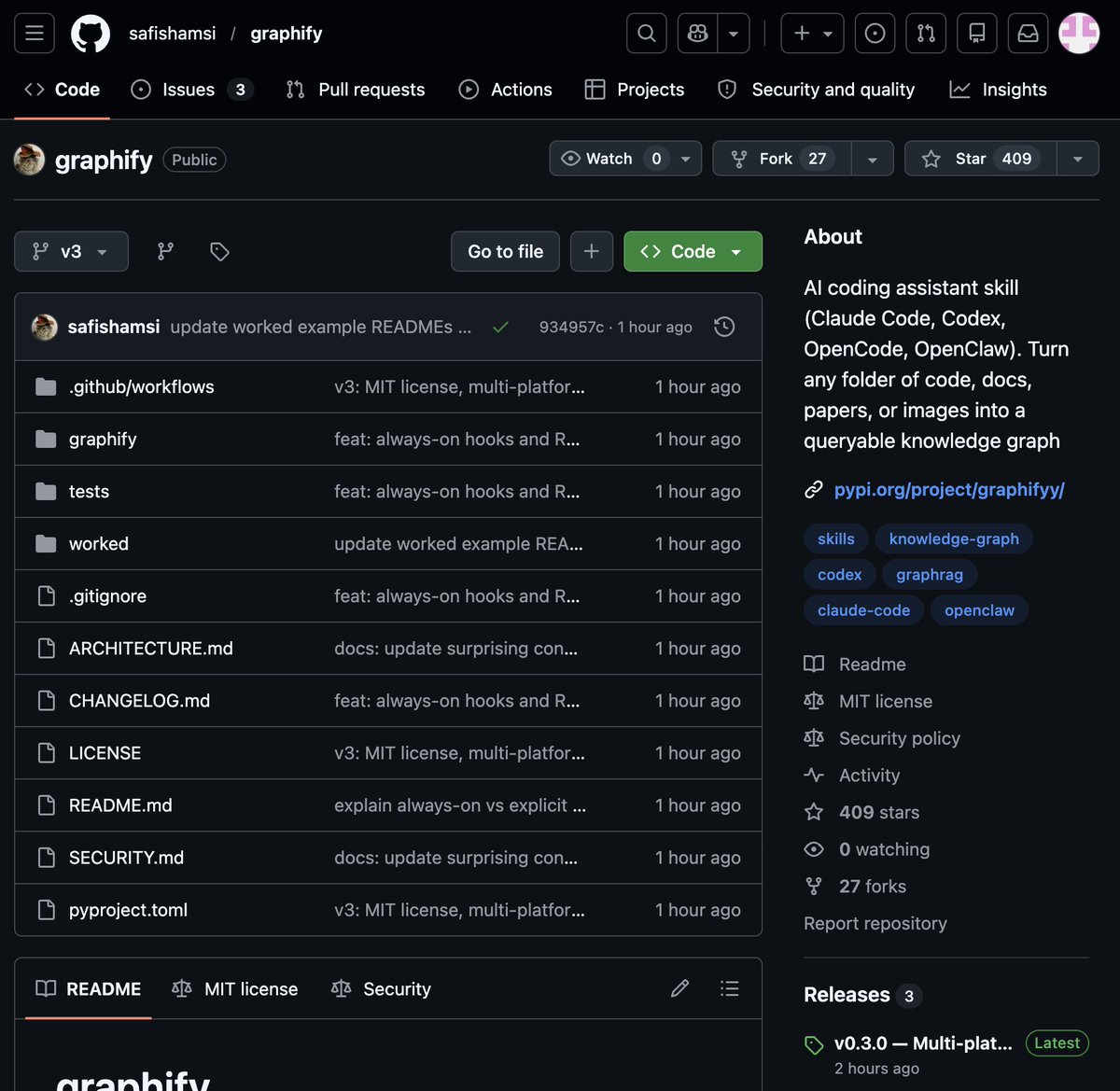
🚨 BREAKING: Someone just built the exact tool Andrej Karpathy said someone should build.
48 hours after Karpathy posted his LLM Knowledge Bases workflow, this showed up on GitHub.
It's called Graphify. One command. Any folder. Full knowledge graph.
Point it at any folder. Run /graphify inside Claude Code. Walk away.
Here is what comes out the other side:
-> A navigable knowledge graph of everything in that folder
-> An Obsidian vault with backlinked articles
-> A wiki that starts at index. md and maps every concept cluster
-> Plain English Q&A over your entire codebase or research folder
You can ask it things like:
"What calls this function?"
"What connects these two concepts?"
"What are the most important nodes in this project?"
No vector database. No setup. No config files.
The token efficiency number is what got me:
71.5x fewer tokens per query compared to reading raw files.
That is not a small improvement. That is a completely different paradigm for how AI agents reason over large codebases.
What it supports:
-> Code in 13 programming languages
-> PDFs
-> Images via Claude Vision
-> Markdown files
Install in one line:
pip install graphify && graphify install
Then type /graphify in Claude Code and point it at anything.
Karpathy asked. Someone delivered in 48 hours.
That is the pace of 2026.
Open Source. Free.
The coolest meeting I had this week with was Paul, who used ChatGPT and other LLMs to create an mRNA vaccine protocol to save his dog Rosie. It is amazing story.
"The chat bots empowered me as an individual to act with the power of a research institute - planning, education, troubleshooting, compliance, and yes, real scientific design work in converting genomic data to a vaccine prescription and designing the treatment protocol around it. But they worked alongside humans at every step. The combination is what made it possible."
It immediately got me thinking "this should be a company".
Also, Paul is an extraordinary guy. This should be easy to do, but it is not yet.
Canada spent $5.1 BILLION fixing a broken payroll system (Phoenix). Now we're about to spend $4.2 BILLION+ replacing it with Dayforce.
I went through every lobbying record, every communication report, and every revolving-door hire to identify potential conflicts of interest.
Here's what I found.
1/🧵
After @Pinterest@Airbnb@NotionHQ@cursor_ai, today it’s @eoghan@intercom publicly sharing that they’re finding it better, cheaper, faster to use and train open models themselves rather than use APIs for many tasks.
And hundreds of other companies are doing the same without sharing.
Ultimately, I believe the majority of AI workflows will be in-house based on open-source (vs API). It took much more time than we anticipated but it’s happening now!
Software horror: litellm PyPI supply chain attack.
Simple `pip install litellm` was enough to exfiltrate SSH keys, AWS/GCP/Azure creds, Kubernetes configs, git credentials, env vars (all your API keys), shell history, crypto wallets, SSL private keys, CI/CD secrets, database passwords.
LiteLLM itself has 97 million downloads per month which is already terrible, but much worse, the contagion spreads to any project that depends on litellm. For example, if you did `pip install dspy` (which depended on litellm>=1.64.0), you'd also be pwnd. Same for any other large project that depended on litellm.
Afaict the poisoned version was up for only less than ~1 hour. The attack had a bug which led to its discovery - Callum McMahon was using an MCP plugin inside Cursor that pulled in litellm as a transitive dependency. When litellm 1.82.8 installed, their machine ran out of RAM and crashed. So if the attacker didn't vibe code this attack it could have been undetected for many days or weeks.
Supply chain attacks like this are basically the scariest thing imaginable in modern software. Every time you install any depedency you could be pulling in a poisoned package anywhere deep inside its entire depedency tree. This is especially risky with large projects that might have lots and lots of dependencies. The credentials that do get stolen in each attack can then be used to take over more accounts and compromise more packages.
Classical software engineering would have you believe that dependencies are good (we're building pyramids from bricks), but imo this has to be re-evaluated, and it's why I've been so growingly averse to them, preferring to use LLMs to "yoink" functionality when it's simple enough and possible.
Introducing the Google Workspace CLI: https://t.co/8yWtbxiVPp - built for humans and agents.
Google Drive, Gmail, Calendar, and every Workspace API. 40+ agent skills included.
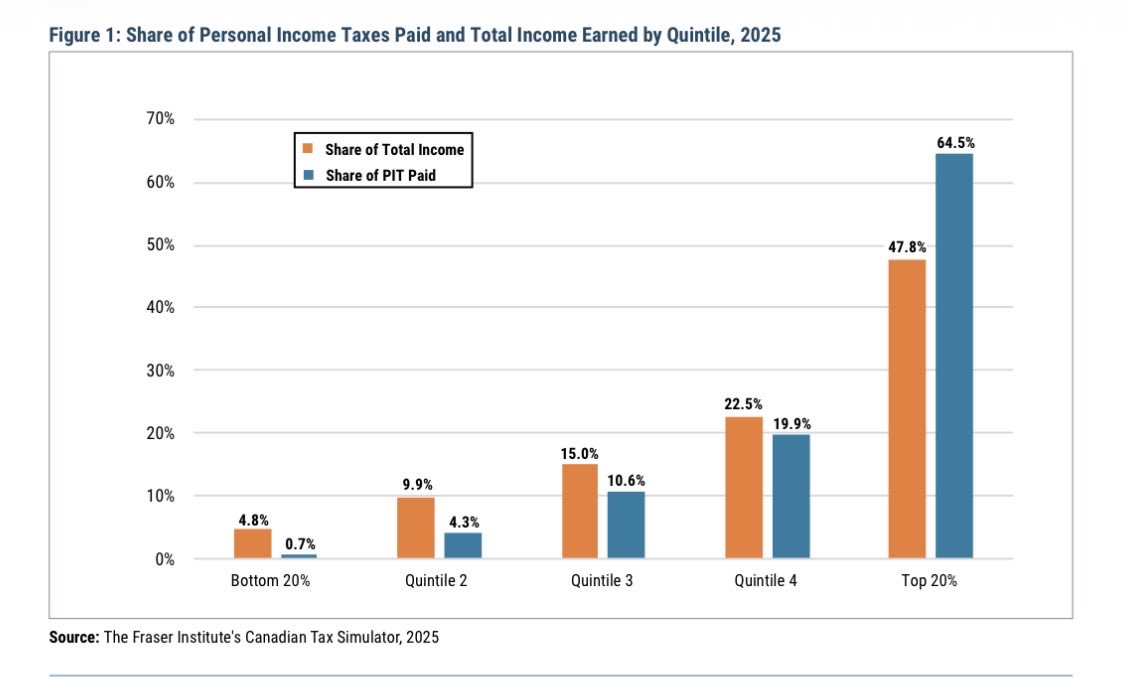
Always interesting to see how people make assertions that are often wrong, but never in doubt. This is data based from StatsCanada (latest is 2023) and summarized by Fraser Institute (check the data yourself like i did directly with StatsCanada). Draw your own conclusions.
After hearing feedback from Canadian founders in our network, we’ve decided to add Canada back to our list of accepted countries of incorporation.
Going forward, YC will once again invest in US, Canada, Cayman, and Singapore corporations.
https://t.co/2gQA55u4fL
Claude Startup Program is also OPEN btw
> API credits for early-stage startups (up to ~$25K)
> Built by Anthropic (Claude)
> No VC needed (unlike OpenAI)
> Selection based on product + real Claude usage
> Actually friendly to bootstrapped founders
Apply: https://t.co/KQIgRqfPan
The way startups are built has shifted quickly.
We're excited about a range of startup ideas for AI-native companies that can now be built faster, cheaper, and with more ambition than ever.
https://t.co/Ms3Vn5Vq7q