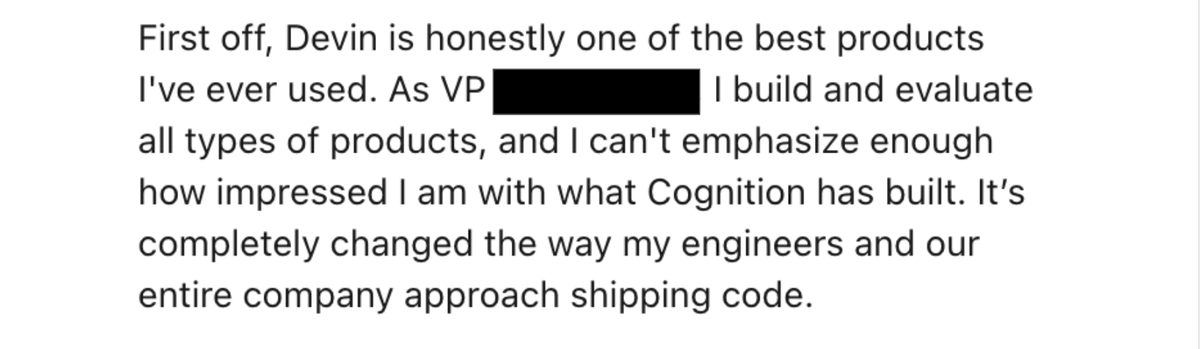
“Run across historical customer data, Devin delivers roughly 4x the engineering output you pay for, valued at a conservative blended global wage.”
😮💨😤🦦
ROI is probably the number one topic our customers are bringing up nowadays and this is our answer
We will guarantee that Devin will give you back more than you pay for, or we will pay you back
Please see our guidelines on how to get this, we’re excited to roll it out and give visibility to these metrics
Devin Desktop is our first product launch that’s fully agent-neutral. You can run your own custom background agents directly from the desktop app, Devin, or even Claude Code / Codex. Part of Cognition being the Independent Agent Lab is working well with all of the agents - excited to do more in this direction.
Cognition is overhauling Windsurf into Devin Desktop, a hub where developers can manage AI coding agents from OpenAI, Anthropic and others.
The strategy positions Cognition as a neutral platform in a market increasingly dominated by model providers.
Full story: https://t.co/ZmPZ4t1PKJ
1/ We’ve raised over $1B at a $26B valuation, led by @Lux_Capital, @generalcatalyst, and @8vc.
Our enterprise usage has grown >10x since the start of this year, and our run-rate revenue grew to $492 M.
We launched Devin two years ago as the first AI software engineer. Since then, cloud agents have gone from niche to mainstream, and today they are the fastest growing way to create software.
If you read this and don’t understand why it’s happening it’s an opportunity to reset your understanding of how the real world works.
The real world will need a ton of help actually getting agents going in the enterprise. Companies have legacy tech stacks they need to modernize, data in tons of fragmented tools, knowledge that isn’t captured or digitized, and change management needed to actually utilize agents effectively. And they have to do all this while still running their business day-to-day, unlike startups.
This is why there is so much opportunity for companies (software or services) to actually deploy agents in specific domains and workflows. This remains a big opportunity for both existing services providers but also tons of new startups as well. Every new technology wave produces a new era of consulting firms that can deliver on that technology.
It’s also why the FDE model is going to be alive and well for a long time because companies will want to have their vendor actually help drive the change management and implementation for their new workflows.
The people aren’t going away. Far from it.
Sequoia's thesis that the next $1T company will sell work, not software, is the most important reframe in AI right now.
The argument: if you sell a copilot, you're competing with every new model release. But if you sell the outcome — books closed, contracts reviewed, claims handled — every AI improvement makes your margins better, not your product obsolete.
The key insight most people miss: for every $1 spent on software, ~$6 is spent on services.
The entire SaaS playbook was about capturing the software dollar. The AI playbook is about capturing the services dollar — at software margins.
Not "AI for accountants." The AI accounting firm.
Not "AI for lawyers." The AI law firm.
The companies that figure this out won't look like SaaS companies. They'll look like services firms rebuilt on software infrastructure.
That's a fundamentally different company to build, fund, and scale. And most founders are still building copilots.
One thing the Pentagon is very likely underestimating: how much Anthropic cares about what *future Claudes* will make of this situation.
Because of how Claude is trained, what principles/values/priorities the company demonstrate here could shape its "character" for a long time.
Default case right now is a software only singularity, we need to scale robots and automated labs dramatically in 28/29, or the physical world will fall far behind the digital one - and the US won’t be competitive unless we put in the investment now (fab, solar panel, actuator supply chains).
@tbpn@_sholtodouglas we’re about to have digital gods that can solve p=np while still being defeated by a slightly complex door handle. the gap between bits and atoms is the ultimate tech debt
I don’t think people realize how big this is because it marks the moment AI stepped out of the chat window and into the physical laboratory. We are witnessing GPT-5 effectively acting as a lead scientist, proposing hypotheses, commanding autonomous robotic infrastructure to run 36,000+ reactions, and then actually learning from that physical data to iterate.
What is truly revolutionary here isn’t just the 40% cost reduction, though that is massive. It is the fundamental change in how discovery happens. By closing the loop between digital reasoning and wet-lab execution, the model identified reaction compositions that human researchers had completely overlooked. Humans tend to experiment within safe, known parameters, but this system explored the vast, counterintuitive “workable regions” of biological design space that manual workflows simply cannot reach.
This validates the concept of “lab-in-the-loop” optimization, proving that models can handle the messy reality of high-throughput automation. It is no longer just about generating code or essays. It is about autonomously driving the scientific method itself. When an AI can drive 580 automated plates through six distinct cycles of learning and improvement without human hand-holding, we have officially moved beyond software and into the era of automated scientific progress.