Our paper on positive epistasis and balancing selection now out in @eLife! See how an extremely polymorphic population of a wood decay fungus can navigate rugged fitness landscapes (thanks @VBurskaia for the beautiful illustration) https://t.co/RiJhZgreEy
Very excited to share that I recently started my lab in @CompOncMSK at @MSKCancerCenter!
Looking for postdocs and graduate students interested in cell fate decisions/cancer evolution/computational single-cell genomics. Come join us in NYC!
Spread the word & please #RT. Thanks!
Our study on within-population epistasis is out as a preprint today! https://t.co/F6nJJtQBVC
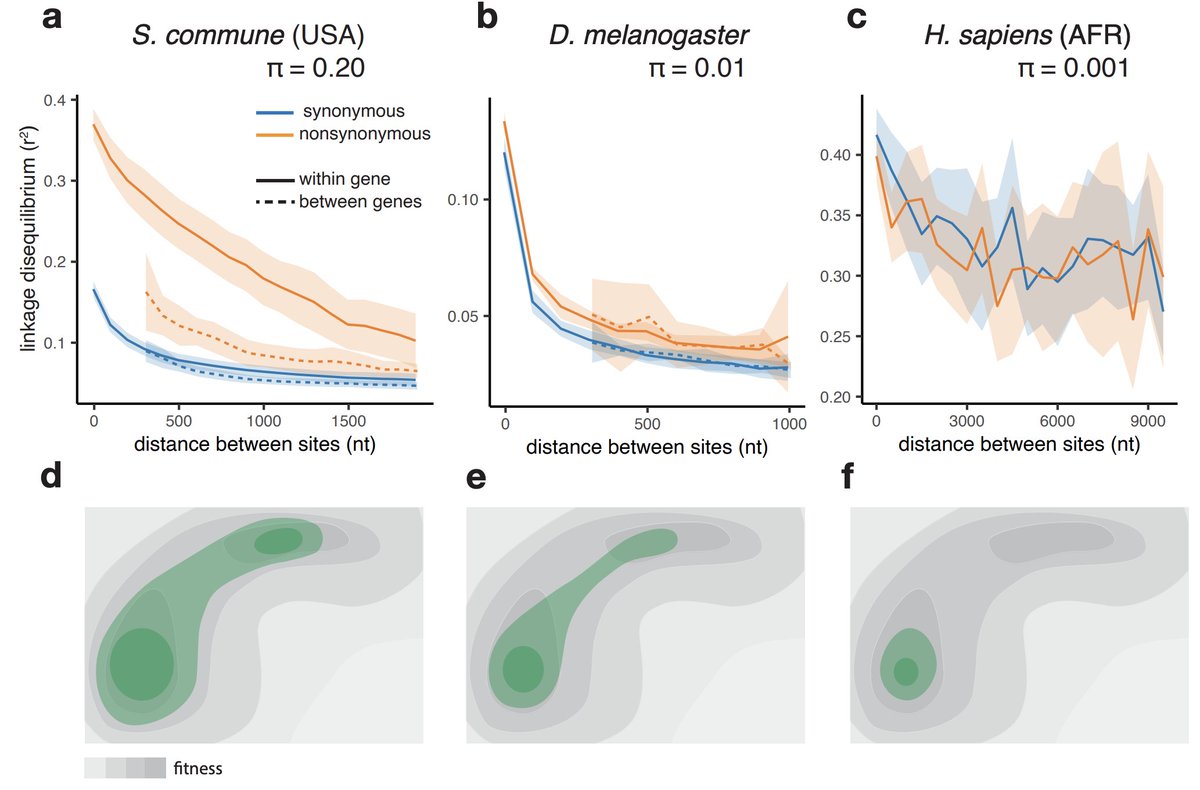
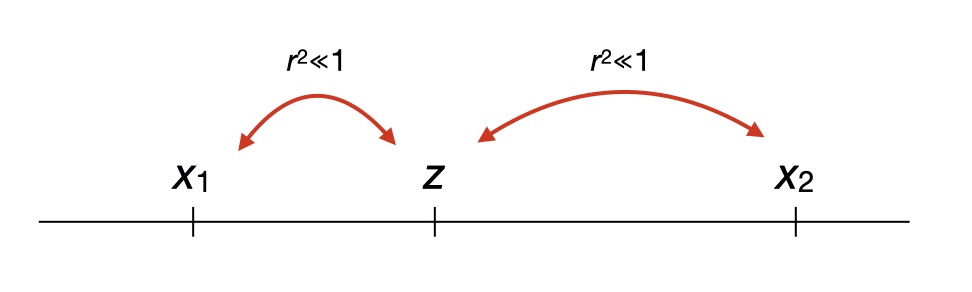
Epistasis shapes variation within a hyperpolymorphic fungus S. commune - with ~20% of neutral sites differing between any two sampled genomes. We detect it by linkage disequilibrium (1/4)
Our paper on positive epistasis and balancing selection now out in @eLife! See how an extremely polymorphic population of a wood decay fungus can navigate rugged fitness landscapes (thanks @VBurskaia for the beautiful illustration) https://t.co/RiJhZgreEy
Epistatic effects are particularly pronounced in short (<1kb!) but abundant haploblocks, which we suppose are maintained by balancing selection. (4/4)
Thanks to @GBazykin and Alexey Kondrashov for the supervision and discussions!
Our study on within-population epistasis is out as a preprint today! https://t.co/F6nJJtQBVC
Epistasis shapes variation within a hyperpolymorphic fungus S. commune - with ~20% of neutral sites differing between any two sampled genomes. We detect it by linkage disequilibrium (1/4)
Epistatic constraints are preserved in two diverged S. commune populations, so that LD values between pairs of shared alleles in two populations are correlated (3/4)
It is well known that mutation rate varies along the genome. Together with @seplyarskiy we employed this variability to reconstruct portrait of major mutational processes in the human germ line. Thanks to Shamil Sunyaev, his lab members and @KharchenkoLab!
https://t.co/mskHmmk5ch
I went down a cool scientific rabbit hole this morning, and thought others might find it interesting. It's about "phantom epistasis"--basically the statistical appearance of epistasis when everything is additive.
1/x
Wide-spread sex in famously asexual bdelloid rotifers (previously known as “the evolutionary scandal” because they allegedly couldn’t do sex). Still unclear how they do it, but the fact is now inescapable. Congratulations Olga! https://t.co/BGxX2fI5GH
1st cloned Przewalski’s horse born Aug 6. Nucleus from stallion cells cryopreserved ~40 yrs ago in San Diego Zoo Global Frozen Zoo® introduced into oocyte from domestic horse. @SSRepro @___SDB___ @the_Node@GeneticsGSA@sdzglobal https://t.co/rXlwsA1RHN