The only reason I stay ahead is because, if you’re gonna be a reckless driver, do that behind me. Trust me I am not racing you. I’m just making sure I get to my destination. Buh bye now #fordfiesta#beepbeep
Galaxies appear in countless shapes and sizes, with spiral galaxies standing out as one of the major classes.
NGC 2985 is a breathtaking specimen, found more than 70 million light-years from our solar system in the constellation Ursa Major
(Credit: ESA/Hubble & NASA, L. Ho)
These aren’t mountains. They’re the Cosmic Cliffs, a vast stellar nursery 7,600 light-years away, captured by NASA’s James Webb Space Telescope.
Powerful young stars are carving through the Carina Nebula, revealing hidden regions where new stars are being born.
(Video by Universal-Sci - Credit: NASA, ESA, CSA, STScI)
A-meow-zing 😻
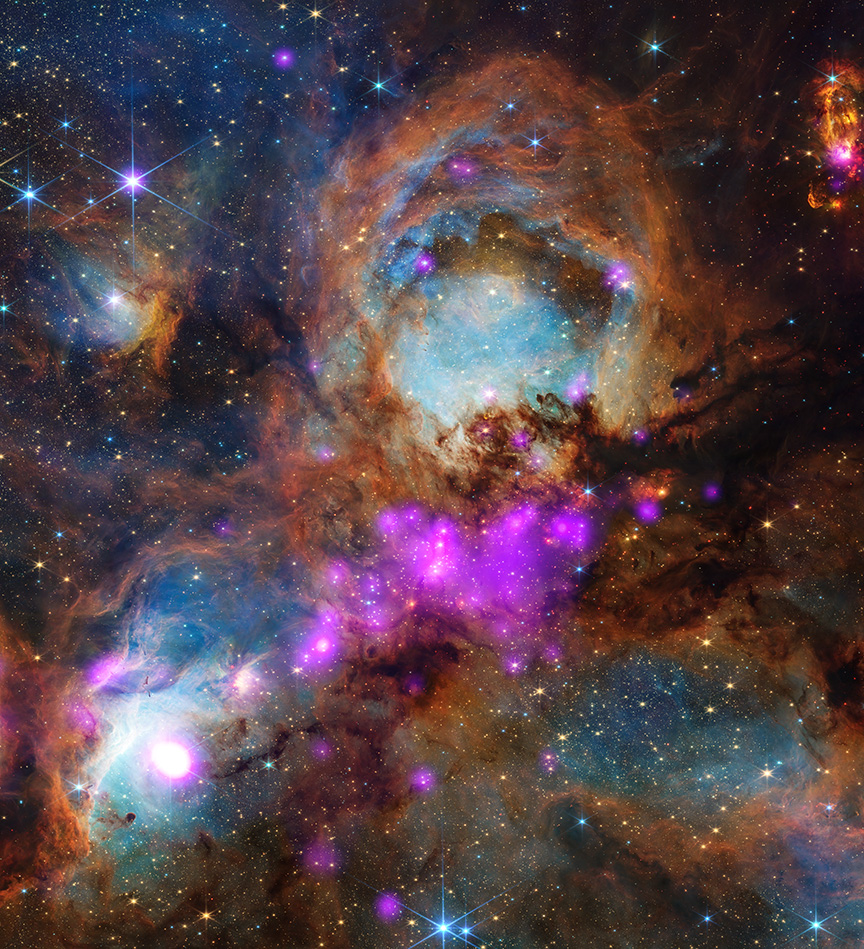
@NASAWebb and @ChandraXray joined forces to deliver this view of the Cat's Paw Nebula. Different wavelengths combine to reveal young stars at the center of these dusty clouds.
Amazing: NGC 1961 unfurls its gorgeous spiral arms in this amazing image from the Hubble Space Telescope.
(Credit: NASA, ESA, J. Dalcanton, R. Foley; Image processing: G. Kober)
Completely unseen, yet shaping our cosmos. Scientists have long wondered about the formation of spiral galaxies. Infrared observations expose invisible magnetic fields aligned with the spiral arms.
(Credit: NASA/SOFIA; NASA/JPL-Caltech/Roma Tre Univ.)
Mesmerizing: A ten-light-year cosmic dust ribbon drapes the Taurus Molecular Cloud, hiding young stars and dense gas awaiting transformation.
(Credit: ESO/APEX (MPIfR/ESO/OSO)/A. Hacar et al./Digitized Sky Survey 2. Acknowledgment: Davide De Martin)