Anthropic top researcher Nicolas Carlini (67.2k citations on Google Scholar) says Claude is a better security researcher than him, made $3.7 mn from exploiting smart contracts, and found vulnerabilities in Ghost (a 52K+ Github star project).
I refactored my AI security agent to go beyond web pentesting.
gave it a headless Kali Docker container with 35+ tools so it runs on both Win11 and Kali at the same time.
Now it solves Reversing, Crypto, PWN, Forensics, and Web. All from a single prompt and a target URL.
Every run I watched it work, spotted where the methodology broke, and patched the rules right there. That's what got the results.
In 24 hours it went from rank ~5,000 to #55 on a cybersecurity platform @FlagYard (5,300+ users)
72 challenges solved. 12,245 points.
33 Easy 21 Medium 17 Hard 1 Insane
Got rate limited multiple times by AI providers during heavy runs. Would've been higher without the throttling.
Also, Anthropic just dropped a blog on harness design for long-running agentic apps. Worth a read if you're building agents
https://t.co/gmZZGJrctU
#BugBounty #ctf #ai
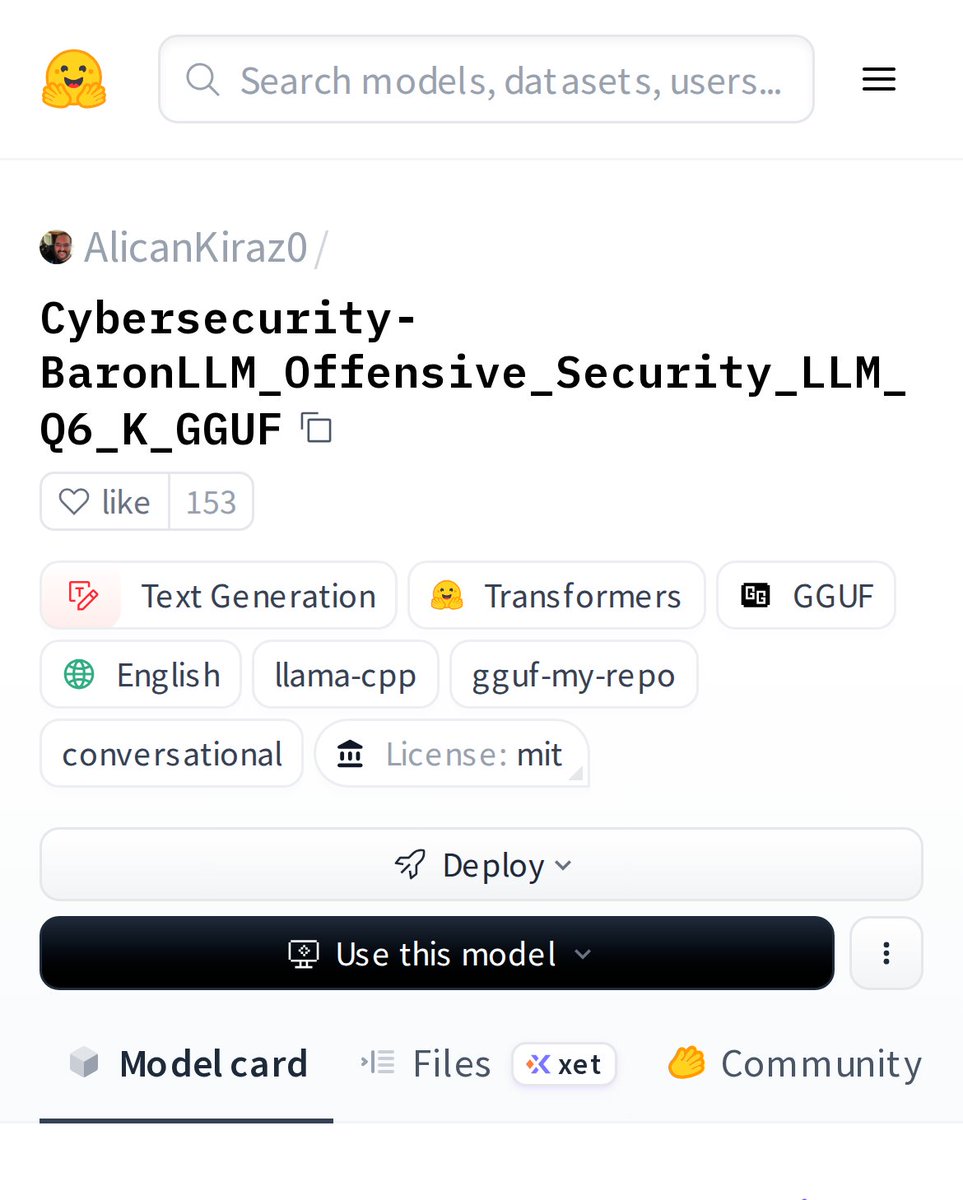
Meet the Cybersecurity Baron: a specialized LLM fine-tuned for offensive security. This isn't your average chatbot. It's a quantized, 6-bit GGUF model built on Llama 3.1 Instruct, designed to think like a penetration tester. Perfect for ethical hackers and security researchers.
🤯Protocols would pay >$1000 per run for this. Someone just Open Sourced it for free. MIT Licensed.
This AI security tool is proven to get up to 90% coverage post human audits. I haven't seen another one that digs deeper into a codebase. Massive boost for the space🫡
Spent a week testing AI for vulnerability research. 14 confirmed bugs in 20 min on one target. 5% hit rate on a hardened one. Same AI, same setup. 4 approaches, what worked, what failed, why target selection matters more than model sophistication. https://t.co/R5ofHyXQem
i have a VERY VERY stupid simple way i am doing this, and will likely get made fun of for how I am doing it... but I gave each of the 4 systems their own physical box (tho 2 are VM's, but each VM is on its own Mac host and the VMs run ubuntu arm). They all have ssh + sudo access to each others machines. I have shared network drives linking all machines together, and cronjobs + shell scripts monitoring for 'f;ags' to be set. When Claude (my manager) wants to assign a task to one of the other models, it opens up a Assignments.md file in the shared drive, and puts who its assigned to, what the job is, what it needs to produce, what agents it should use to complete the tasks and what LLM's should be reviewing its work. It then creates the 'flag' (this is just a file in the shared drive named message_for_gemini as an example). gemini's cron job will detect that flag within 60 seconds, and will then run a shell script that invokes gemini in yolo mode, its passed a very small system prompt that tells it how to parse the assignments.md file, and how to use my shared_comms.md file (this one is basically a place for them to 'chat' and ask each other questions easily and quickly). once it parses the assignment, it will launch the agents needed to perform the task, and once it has something it thinks is ready, it will create the flag for whatever LLMK is suppose to check its work. if they both agree, it sends the info to Claude with the shared_comms and message_for_claude flag creation. claude then reviews it. if claude thinks its wrong, it will either ask me (if it has evidence on why its wrong) or will ask the 4th model (most of the time grok) for its input. if grok agrees its all good, then claude accepts it and keeps the process going. if grok or claude think its wrong, they send me a text message asking me to check the laptop to provide feedback and a final decision. it seems confusing af writing it all down, but its been working really well for about 2 months now. They also all have to keep a running log of every single command/tool they run (with all params) and some other stuff, depending on the task at hand (and whether its something i want to learn, or already know how to do).
Building out a CVE monitoring system with Infinite Monitor.
Each widget it's own little agent environment powered by @aisdk@p0 just-bash and a bunch of other stuff I've been meaning to try out.
Initially I wanted each widget to be sandbox, but it became far to expensive.