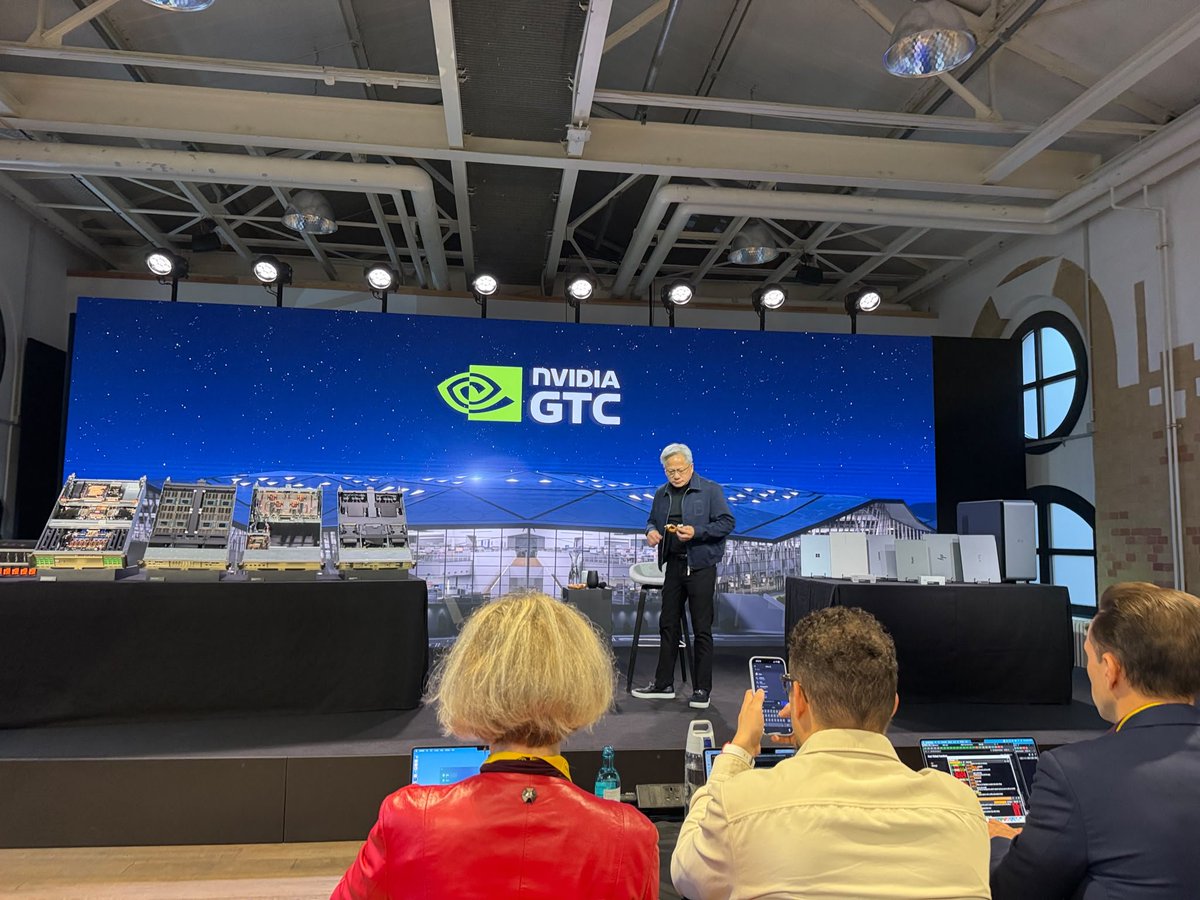
One of Jensen's strongest messages: Europe must move from consuming AI to producing it. With NVIDIA working with over 12,000 partners across Europe, the foundations are growing. But how do we translate this into lasting economic value?
NVIDIA is no longer just building GPUs. It is building the infrastructure for an AI-driven economy.
At #GTCBerlin 2026, Jensen Huang outlined a major shift towards AI factories, autonomous agents and the systems needed to put intelligence to work.
From DSX POD reducing deployment times to OpenShell securing AI agents and new technologies connecting enterprise data with AI, the focus is moving beyond computing power towards real business value.
The bigger question: How quickly can enterprises turn these technologies into measurable productivity and economic growth?
https://t.co/WKdKg3le2F
#NVIDIA #JensenHuang #AIFactory #AgenticAI
NVIDIA says Europe now has 12,000+ partners in its ecosystem and that it has committed nearly $10 billion across the continent. At the same time, GTC Berlin is putting Physical AI, industrial AI and AI factories at the centre of the European agenda. The technology is scaling quickly, but who should capture the productivity gains: infrastructure owners, companies, workers, cities, or all four?
We are entering an era where AI could significantly reduce the costs of manufacturing, logistics and essential services. But greater productivity does not automatically translate into greater prosperity for everyone. If AI factories can generate unprecedented economic value, what policies, business models and institutions will ensure that workers and communities share in the benefits?
ChatGPT Is Building Detailed Psychological Profiles of Its Users
"...there is no boundary anymore; the system is acting as your advisor, your friend, your doctor, your lawyer, and so it has information on everything."
By Maggie Harrison Dupré
Chatbots are building intimate “algorithmic self-portraits” of users as they retain information to offer a hyper-personalized experience, researchers warn.
A recent study, conducted by a coalition of scientists in Germany, India and the Netherlands and presented at the ACM Web Conference 2026, investigated the ways that OpenAI’s ChatGPT has tracked and made sense of user inputs to develop comprehensive digital profiles of users.
https://t.co/Ka9RRw9wdS
What happens when you take the operating discipline of fintech and apply it to one of the world’s most capital-intensive industries?
Alan Chang joined Revolut at 21, became Head of Operations at 22 and Chief Revenue Officer at 27. After leaving at 28, he moved into energy and co-founded Fuse Energy with Charles Orr.
Fuse is trying to combine software, renewable generation, infrastructure ownership and a technology-led operating model rather than behaving like a traditional electricity supplier. The company reported more than $300 million in annualised revenue by 2025 and has since been publicly described at a $5 billion valuation.
But the more interesting story is bigger than one startup.
We are seeing experienced technology operators move beyond software into energy, infrastructure, manufacturing and other physical industries. The next generation of tech companies may not simply digitise existing systems. They may own and rebuild parts of the physical infrastructure itself.
The question is whether the speed and operating models of high-growth fintech can translate sustainably into sectors where capital, regulation, engineering and physical assets matter just as much as code.
https://t.co/Lu4wvT6NPX
#Energy #Fintech #Revolut #FuseEnergy #RenewableEnergy #Technology #Startups #Infrastructure #DigitalTransformation
Honoured to be recognised by @thinkers360 among the Top 50 Global Thought Leaders and Influencers on Data Center 2026.
Data centres are becoming one of the defining infrastructures of the AI economy. As AI factories, accelerated computing, digital twins, sovereign AI and agentic systems scale, the conversation is no longer only about compute. It is also about energy, cooling, networks, resilience, security and the physical infrastructure required to support intelligence at scale.
Pleased to be included alongside:
@williammcknight , @ralf_ladner@mclynd , Osman Kivanc Cengel, @sameersparadkar , William Genovese, @sethearley , Dana Gardner, @cleartechtoday , @ITProGuru , @Kevin_Jackson@Ronald_vanLoon EUR ING. Ts. Sukor Zainal, @RobTiffany , @rahilkaredia , @Nicochan33 , Tommy Stewart, @EvanKirstel , Charles S. Logan, Dr. Suman Ghosh, Dr. Raphael Akangbe, @jeffdaniels , Astrid van Dorst, Ganes Kesari, @tdav , Sue Shaw, Prof. Sanjay Rout, @davefood , John Thompson, @YuHelenYu , Itohanoghosa Eregie, Michael Leone, @dineshtbe , Colin Slade, Mrinal Rai, @MikeFultonIT , Hamza Basyouni, Nitin Kumar, @VladoBotsvadze , @WillTownTech , @MarshaCollier , @vamsiin Jaideep Khanduja, @GTChristensen , Dion Hinchclife, Deepak Lalwani, @nyike , @TKspeaks and Goutama Bachtiar.
Congratulations to everyone recognised, and thank you to Thinkers360 for continuing to highlight the people shaping these critical technology conversations.
The next phase of AI will be built not only in models, but in the data centres, AI factories and physical infrastructure that make intelligence possible.
#DataCenter #AI #AIInfrastructure #AIFactory #DigitalTwins #SovereignAI #Cloud #FutureOfAI #Thinkers360
AI is opening opportunities across the entire fashion value chain, from design and pattern-making to personalised sizing, manufacturing and supply chains. Somy shared how AI helped her achieve accurate measurements and get samples right on the first attempt. Think about the potential for reducing material waste, production costs and development time. Can AI help us create a fashion industry that is both more creative and more sustainable?
𝐂𝐚𝐧 𝐀𝐈, 𝐒𝐮𝐬𝐭𝐚𝐢𝐧𝐚𝐛𝐢𝐥𝐢𝐭𝐲 𝐚𝐧𝐝 𝐖𝐞𝐥𝐥𝐧𝐞𝐬𝐬 𝐑𝐞𝐝𝐞𝐟𝐢𝐧𝐞 𝐭𝐡𝐞 𝐅𝐮𝐭𝐮𝐫𝐞 𝐨𝐟 𝐋𝐮𝐱𝐮𝐫𝐲 𝐅𝐚𝐬𝐡𝐢𝐨𝐧?
“I figured out a way to combine wellness with fashion, that is, designing beautiful designs, but made it out of fabrics that are scientifically proven to regulate your nervous system.” – Somy Madani
Somy Madani is a Saudi-born, London-based fashion designer, entrepreneur and advocate for ethical luxury fashion. She is the founder and Creative Director of Somi London, a luxury fashion house combining Saudi cultural heritage with contemporary Western design, sustainability and well-being.
Her work has been showcased at London Fashion Week and the Cannes Film Festival, with her collections exploring identity, femininity, cultural storytelling and the relationship between fashion and human emotions.
“It’s a privilege to be a fashion designer - we don't follow the trend, we create the trend and that's how we stand out. My vision is to continue combining east and west, combining the modern luxury with the historical culture of Saudi Arabia just because I found out that that's really who I am.”
Through Somi London, she is exploring biodegradable materials, natural fibres and the potential of fashion to support wellness and longevity.
“It's important to know where the fabric is coming from. It's very important to know if the person who worked on this fabric is getting paid enough and that's part of sustainability”
Somy also founded Somi Talents Academy, helping emerging creatives develop their identities and build careers in fashion.
During our discussion, we explored Saudi Arabia's growing fashion ecosystem, sustainable luxury, AI-powered design and manufacturing, the role of social media in creative entrepreneurship, and the future of intelligent wearable textiles.
“Thanks to AI because of the measurement, they get the measurements so accurate. They get the pattern so accurate. There is no mistake. I got the samples right from the first from the first try.”
𝐈 𝐭𝐡𝐢𝐧𝐤 𝐢𝐭'𝐬 𝐢𝐦𝐩𝐨𝐫𝐭𝐚𝐧𝐭 𝐭𝐡𝐚𝐭 𝐰𝐞, 𝐚𝐬 𝐚 𝐜𝐫𝐞𝐚𝐭𝐢𝐯𝐞 𝐩𝐞𝐨𝐩𝐥𝐞, 𝐝𝐨𝐧'𝐭 𝐟𝐞𝐚𝐫 𝐀𝐈. 𝐋𝐞𝐭'𝐬 𝐦𝐚𝐤𝐞 𝐢𝐭 𝐨𝐮𝐫 𝐟𝐫𝐢𝐞𝐧𝐝”
How can AI help fashion designers innovate while preserving the creativity, craftsmanship and human identity that define luxury?
Watch the full conversation on my YouTube channel: https://t.co/iDgpxa6V3t
#fashioninnovation #futureoffashion #luxuryfashion #sustainablefashion #aiinfashion #fashiontechnology #ethicalfashion #wearabletechnology #smartclothing #fashioninnovation #sustainablefashion
CC @YuHelenYu@efipm@enilev@JagersbergKnut@TysonLester@CurieuxExplorer@GlenGilmore@FrRonconii@chidambara09@jeancayeux@mvollmer1@Nicochan33@RLDI_Lamy@pchamard@mikeflache@Fabriziobustama@Mack1510019@ipfconline1@PawlowskiMario@drsharwood@kalydeoo@baski_LA@AnthonyRochand@smaksked@Eli_Krumova@andresvilarino@gvalan@AI_4_Healthcare@bimedotcom@arlenenewbigg@NewsNeus@domingonarvaez1@bamitav@jornalistavitor@jblefevre60@FmFrancoise@MHcommunicate@Corix_JC@c4trends@smoothsale@amalmerzouk@PVynckier@bbailey39@ralf_ladner@mary_gambara
75% of UK financial firms are already using AI. But adoption is only one part of the equation. How many can actually explain, audit and control the decisions their AI systems make? Are we measuring AI success by deployment speed or by accountability?