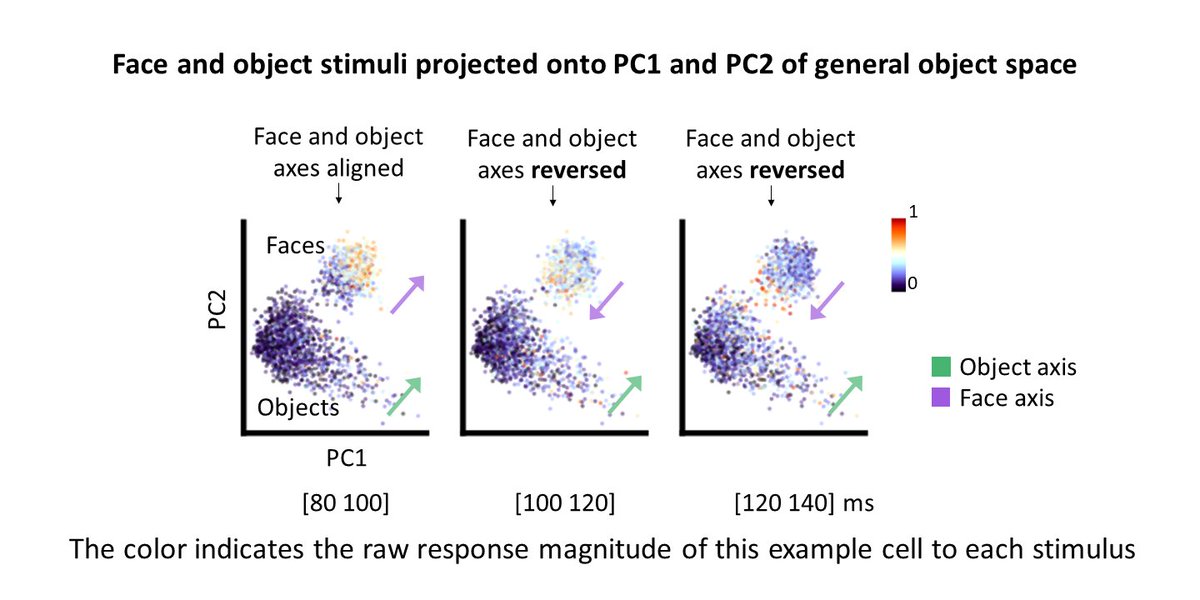
Thrilled to share our new paper describing a novel form of neural computation: single cells drastically change their tuning in <20ms, shifting from a code for face detection to one that enables fine face discrimination. Neural dynamics are much richer than previously conceived!
(6/6) For #patients
People have been looking for ways to prevent cancer, and early diagnosis has been proved to be an useful approach. There are many ways AI can truly benefit society, and we hope our work demonstrates one of them. You won't wait too long - please stay tuned.
(1/6) Very excited to share our work on @NatureMedicine using #AI to predict #cancer with disease history only (no CT scan!). Glad to co-lead the work with @davplacido @jessicaxhu Chunlei Zheng @sandercbio@TheBrunakLab and many more great colleagues https://t.co/vEY2eOUN4A .
(5/6) For cancer screening, what we care the most about is precision. Among many architectures, the attention-based transformer performs the best (50 times higher precision compared to non-sequential models). We also used IG interpretation to find the predictive features.
I am extremely excited to announce our next Q&A with the one and only @deboramarks. Come participate in our live Q&A on Slack on September 12 at 1:30pm PST/4:30pm EST (as always, you can find this on our calendar).
This is a great opportunity to chat all things ML + bio
The Spotlight: A General Method for Discovering Systematic Errors in Deep Learning Models
https://t.co/CwamWYXZN7
by Greg d'Eon et al.
#NeuralNetwork#Classifier
Besides, we adapted the original CellBox to Julia differential programming and augmented the method with adjoint sensitivity. So say hi to the newborn CellBox.jl!! https://t.co/nIS8G887la
Check out our latest work at #simdl#ICLR2021@iclr_conf today. The CellBox method works great for a melanoma cell line, but how general it can be? How about other network systems? What if we can take time series measurement - instead of a single snapshot - of the dynamic system?
Together with @hellocombustion and @JudyShen_yue, we demonstrated the effectiveness of CellBox for a diversity of “biological networks” proposed by @AdityaPratapa_ @t_m_murali et al. Also, adding synthetic ground truth enables us to directly evaluate the network learned from data
Interesting interview with Aviv Regev about her move to @genentech: How to deliver better medicine? 1. human biology, 2. high-res methods, 3. modalities, and 4. computation & maths, the latter for "predictive, generative and interpretable models". https://t.co/vgPTJClrbb
We just recently published three Research Highlights! The first one highlights the work by @boyuan_data and colleagues that presents an interpretable deep-learning framework that can predict cell responses to unseen perturbations. https://t.co/dqDen0XoNR
A letter (draft) to the President @MIT from ~100 MIT faculty members.
It compares facts and Government's allegations against Professor Gang Chen.
Versions of it have been sent to many people, and it is in the public domain.
A powerful ending:
"We are all Gang Chen"
Excited to share our #preprint on inCITE-seq for measuring nuclear protein levels + transcriptome at single cell! Like CITE-seq for cell-surface proteins, we use DNA-conjugated antibodies to measure proteins, but now inside the nucleus + transcriptome.
https://t.co/Ixm4HwxH4O
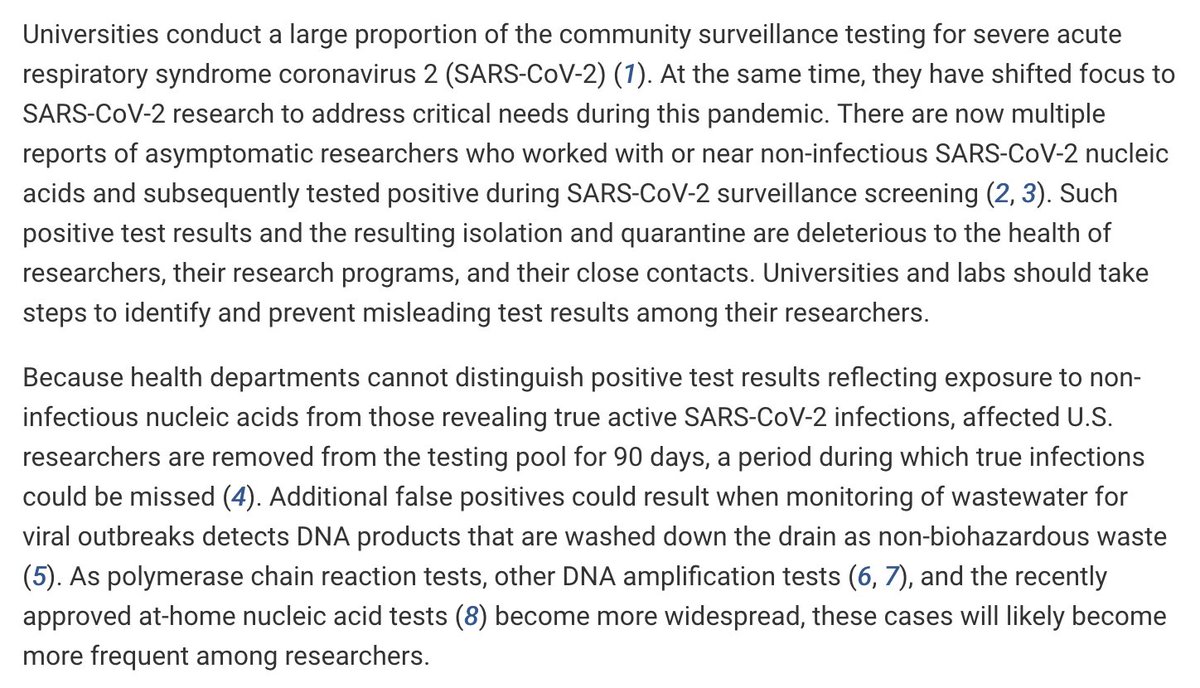
Interesting--researchers working on SARS-CoV-2 are testing positive (and hence required to quarantine) not because they are infected but because they are contaminated with SARS-CoV-2 nucleic acids from lab.
Could affect Boston wastewater testing also.
https://t.co/gC63nWqdTJ