THIS CHART explains how scarce #Bitcoin is. 🤯
How many #BTC per millionaire? 💰
How much #BTC to get rich? 📈
How early are you to #Bitcoin? 🤔
Let's take a brief visual journey into pricing abundance via scarcity... 👇🧵
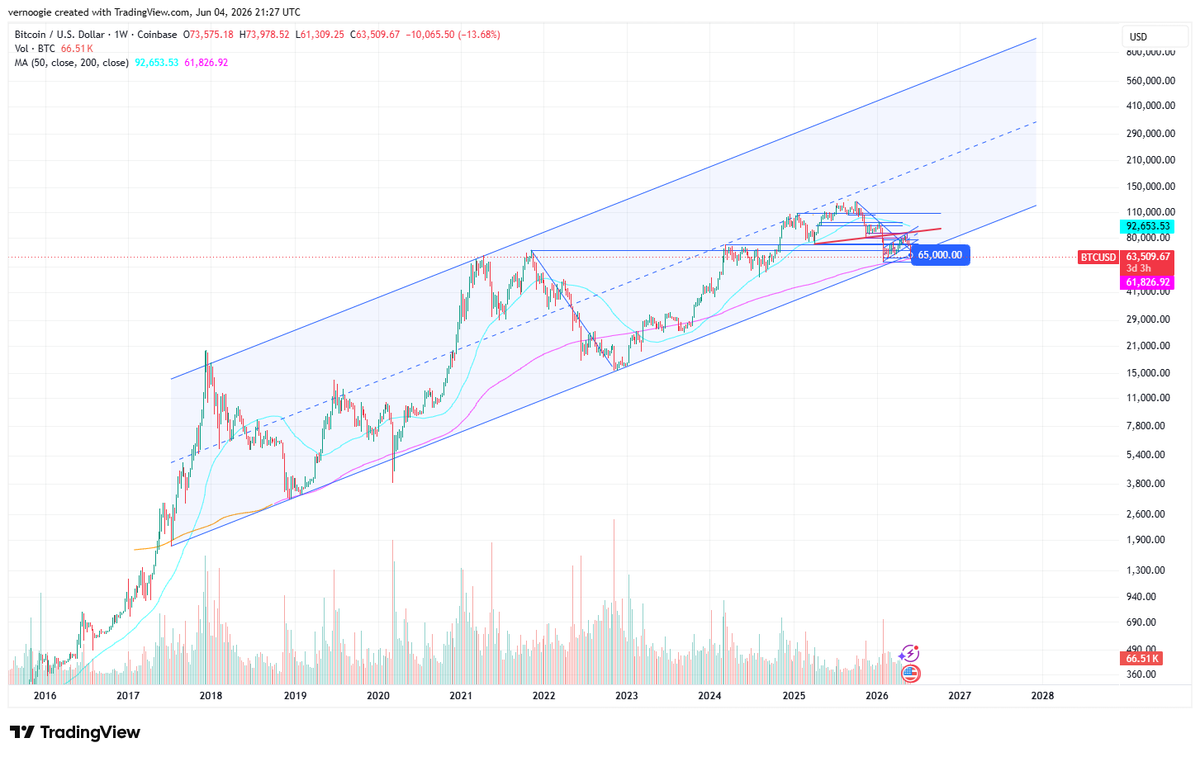
@Sykodelic_ A $65,000 weekly close keeps it in the channel going back to 2017. That would be ideal. Below 65K breaks that decade-long trend, not ideal.
A Mom in Tulsa called 3 health systems last week asking the price of her son's tonsillectomy.
Health system A: "We cannot quote you a price."
Health system B: "Pricing depends on your insurance."
Health system C: "Our financial counselor will reach out after the procedure."
No other industry in America gets to operate this way.
Imagine ordering at a restaurant and getting the bill six weeks after dinner.
STRK around $72 means you’re buying a fixed 8% dividend at an effective yield of ~11%, plus conversion optionality into MSTR common.
The discount to par is your margin of safety, the conversion feature is your asymmetric upside.
$STRK is underrated because most income instruments don’t give you both.
We're now 3 years in to Bhutan's Bitcoin experiment
That means we now have robust data on how it has impacted the economy
For context: Bhutan's economy was in dire shape in 2022 due to loss of all tourism income (it's #2 export earner) during the COVID period.
It got so bad that Bhutan was 3 months away from defaulting on import payments.
IMF was poised to step in to structure a loan which would have led to heavy debt repayments, but also ceding of economic sovereignty to a lender whose loan conditions permit them to dictate how to (re)structure an economy.
Instead, Bhutan formed a large Bitcoin Strategic Reserve by using their surplus renewable hydropower to mine Bitcoin.
The IMF has warned on numerous occasions that nations embracing Bitcoin would destabilize their economy, be less effective at attracting foreign direct investment, and endanger their decarbonizing and environmental initiatives.
What does the data say (as reported by Wall St Journal, Al Jazeera and Forbes)
1. Bhutan was able to "use Bitcoin reserves to avert a crisis as foreign currency reserves dwindled to $689 million"
2. The bitcoin reserves have directly addressed pressing fiscal needs. "In June 2023, Bhutan allocated $72 million from its holdings to finance a 50% salary increase for civil servants"
3. Prime Minister Tshering Tobgay in an interview said that bitcoin also "supports free healthcare and environmental projects"
4. Tobgay also said their Bitcoin reserves helped in "stabilizing [the nation’s] $3.5 billion economy"
5. Independent analysts have now said that "this model could attract foreign investment, particularly for nations with untapped renewable resources"
Considering that what transpired in Bhutan has helped stabilize an economy that the IMF warned Bitcoin would destabilize, it begs the question: what data was the IMF's predictions based on?
For Bhutan, Bitcoin didn't just boost the economy, it allowed Bhutan to maintain economic independence and provided an example to other small nations of a path forward that did not require the IMF.
The final boss: "There is no upward bound on the demand for a product solves everyone's investment product." ~@hillery_dan
Psychologically, people will chase yield, esp as inflation erodes purchasing power & worsens over time, accelerating quickly.
4% no longer cuts it.
I admire how Strategy has achieved true financial enlightenment by becoming the most polarizing asset on Earth.
Half of us believe it’s a mathematically inevitable, fully weaponized money printer that will vaporize the concept of middle class employment forever.
The other half is absolutely convinced it’s a deranged, leveraged Ponzi cult seconds away from bankruptcy court, liquidation, and a Netflix documentary.
Somehow both sides are 100% confident, deeply offended, and watching the same ticker.



![DSBatten's tweet photo. We're now 3 years in to Bhutan's Bitcoin experiment
That means we now have robust data on how it has impacted the economy
For context: Bhutan's economy was in dire shape in 2022 due to loss of all tourism income (it's #2 export earner) during the COVID period.
It got so bad that Bhutan was 3 months away from defaulting on import payments.
IMF was poised to step in to structure a loan which would have led to heavy debt repayments, but also ceding of economic sovereignty to a lender whose loan conditions permit them to dictate how to (re)structure an economy.
Instead, Bhutan formed a large Bitcoin Strategic Reserve by using their surplus renewable hydropower to mine Bitcoin.
The IMF has warned on numerous occasions that nations embracing Bitcoin would destabilize their economy, be less effective at attracting foreign direct investment, and endanger their decarbonizing and environmental initiatives.
What does the data say (as reported by Wall St Journal, Al Jazeera and Forbes)
1. Bhutan was able to "use Bitcoin reserves to avert a crisis as foreign currency reserves dwindled to $689 million"
2. The bitcoin reserves have directly addressed pressing fiscal needs. "In June 2023, Bhutan allocated $72 million from its holdings to finance a 50% salary increase for civil servants"
3. Prime Minister Tshering Tobgay in an interview said that bitcoin also "supports free healthcare and environmental projects"
4. Tobgay also said their Bitcoin reserves helped in "stabilizing [the nation’s] $3.5 billion economy"
5. Independent analysts have now said that "this model could attract foreign investment, particularly for nations with untapped renewable resources"
Considering that what transpired in Bhutan has helped stabilize an economy that the IMF warned Bitcoin would destabilize, it begs the question: what data was the IMF's predictions based on?
For Bhutan, Bitcoin didn't just boost the economy, it allowed Bhutan to maintain economic independence and provided an example to other small nations of a path forward that did not require the IMF.](https://pbs.twimg.com/media/HCK0JsUagAEb_7a.png)





