Lately hearing more reports of refineries in the Atlantic Basin delaying their maintenance. If that is so, watch out for higher risks of unplanned outages as a consequence of pushing units to the operational limit.
#oott
🚨🇺🇸🇮🇱🇱🇧U.S., Israel and Lebanon in a joint statement: "As a result of the U.S. led negotiations, Israel and Lebanon agreed to the implementation of a ceasefire. The ceasefire is contingent on a complete cessation of Hizbollah fire and the evacuation of all Hizbollah operatives from the South Litani Sector"
🚨🇺🇸🇮🇱🇱🇧U.S., Israel and Lebanon in a joint statement: "As a result of the U.S. led negotiations, Israel and Lebanon agreed to the implementation of a ceasefire. The ceasefire is contingent on a complete cessation of Hizbollah fire and the evacuation of all Hizbollah operatives from the South Litani Sector"
Germany deservedly snubbed for the UN Security Council. Lack of principles and spine, compensated by sanctimonious grand-standing, finally punished. Deeply satisfying. Great job, Merz, Wadephul, Baerbock.
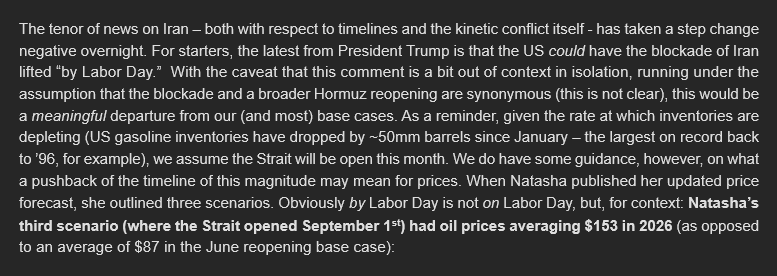
I have no idea what these banking idiots think about Hormuz opening base case this month, later will be next month.
My base case is 2027 and beyond if ever.
"The US is preparing to face the first naval guerilla war as Iran prepares thousands of small boats to face the might of the US Navy. @andreas_krieg, a security studies specialist at KCL, explores how the IRGC decentralised it's naval forces and why the 'grey zone' is the ideal stage for Iran to cause havoc"
@SinaToossi "All contractor and civilian (dependent/retiree) travel must be conducted through Kuwait City International Airport (KCIA)." On a US military website.
@SinaToossi Cargo City is at Kuwait airport. It's clearly a legit target.
"Cargo City, a detachment of the 386th Air Expeditionary Wing here, moves three-quarters of all assets, supplies and personnel into the U.S. Central Command area of responsibility."
https://t.co/gaDCBZj29V
Over the past eight or so days, the US has targeted Iranian vessels as well as targets on the Iranian mainland. This included non-Iranian oil vessels. In essence, this was the US seeking to escalate the blockade of the blockade.
At first, Iran's response was proportional. The US could tolerate that response.
In fact, it was beneficial to the US to continue the exchange of blows but keep them relatively limited, as it would slowly but surely erode Iran's deterrence without imposing intolerable costs on the US.
But yesterday, Iran moved to change that equation.
After the US struck a Botswana-flagged tanker as part of Trump's blockade, the Iranians counter-escalated disproportionally.
Tehran struck Kuwait International Airport as well as a US base in Kuwait, Ali Al-Salem.
It struck the 5th Fleet facilities in Bahrain. (Full extent of damage unknown.)
It struck Jordan. (Full extent of damage unknown.)
It struck northern Iraq. (Full extent of damage unknown.)
It struck the UAE. (Full extent of damage unknown.)
It struck the Al-Udeid Air Base in Qatar. (Full extent of damage unknown.)
It was a demonstration - and reminder - that Tehran retains escalation dominance.
Whereas the US is comfortable with either a possible deal or a low-level exchange of fire, but not a return to full-scale war, Tehran is comfortable with a possible deal or a full-scale war, but not with a low-level exchange of fire that erodes Iran's deterrence and allows for Trump's "blockade of the blockade" to become effective.
The area where both can actually be comfortable is some sort of a deal. Reaching it, however, is a different story.
@gbrew24@Jack_McClendon Using force to open strait very difficult, doesn't solve fundamental issue of geography and shipping concerns, and would likely exacerbate energy supply and price problems. Would be another Trump policy of creating more problems, finding a solution that creates more problems, etc
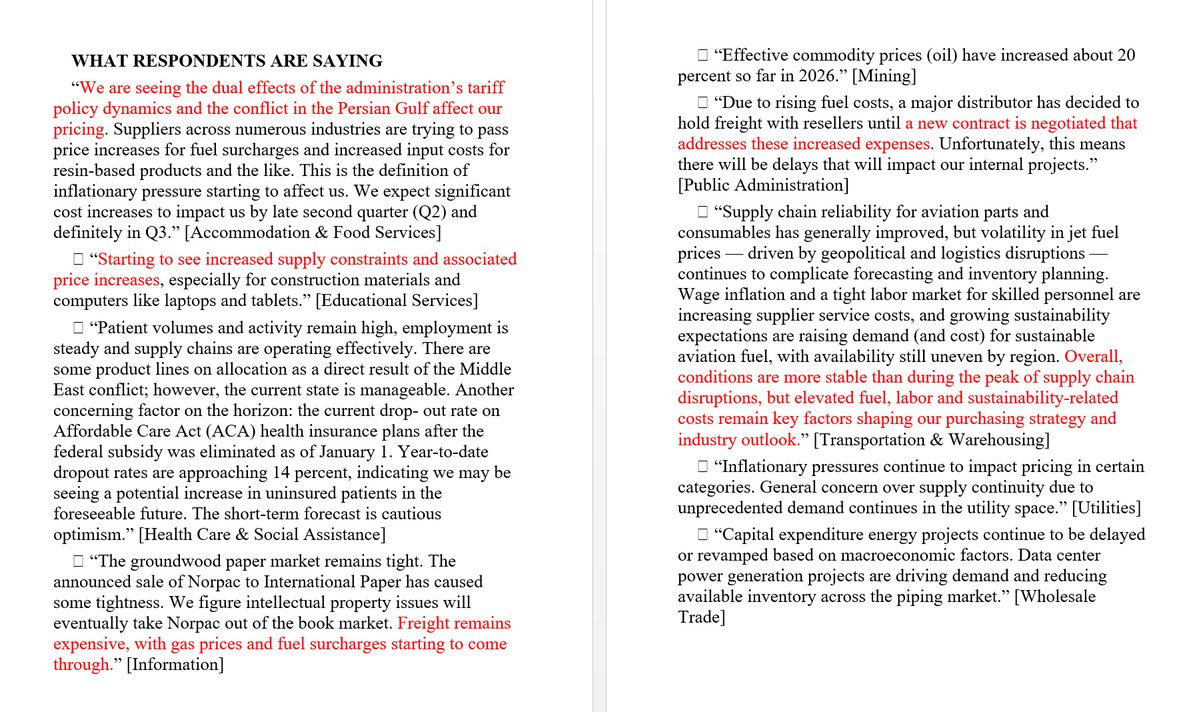
Across the 10 responses included from this month's ISM survey of service-industry purchasing managers (the people who buy things on behalf of businesses), the dominant theme is rising costs, driven by fuel and energy prices, tariffs, and AI-related demand.
No respondent reports prices easing or falling. A few comments focus more on supply tightness than on prices directly, but none point in a disinflationary direction.
BREAKING: Iran’s oil exports fell by more than 90% in May, as U.S. blockade severely disrupts Tehran’s ghost fleet network. @UANI recorded just 4 naphtha exports & limited LPG cargoes, with no crude successfully passing the blockade.
@UANI’s May blog: https://t.co/uAL9RmRmXb
Must-read piece by @Rory_Johnston on what it will take to reopen the Strait of Hormuz if/when the U.S. and Iran reach a deal (linked below).👇
An immediate stockpile of roughly 160 million barrels will be released to the market as trapped tankers exit, but the real issue is the flow problem: getting the roughly 14 mb/d of shut-in production back online.
From a sheer physical perspective, Kuwait has said that could take 3-4 months for its oilfields to resume prewar production levels, though timelines will vary by country. To enable that, the excess oil in onshore storage will need to be cleared to make way for new production.
But physical constraints aside, the bigger issue is whether and when Persian Gulf countries can be assured that a regular outlet for exporting petroleum exists -- i.e. can they trust that Iran will actually *keep* the Strait of Hormuz open, and will it permit a resumption to prewar levels of traffic?
When cast that way, the reasons for the strong resistance of Persian Gulf governments to "allow" Iran any post-war control over Hormuz becomes obvious: Iran could potentially use its leverage over Hormuz to essentially *decide for them* what their new levels of ongoing oil production will be.
Whether, and under what conditions, Iran would try to impose de facto production limits on Gulf states by squeezing Hormuz is unclear.
But my take is that the issue is best left for regional actors to work out themselves. After all, the U.S. has armed and equipped states like the UAE and Saudi Arabia with U.S. materiel for years. Local actors can retaliate impose costs on Iran, too, should Tehran get cute with the Strait of Hormuz. They have means to deter Iran from interference with the strait.
In the most recent war, Gulf countries stayed largely on the sidelines in hopes of minimizing Iranian retaliation (with the UAE a glaring exception, as it conducted significant airstrikes on Iran).
But if the U.S. were not so deeply enmeshed, trying to micromanage everything in the region, 1.) this war would never have happened and Iran would not have discovered the extent of its geographic leverage over Hormuz, and 2.) regional actors would balance each other and work out their political problems without the U.S. -- perhaps more peacefully. The resulting political arrangements would be more durable in the absence of U.S. meddling because they'd more accurately reflect the regional balance of power.
International relations is all about bargaining in the shadow of relative power. With the U.S. constantly and ham-handedly putting its thumbs on the scale, we interrupt and warp local bargaining processes in ways we barely understand -- and keep us trapped in the region.
Trump never should have launched this disastrous war. But he did, and the Persian Gulf won't ever be the same. An irresponsible U.S. regime change war is what provoked Iran into closing the Strait of Hormuz and taking the global economy hostage.
Simply put, we did this to ourselves. Meddling has consequences. And there's no engineered solution that can be attained through U.S. military force that approaches anything like reasonable cost.
The sane response to failure is to change strategies. Trump should drop his blockade in exchange for Iran reopening the Strait of Hormuz. Other issues can be handled later. The longer Trump waits, the worse his leverage gets, as the delayed costs of the Hormuz closure finally hit this summer.
And then the U.S. needs to reconsider its entire approach to the Middle East.
All those wrecked U.S. military bases? We should NOT rebuild them -- and not just because our air defenses can't adequately protect them from Iranian missiles and drones.
We need to take this opportunity to drastically scale back U.S. commitments to the region -- not just physical U.S. posture and presence, but the *underlying political commitments* to regional actors, whether it's Israel or Saudi Arabia.
Regional actors can balance Iran. They have more skin in the game and a far better understanding of realities on the ground than Washington ever could.
Rarely do historical events so upend political inertia as the Iran War has. Let's hope that the U.S. can take advantage of this opportunity to redefine its role and trim legacy commitments that no longer serve U.S. interests -- if they ever truly did.
Based on current trends, the Strategic Petroleum Reserve (SPR) would reach operational minimum levels around August. The drawdown pace is surpassing what was seen during the SPR release authorized by the Biden admin in 2022.
How should Iran's latest attacks on U.S. bases and infrastructure in Kuwait and Bahrain be understood?
The key point is that Iran appears intent on breaking what some Iranian analysts describe as the current "controlled tension" equilibrium.
Over the past week, the already fragile "ceasefire" framework has become increasingly unstable. The United States and Iran have each continued efforts to enforce their respective blockade measures in and around the Strait of Hormuz.
Washington has continued limited military operations and efforts to move shipping through the region, while Iran has responded with calibrated strikes and pressure of its own.
The result has been a series of tit-for-tat exchanges, escalating to more U.S. strikes on Iranian territory and Iran's retaliatory attacks on facilities in Kuwait in recent days.
But from Tehran's perspective, this equilibrium has become unacceptable.
The negotiations appear deadlocked. Trump still has not made a decision on key concessions reportedly contained in the emerging framework, while facing pressure from pro-Israel groups, donors, and hawkish senators opposed to compromise.
At the same time, economic realities are becoming harder to ignore. Summer energy demand is increasing, global energy inventories are dwindling under extraordinary strain, and concerns continue to mount around diesel, jet fuel, kerosene, and broader supply-chain disruptions.
Against this backdrop, Iranian strategists increasingly seem to believe that proportional responses merely normalize an unstable, unfavorable status quo.
From Tehran's perspective, if Washington can continue applying military and economic pressure while bearing only manageable costs to the viability of the "ceasefire," that pressure risks becoming the new status quo.
This is why these new attacks matter. The message is not simply retaliation. The message is that Iran no longer accepts a model in which the U.S. can sustain pressure below the threshold of a major confrontation while negotiations remain deadlocked.
The growing consensus among the Iranian analysts and debates I track is their view that deterrence is not created by merely matching an adversary's actions. It is created by raising the cost of continuing them.
From this perspective, Iran's objective is not necessarily to trigger a wider conflict, but to force Washington to confront a choice it has so far sought to avoid: move toward meaningful de-escalation and genuine compromise, or accept *rising* military, economic, and political costs across the region.
Taken together, the recent attacks suggest that Tehran is no longer trying to manage the existing equilibrium.
It is trying to break it by going higher on the escalation ladder in response to U.S. actions.
Another day, another clash in the gulf:
A. Without a deal, friction inevitably drives escalation.
B. In an environment already marked by high tensions, escalation can become uncontrolled, even when neither side actively seeks a broader conflict.
C. Iran continues to operate within its established deterrence framework, but recent statements by senior officials, including Mohsen Rezaei, suggest that the scope of potential retaliation may be expanding. This time, references have reportedly included the U.S. Fifth Fleet headquarters in Bahrain.
D. Through its actions, Iran is signaling that it will not allow a return to the previous status quo in the Gulf. From Tehran’s perspective, the regional landscape has changed, and any attempt to restore the old order will be challenged.
E. The continuation of the blockade creates an inherently unstable situation. Such a reality is difficult to sustain indefinitely without a direct confrontation at sea. As encounters between the parties become more frequent, the likelihood increases that an Iranian response will be more forceful and consequential.
Bottom line: another day, another incident, another round of restraint. But this pattern is unlikely to remain sustainable for long. The risk is not necessarily deliberate escalation, it is miscalculation, followed by a cycle of action and reaction that neither side initially intended.
#iran
#IranWar
@KasraAarabi@UANI@supbrow@JemimaShelley But does it get a political result? That’s the point. And global economy is coming up towards a cliff later in summer.