1/ Revenue teams have access to the best AI models that have ever existed. Yet, most still can't get them to do meaningful revenue work. The challenge is models don't come knowing your customers, your team, how you sell, or what winning looks like at your company.
“The lifestyle of an entrepreneur at its core is: I can take more pain than the other guy, and I'll prove it.”
“ There's a zen that can happen when a warrior has fought for a long time. You can get used to it.”
“ You almost start accepting it. Like, something bad happens and you don't even get mad.”
“ There are benefits. But you need to make sure you don't get so used to it that it doesn't even bother you. You can get so zen, you're unbothered.”
“ There's something special about the extra fierceness of being bothered, being upset about something that is wrong.”
— @travisk
I wonder how many support tickets could be avoided by highlighting in app we're in daylight savings today across the myriad apps that do anything with time....better yet, getting rid of daylight savings altogether lol
Most people think the psychedelic experience is what heals.
They're wrong.
It's what happens in the days and weeks AFTER that determines everything.
In 2023, Gül Dölen's lab at Johns Hopkins made a discovery that should reshape how every practitioner thinks about their work:
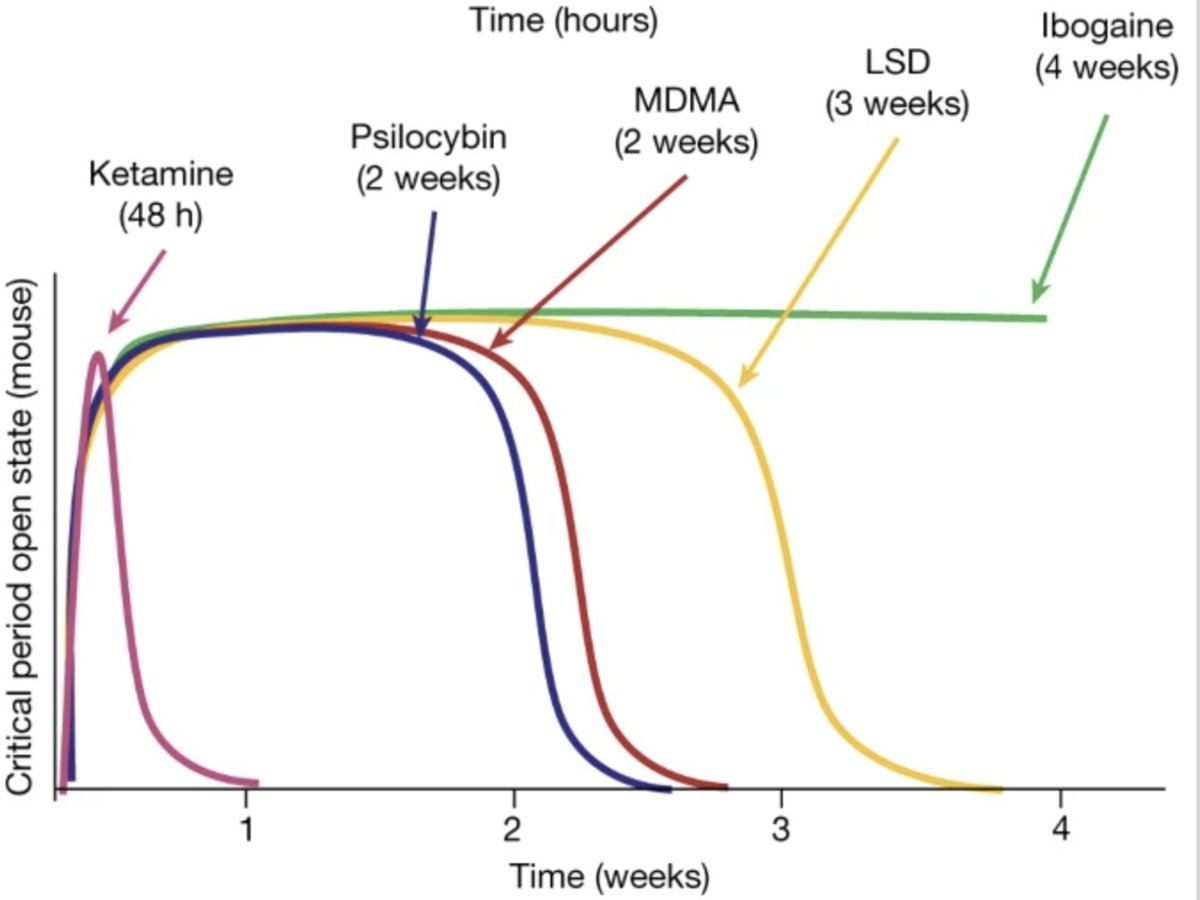
MDMA, psilocybin, LSD, ketamine, and ibogaine all reopen the social reward learning critical period, those rare developmental windows when we learn how to bond, trust, and adapt.
Our brains were once thought to close these windows by age 26. Turns out, psychedelics hand us the key to unlock them again.
Here's what makes this research so compelling:
Different compounds hit different receptors — 5-HT2A, NMDA, KOR — yet they converge on the same outcome: reopening critical learning windows.
It's not the trip that heals. It's the open state.
And each substance opens that window for a different duration:
→ Ketamine ≈ 48 hours
→ Psilocybin ≈ 2 weeks
→ LSD ≈ 3 weeks
→ Ibogaine/5-MeO-DMT ≈ 4 weeks
This isn't chaotic hyperplasticity. It's metaplasticity, a refined readiness to rewire. Dölen's team found oxytocin-mediated changes in the nucleus accumbens and softened extracellular matrix, which basically means the brain's scaffolding loosens so new wiring can stabilize.
Think of it as a biological permission slip for transformation.
But here's what most people miss: this window is time-sensitive.
During the open state, new behavioral habits and secure attachment patterns can take root. Miss the window, and old circuitry reasserts itself. Most people don't realize how critical the days and weeks AFTER a session really are.
This is exactly why we built our Practitioner Training at the Psychedelic Coaching Institute the way we did.
If the medicine opens a window, then the practitioner's job is to help clients make the most of it before it closes.
That means designing protocols around windows, not just sessions. It means mapping dose → duration → practice. Tracking behavior, HRV, mood, and relational change weekly.
The aim isn't to chase peak experiences. It's to facilitate durable rewiring through intentional repetition in the open state.
This is the next era of psychedelic work: utilizing microdosing, nervous system training, and intentional practice to expand the learning window.
The medicine opens it. Your discipline keeps it open. That's how insight becomes identity.
For practitioners ready to work at this level, our next PCI cohort (kicking off February 19!) is where this science meets real-world application.
What are your thoughts on how to design integration around the critical period window?
Miamiposting might be a phenomenon whose time has passed, but having just spent a few days visiting, it really does feel like a boomtown in a way that no other American city that I've spent time in over the past few years does. In some ways, it reminds me of Chinese cities.
Here’s why context engineering is such a big deal.
We just spent 2 hours debating when an agent should rely on its internal knowledge vs. trying to find relevant context within data for just one type of question. We got through 2 test cases of hundreds.
Even the people involved in the brainstorm couldn’t all agree on what they would expect humans to do in this situation. There truly was no right answer, and it’s always context specific customer by customer.
Everything in context engineering is a tradeoff between a variety of factors: how fast do you want the agent to answer a question, how much back and forth interaction do you want to require for the user, how much work should it do before trying to answer a question, how does it know it has the exhaustive source material to answer the question, what’s the risk level of the wrong answer, and so on.
Every decision you make on one of these dimensions has a consequence on the other end. There’s no free lunch. This is why building AI agents is so wild.
It also highlights how much value there is above the LLM layer. Getting these decisions right directly relates to the quality of the value proposition.
Strong recommendation for businesses doing over $50M per year.
Memos. I cannot emphasize enough how transformative memos have been for Leila and I. A culture of memos.
Plans are more thought out. Meetings are more productive. People can see the entire picture before a conversation begins. Theres far more structure and clarity around decisions. Complex decisions and initiatives can get buy in from the top down because everyone getrs the same information. It's better for buy in and transparency. You have documentation for tinking process for new hires. I could go on.
But I think the main reason I love them is this: Unclear thinking has no place to hide in written word.
And you will quickly see who on your team thinking clearly vs. the ones who are just good at talking. And that may be the single best razor of all.
Peter Attia: "Ozempic & Wegovy's Dark Secret - You're Losing Muscle, Not Fat"
Dr. Peter Attia reveals the shocking body composition data behind the weight-loss craze.
"The ideal ratio for weight loss is 75% fat, 25% lean mass. But with these drugs, we're seeing the opposite."
DEXA scans from his clinic show a alarming reality:
➡️ 2/3 of weight loss is LEAN MASS.
➡️ Only 1/3 is fat.
"Patients are getting lighter on the scale, but they're getting fatter in terms of body composition."
This isn't just weight loss. It's a raid on your metabolic health.
Morning light is the best thing you can use to go to sleep earlier (and sleep better)
In a new study, each 30 min of sun before 10 a.m. was associated with an advanced sleep midpoint by 23 minutes and improved sleep quality
There is NO evidence that exchanging high fructose corn syrup sweetened cola for cane sugar sweetened cola will have ANY impact on human health. NONE. ZERO. @SecKennedy I invite you to produce ONE study demonstrating that substituting cane sugar for high fructose corn syrup improves health outcomes
We need to address the REAL issue that NO ONE in MAHA wants to touch:
The average calorie consumption in the US is 3540 kcal/day (FAO data) & the average physical activity is less than 20 min per day
THAT IS THE REAL ISSUE
@foundmyfitness@ShanonSquires Sorry, but is reducing your bad cholesterol by up to 30mg/dl taking it to the next level? Honestly, this doesn't seem like an optimization at all. That's a lot!
🚨 Launch Day 🚨 @VCMastermind is live.
A private global network + podcast for global #VC GPs building firms managing $50M–$5B.
👇
🎙️ Weekly private podcast
🍸 IRL & virtual events
💡 Fund strategies that actually work
By application only:
https://t.co/as49ol4wwF