LZ77, a 1977 breakthrough, still powers most compressed files you download. I found a way to improve it: give each match length its own window.
The result: two open-source compressors, now in lzbench and TurboBench, one beating Zstandard's top level on Silesia. How it works ↓
Every back-reference ("copy 12 bytes from 3,000 bytes ago") costs bits, and the farther back it points, the more it costs. Yet LZ4 and Zstandard give every match the same reach: a 4-byte match, which saves almost nothing, may point as far back as a 300-byte one, and the distance code must allow for that.
So in my compressors, short matches may only point to nearby data, where distances are cheap to write, and long matches may reach up to 128 MB back. The decoder reads the length first, so it knows the window and no extra bits are sent.
The rest of the design builds on that rule. Each group of lengths gets its own distance code; one symbol carries the length, the literal run before the match and any reuse of a recent distance; and the parser prices every candidate under these codes to find the cheapest parse.
The numbers:
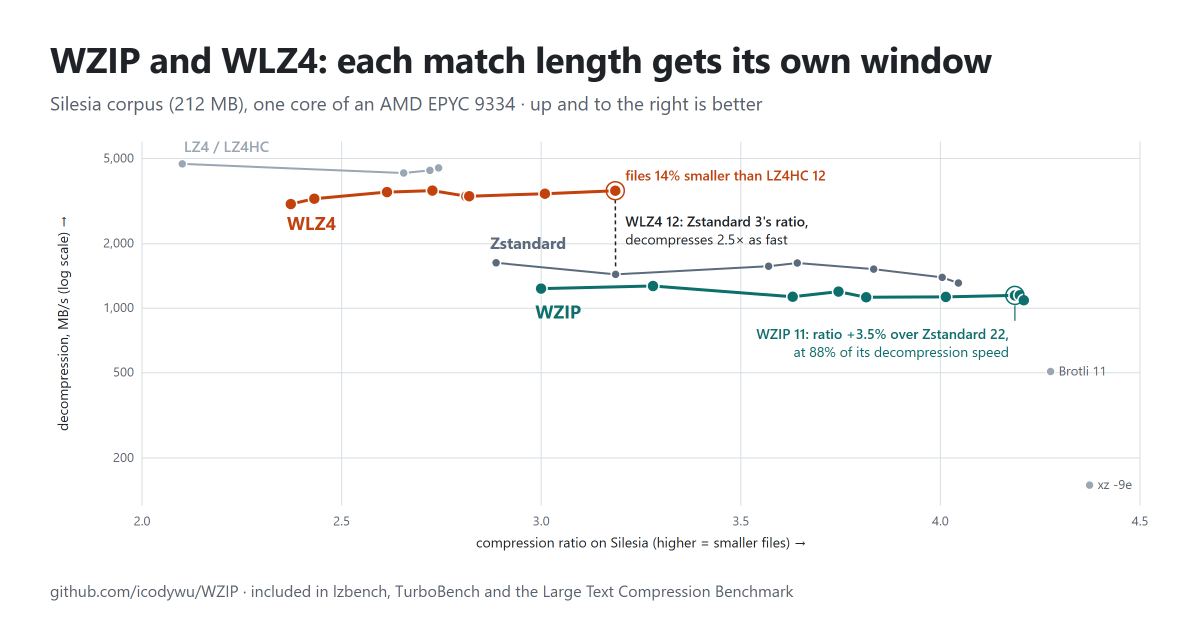
• WLZ4 (LZ4 class): files 14% smaller than LZ4HC at its highest level, at 78% of its decompression speed. It reaches Zstandard level 3's ratio while decompressing 2.5× faster, but compresses far more slowly: it's built for compress-once, read-many data.
• WZIP (Zstandard class): on the Silesia corpus, a 3.5% better ratio than Zstandard at its maximum level (1.2% without WZIP's filters for executables and tables), at 88% of its decompression speed.
Beyond lzbench and TurboBench, Matt Mahoney's Large Text Compression Benchmark lists WZIP: no compressor ranked above it there decompresses faster.
Its theorical framework is submitted to IEEE Trans. Information Theory (arXiv 2610.06530). It proves that the windows keep LZ77's long-run optimality while cutting search time and memory. It also isolates why the length code matters: on purely random data, the original 1977 format's overhead stays on the order of log(B)/B whatever longest match it allows, where B is the window size in bits, while a match cap that grows with the window, plus a cheap code for lengths, brings it down to log(log B)/B.
Code, benchmarks and papers in the first reply ↓
Apologies for the delay on getting MoE 101's last episode out!
Originally I planned to cover inference arithmetics only, but we turned it into the MoE inference 101!
I know you enjoyed the MoE training perf modeling, this one is for inference. On both gpus and cerebras.
https://t.co/zrtN8DgA2n
🧵1/n
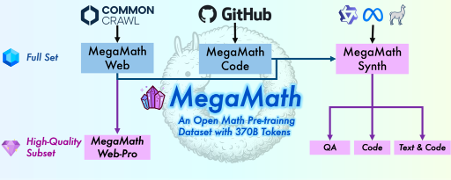
Proudly present MegaMath, the largest open-source math reasoning pretraining corpus—371B tokens of high-quality mathematical web, code, and synthetic data, designed to build the data foundation for next-generation math-proficient LLMs like o1 and R1. 🧵👇 #LLM#OpenSource #MegaMath #Math #Data4LLMs #Pretraining
Trending now on Hugging Face: https://t.co/MIotqUyeCV
My paper RelCon: Relative Contrastive Learning for a Motion Foundation Model for Wearable Data, from my @Apple internship, has been accepted at #ICLR2025! 🎉
We introduce the first IMU foundation model, unlocking generalization across motion tasks. 🏃♀️📊
https://t.co/BGVzFjSjxn
#ICLR2024 How can we choose meaningful positive pairs for time-series contrastive learning? What about motif similarity?
REBAR uses a learned measure that captures motif similarity and achieves SOTA performance.
Arxiv: https://t.co/hvYfgZD1wO
Github: https://t.co/e5oNccvzlz
@EhudReiter You can compare order statistics as long as it is the same order statistic across models/algorithms. So you can’t compare the max of one model to the min of another, but you can definitely compare two max values.
@ruben_menke@kchonyc It’s not even necessarily toxic. They might just not understand what constitutes coauthorship and their advisor didn’t tell them to add these people they talked to/whose data they used.
@kchonyc It’s not hard if you do interdisciplinary stuff. The student doesn’t know that the people whose dataset they are using who they consulted about the science should be authors too. Advisor doesn’t make sure they include them at submission time.
@hugo_larochelle@BeEngelhardt@NailaMurray This is pretty cool. You might want to talk to the organizers of ubicomp who have been doing something similar for a few years.
@cgf1a3 @kareem_carr There are versions of the central limit theorem that make weaker assumptions such as independence only (but not identically distributed). There is also a martingale version (a bit more complicated).
@InfoSymmetries @DellAnnaLuca@michael_wiebe Right. And you can only conclude that there is a significant difference between two groups, not that the difference is due to treatment.