Introducing BAM: The Block Assembly Marketplace that revolutionizes how Solana processes transactions.
Private. Transparent. Verifiable.
This is how Solana wins ⬇️
Today's a good day to remember why we're here.
We're building the future of finance—internet finance.
Unstoppable global free trade, not trade wars.
Credible neutrality, not entrenched interests.
Permissionless innovation, not bureaucracy.
Undebasable money, not money printers.
Sovereign individuals, not intermediaries.
A multi-decade vision, not 4-year cycles.
The internet, not imperial superpowers.
Positive-sum games, not rent-seeking.
Peaceful revolutions, not warmongers.
Cryptography, not aircraft carriers.
Network effects, not isolationism.
Fairness by design, not cronyism.
Open competition, not oligopoly.
Network states, not nationalism.
Frictionless markets, not tariffs.
Innovators, not lobbyists.
Builders, not lawyers.
Devs, not politicians.
Internet finance is coming. It's built different. Believe in something.
@AndreasSteno people should look at U-6 unemployment rate instead..the rate we usually see on media is oversimplified and they don't take underemployed part-time workers and discouraged job seekers into account
Despite all the negative sentiments on Ethereum, there is actually no other chain that come close in terms of
- Decentralization & resiliency
- Programmability (so excludes BTC until OP_CAT)
- Deep liquidity and Lindy effect
- Widely-accepted standards
Yes, Ethereum lost the memecoin battle to Solana. But that's now basically irrelevant for the upcoming battles.
To win the long war, Ethereum needs to position to win the next wave of big opportunities, which (IMO) are (1) stablecoins/RWA (2) DePIN (or what I call participant-owned platform businesses) and (3) private interoperable chains for institutions.
To do that Ethereum needs to
- Incentivize asset issuance back to the L1 and continue to scale it
- Aggressively push for universal interop standards for L2s
Pectra is going live 🥳
Holesky will fork at slot 3710976 (Mon, Feb 24 at 21:55:12 UTC)
Sepolia will fork at slot 7118848 (Wed, Mar 5 at 07:29:36 UTC)
Assuming Sepolia goes smoothly, we'll pick the mainnet slot on the March 6 ACD call 📅
Upgrade #1: Censorship Resistance
Currently, block production is extremely centralized.
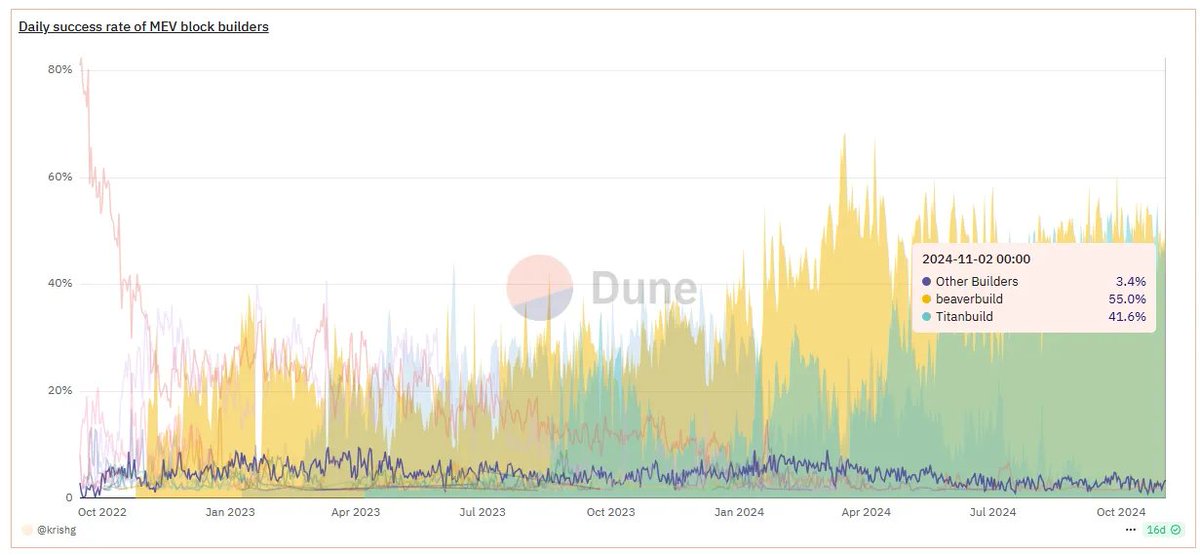
Two block builders; Beaver Build and Titan Build, build almost every single Ethereum block:
These builders create blocks in such a way that they maximize their profit in the form of MEV; by arbitrarily including, excluding, or re-ordering transactions within the blocks they produce.
Today, if your transaction is not beneficial for these 2 block builders to include, they may choose to exclude your transaction from blocks, effectively censoring your transaction.
This upgrade, proposed in EIP-7805, increases Ethereum’s censorship resistance by allowing validators to select transactions from the mempool and enforce their inclusion through Inclusion Lists (ILs), which builders must respect to have their blocks accepted by the network.
In the Beam Chain upgrade, 16 validators in every slot will build a list of transactions that MUST be included by block builders, meaning block builders can no longer censor transactions.
1/ Based on feedback from across the Ethereum community, we drafted a short, less technical document on Commit-Boost. Post and thread below!
https://t.co/zZv5BoidC8
Bangkok Devcon coming in a few days! Meanwhile today we assisted to @VitalikButerin keynote full 20min about the future of #ETH Staking.
The final goal is to keep Staking as much as decentralised possible.
1. Reducing staking fee from 32 ETH to ideally 1ETH
2. Reducing Node Operator cost. Cost and technical difficulties are an obstacle.
Goal is to have small devices that will be able to partecipate in a fast way using Snarks to verify blocks.
Amazing event organised by @StakingRewards
Feel free to watch all the video, very insightful!
#ethereum #eth #vitalik #staking #restaking #lido #blockchain #crypto #web3 #symbiotec #coinbase
Actively Validated Services are the most exciting part of the @eigencloud ecosystem & the unique value EigenLayer brings.
This post is an overview of the EigenLayer AVS landscape. With an introduction to what an AVS even is & what people are building 🏗️
https://t.co/jVLBS168HZ
Idea Propagation in Crypto: A Case Study on MEV
-------------
Thesis -> Antithesis -> Synthesis
Auctions -> FIFO -> CR + Auction -> Proposer commitments
-------------
Problem: How to order transactions in a block?
--- Afaik Flashboys 2.0: first detailed description of problem scope by @phildaian (phd work with @AriJuels): https://t.co/lmnlVFhet3
-------------
Thesis:
Idea: Auction the block.
Protocol: Validators sell the block to the highest bidder
Manifestation: MEV-geth, MEV-boost
@phildaian key proponent
-------------
Antithesis:
Idea: Order transactions based on whichever transaction is received by a majority of validators earlier (FIFO = first in first out).
Protocol: Validators each submit their local ordering of the blocks, and the final ordering aggregates all the local ordering.
Manifestation: Theory - Aequitas (https://t.co/U9ppq1pGAi), Practical Protocol: Themis (https://t.co/riEWQKGPoH)
@_mahimna was key author of these two papers. He was a student of @AriJuels as well :)
@soubhik_deb and I collaborated with @_mahimna and @AriJuels on Themis.
---------------
I was on the FIFO side and we used to have some heated discussions across the two groups (the auction gropu was the dominant one) :)
Here is a fun story. At the stanford conference Sep 2022, there was a panel with @drakefjustin@VitalikButerin@fradamt@phildaian and @zmanian
Someone asked "why does fifo make sense" and @VitalikButerin answered, tongue in cheek, "thats like asking a panel of vegans why factory farming makes sense" conveying the Auction-centric nature of this group :)
https://t.co/5g97UNWMri
---------------
Synthesis:
- Idea: Censorship Resistant "Pre-Block", Auction to find the best ordering.
- Protocol: Include all transactions sent to a majority of users (using Themis-like protocol). Order them via auctions.
- Benefits: Prevents some types of toxic MEV (excluding liquidations via bribing etc), while still capturing CEX-DEX arbitrage MEV etc.
Most vocal proponent: @maxresnick :)
He even made a T-shirt called "End the proposer monopoly"
Manifestation: Multiple-proposer based ordering is being proposed in @ethereum , @solana, and now pretty much everywhere else.
---------------
It is exciting to see these ideas converge!
---------------
My vote for the best protocol for high-throughput censorship resistance is a paper by my former student Bowen Xue (who is a contributor to @eigencloud) created called BigDipper. It is a clearly highly biased vote.
https://t.co/GbQJQBz3EH
---------------
If anyone is interested in experimenting with consensus protocols rapidly on @eigencloud, please DM me.
---------------
Super Synthesis:
---------------
Beyond CR+Auction, there are many more complex methods for proposer commitments.
---------------
Beginning from our work on MEV-Boost++ (https://t.co/x0XbwUKAgn)
to our work on multi-commitment systems (https://t.co/7isLitg7EH)
Now there is a thread of work led by @barnabemonnot at EF, called PEPC (protocol-enforced proposer commitments).
---------------
Many of these commitments can be built out of protocol on @eigencloud. Since EigenLayer uniquely supports native restaking, it allows all validators to equally receive rewards on such MEV enhancements, satisfying @ethereum non-centralization considerations. A new @eigencloud upgrade (https://t.co/6yyeLGObnQ) made native restaking even more affordable!
---------------
With new technologies coming up like @Commit_Boost for adding arbitrary new sidecars, there is a lot of scope for experimenting and building new MEV management techniques both for the L1 as well as for L2s. If you are interested in building MEV management on @ethereum and want to explore @eigencloud please DM me.
NYC Sessions EP. 4: Is AggLayer The Solution To The Modular Fragmentation Problem?
In the 4th episode of our NYC chain abstraction focused content marathon, @andyyy & @0xask sat down with @davidesilverman of @0xPolygon to discuss the evolution of Polygon's product line and the ever-growing importance of interoperability solutions such as the AggLayer.
AggLayer offers a shared bridge model that enables smooth cross-chain communication while supporting multiple rollup stacks and consensus mechanisms via "pessimistic proofs" which have been in development for some time.
But, is this the solution the Ethereum ecosystem looking for?
Is AggLayer competitive or collaborative with Superchain?
When will we expect to see AggLayer in prod?
These, and many more, answered in the full interview with David Silverman. Watch or listen to today's spicy, yet insightful interview detailing where AggLayer fits in the modular thesis:
02:20 Is David a crypto OG?
03:43 Polygon's Evolution and the AggLayer
14:36 AggLayer Can't Rug You
18:31 What Users Really Want
23:44 Understanding the AggLayer's Security Guarantees
30:51 The Business Model of AggLayer
37:34 Road To Mainnet
1/ With LRTs continuing to garner significant adoption, a framework for evaluating risks is paramount for users to understand the market risk landscape for each token.
Today, we published a blog on LRT market risk as part of our partnership with @eigencloud.
Let's dive in👇🧵
The liquid staking/liquid restaking war has now extended from protocols fighting for TVL to infra level with the debut of @Karak_Network as the universal restaking layer🧵
Few keynotes about the Ethereum ecosystem and the role of Karak, plus controversial discussions ongoing.
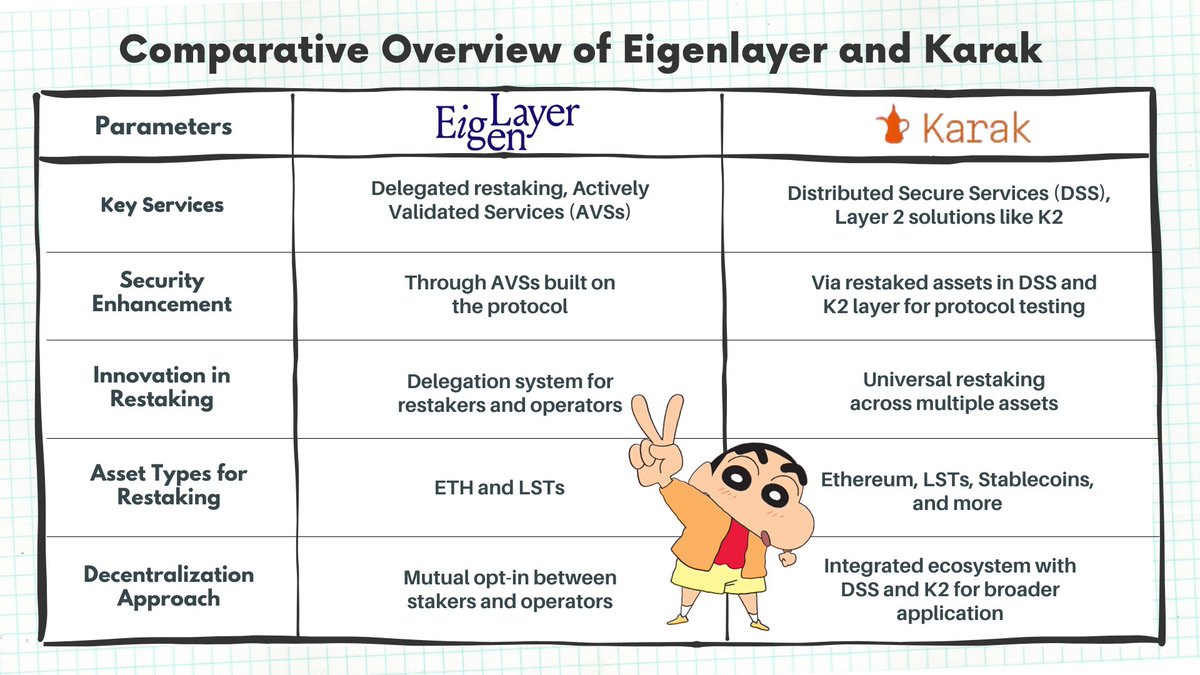
【 EigenLayer VS Karak 】
• Ethereum's role in L2 ecosystem is challenged by modular blockchains like @CelestiaOrg and @dymension to simplify L2 + app.
• @Karak_Network and @eigencloud both offer pioneering approaches to utilizing restaked assets for enhancing security across dApps, but they differ in their methodologies and capabilities.
• Karak's K2 layer serves as a "sandbox" for DSS development, testing, and launch, with an emphasis on decentralizing services. Eigenlayer's approach is rooted in a mutual opt-in system between stakers and operators for a secure delegation process.
• Check out ShinChan's summary table in this tweet for the fundamental differences. If you ask me,
Karak delivers a more versatile solution supporting asset types + holistic security services. In contrast, Eigenlayer presents a targeted, Ethereum-specific approach with a security services marketplace.
【 Metrics on Karak + PR Crisis? 】
TVL surged to $100M within 24 hours since invite-only soft launch. It's not impressive tbh when compared to the hype with EigenLayer + given its $48M Series A at $1B+.
Focus of Karak atm seems not on its infra/tech side but the team background + cap table. @cryptoian + @RayRaspberry1 talked about the controversy publicly.
But if you are gonna stake for airdrop farming, ShinChan's pick is @swellnetworkio $swETH and/or $rswETH for 3x SWELL multiplier. One good thing is that withdrawal for $swETH is now available. Peg for 10K is kept at 99.4% which is okay. One more thing is SWELL TGE is happening this month. So the conversion efficiency would be imminent.
Curious about the differences between a liquid restaking token (LRT) and a liquid staking token (LST)?
@liquid_col breaks down staking, liquid staking, restaking, and liquid restaking, showing how all types of staking can interact within a diverse crypto ecosystem.
Read more: https://t.co/nBuJs2mlv2