@YusufPlug_@arc The $1.71B represents stablecoins held on Arc, not money already spent or deployed.
Most of it is USDC, which can be used for lending, trading, liquidity provision, payments, cross chain transfers and settlement.
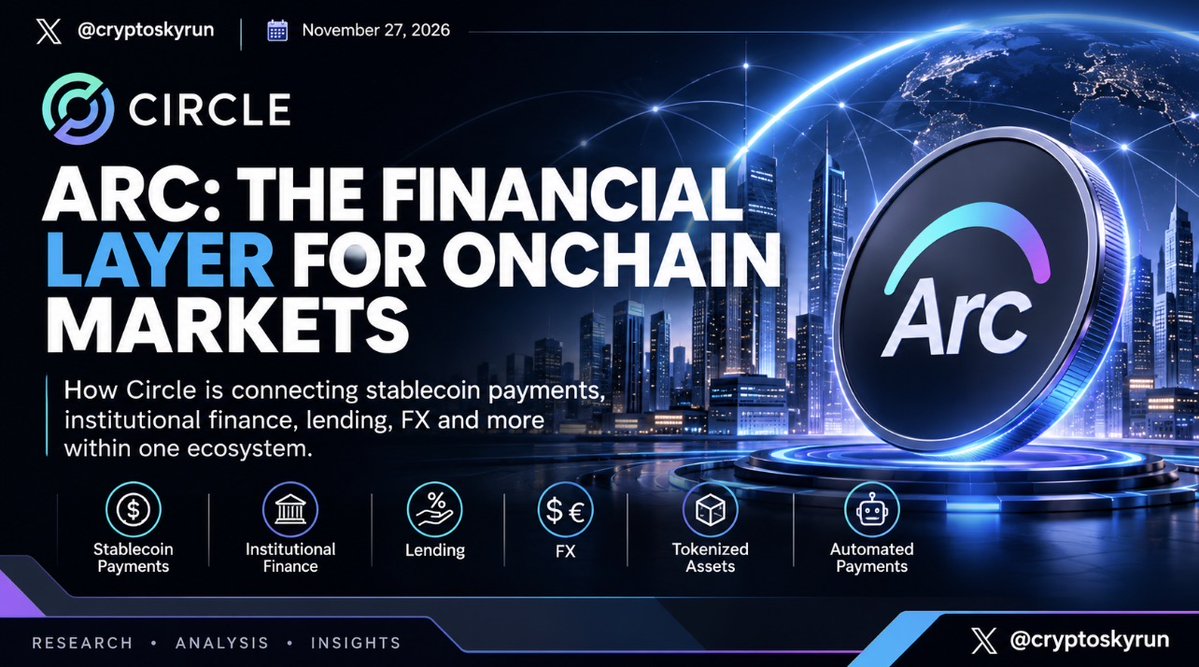
Circle is building more than another Layer 1.
Its new network, @arc, is designed to connect stablecoin payments, institutional finance, lending, foreign exchange, tokenized assets and automated payments within one financial ecosystem and the early numbers are worth examining.
As of Today:
❖ $1.71B in stablecoin supply.
❖ $591M in DeFi TVL.
❖ $470.76M in lending TVL.
There is also an interesting contrast: stablecoin capital has continued flowing into Arc even as its adjusted daily user activity declined significantly after launch.
To me, this suggests Arc may be developing primarily as financial infrastructure rather than another retail focused blockchain.
The opportunity is understanding which projects will provide the services around that infrastructure.
—
● What Circle is actually building
@circle launched Arc mainnet on September 16, 2026.
Three features stand out:
➟ USDC as gas: Projects can pay transaction fees using the same dollar denominated asset they already manage.
➟ Sub-second deterministic finality: Useful for payments, trading, lending and financial settlement.
➟ Institutional infrastructure: Arc combines EVM compatibility with a permissioned validator model designed around institutional participation.
Its founding validator cohort includes @BlackRock, @Visa, @MoneyGram@Mastercard, @The_DTCC, @galaxyhq, @StanChart, Global Payments, ICE, SBI Group, and Sumitomo Corporation.
Circle is also connecting Arc to its existing financial infrastructure:
❖ CCTP for native USDC transfers across supported chains.
❖ Gateway for unified crosschain USDC balances.
❖ StableFX for institutional currency exchange.
❖ Circle Payments Network for cross border settlement.
❖ Agent Stack for programmable wallets and automated payments.
The important shift is that Circle is connecting issuance, liquidity, execution and settlement rather than simply issuing another stablecoin.
—
● Follow the stablecoin flows
Arc’s stablecoin supply reached approximately $1.71B on November 27, according to @DefiLlama.
USDC represents approximately 99.18% of that supply.
CastleLabs reported that Arc added approximately $729M in stablecoin supply over 30 days through November 26.
Bitquery’s investigation also identified approximately $2.38B in incoming CCTP transfers between October 15 and November 17, against approximately $411M in outgoing transfers.
That’s roughly $1.97B in net CCTP inflows.
This is important because it shows that crosschain capital movement is a major part of Arc’s early growth.
But deposits alone don’t establish economic adoption. The next question is what happens to that capital after it arrives.
Bitquery also found that the 25 largest addresses held approximately 86% of Arc’s USDC, highlighting the concentration of early capital.
—
● Lending is already creating business opportunities
Two important lending protocols are operating on Arc:
❖ @aave: Established lending infrastructure with an Aave V4 market on Arc.
❖ @Morpho: Modular lending markets with configurable collateral and risk parameters.
Beyond the lending protocols, look at who manages the capital.
Morpho’s vault showed:
❖ @galaxyhq: $105.2M.
❖ @keyrock: $75.32M.
❖ @SteakhouseFi: $5.26M.
These are deposits in tracked vaults, not protocol revenue.
NOTE: Lending protocols provide the markets, while curators help determine how capital gets allocated and what risks lenders accept.
Other important participants include @gauntlet_xyz for risk management.
This is an overlooked part of institutional DeFi: capital allocation and risk management can become businesses in their own right.
—
● The ecosystem is much bigger than Circle
I’d pay attention to five infrastructure categories.
Trading and liquidity
❖ @Uniswap: Decentralized trading and liquidity.
❖ @aeroxyz : DEX and liquidity infrastructure.
❖ @extendedapp : Perpetual futures markets.
❖ @Yellow: Non-custodial clearing infrastructure and settlement.
Tokenization and credit
❖ @Securitize : Institutional asset tokenization.
❖ @centrifuge : Tokenized real-world credit.
❖ @maplefinance : Institutional lending and private credit.
❖ @DinariGlobal : Tokenized securities infrastructure.
Stablecoins and FX
❖ @AllUnityStable : Euro and other local-currency stablecoin infrastructure.
❖ @BDACSKorea : Korean won stablecoin KRW1.
❖ @jpyc_official : Japanese yen stablecoin infrastructure.
Oracles and blockchain infrastructure
❖ @chainlink : Data feeds and oracle infrastructure.
❖ @ChronicleLabs : Onchain pricing and data verification.
❖ @Quicknode : Blockchain connectivity and infrastructure.
❖ @BlockdaemonHQ : Institutional node and validator services.
Custody and distribution
❖ @FireblocksHQ : Institutional wallets and transaction infrastructure.
❖ @BitGo : Digital asset custody.
These projects have different relationships with Arc. Some have confirmed integrations, others are named ecosystem participants, and some represent complementary infrastructure worth researching. Being on an ecosystem roster does not automatically mean a product is live on mainnet.
—
● The FX opportunity deserves more attention
One of Arc’s most interesting products is StableFX.
It went live on September 22 and is designed for institutional foreign exchange trading and settlement.
It supports request-for-quote execution and atomic payment-versus-payment settlement.
In practical terms, two institutions exchanging currencies can settle both sides of the transaction together, reducing the risk of one party delivering funds without receiving the other currency.
For context, the @BIS_org reported that global FX turnover averaged $9.6T daily in April 2025.
Arc does not need to capture a meaningful portion of that entire market to create a valuable business.
It needs to make specific currency conversion and settlement workflows more efficient.
Local currency stablecoin issuers will be important here, particularly as markets expand beyond USD and EUR.
—
● Another emerging market: AI agent payments
Circle is also building infrastructure for autonomous agents.
Its Agent Stack combines programmable wallets, spending controls, service discovery and USDC payments.
The idea is straightforward: an AI agent should be able to purchase data, access APIs, pay for computing resources and transact with other agents without requiring manual approval for every payment.
Agent Stack is chain-agnostic and supports multiple networks, including Arc. The x402 payment standard is one of the mechanisms supporting this model.
I would watch @Yellow here too. Its clearing infrastructure could become relevant if autonomous agents need to execute frequent transactions across connected markets.
However, transaction counts should not be confused with meaningful economic activity. The agent economy is still developing.
—
● What could the market be overlooking?
Three areas stand out.
Capital allocation: @Morpho, @keyrock , @SteakhouseFi and @Gauntlet_xyz are involved in determining how capital enters lending markets and how risk is managed.
FX and local currency liquidity: StableFX needs market makers, reliable pricing and local payment partners. These are essential services, not optional additions.
Settlement infrastructure: @Yellow, @chainlink and crosschain infrastructure providers could benefit from applications requiring faster, more reliable financial transactions.
These projects don’t necessarily need to issue a new token to become important infrastructure providers.
—
● The risks are worth watching
Arc’s growth comes with several limitations.
❖ Bitquery identified substantial wallet and capital concentration, with the 25 largest addresses holding approximately 86% of Arc’s USDC.
❖ Early DEX activity was heavily influenced by bots and a single large wallet.
❖ Arc currently operates with a permissioned validator set.
❖ Institutional partnerships do not automatically translate into production usage.
❖ Tokenized assets and lending markets still need sufficient liquidity, reliable pricing and appropriate regulatory structures.
Circle has also confirmed that 10 billion ARC tokens were minted at genesis, but explicitly clarified that this does not constitute a commitment to a public token launch.
USDC remains the gas asset.
My take:
Circle is moving beyond stablecoin issuance and building an interconnected financial infrastructure stack.
Arc brings together USDC, lending, FX, tokenized assets, payments and programmable transactions.
The early capital flows are encouraging, but sustained borrowing, genuine trading activity, payment volume, institutional settlement and recurring revenue will tell us much more about adoption.
I’d pay particular attention to the projects managing liquidity, providing risk infrastructure, connecting local currencies and enabling settlement.
They could become some of the most important participants in this emerging financial system.
NFA. DYOR.