There's a shocking fact about AI that nobody tells you: You can catch up to the public AI research frontier in just 2 weeks. Yes, really.
I've built a $150M annual revenue startup over the last 8 years and If I were to start a company today, I’d drop everything and go all-in on AI.
But like many busy software builders, I felt lost—overwhelmed by the noisy, crowded and fast-moving modern AI landscape. And I wasn’t alone.
So I spent my entire holiday diving deep into AI research—reading 30+ papers, watching hours of lectures, analyzing trends, and catching up to the research frontier.
✨ Here’s what I learned:
- You don’t need months (or years) to catch up.
- You don’t need a PhD or decades of ML experience.
- You need fewer than 20 papers and 2 weeks to understand the major breakthroughs shaping AI today.
It's because the technology is extremely nascent and most techniques that came before are no longer relevant:
- ChatGPT is barely 2 years old and Transformers are only 7 years old.
- Most game-changing discoveries happened within the last 4 years, driven by a few breakthrough ideas, scaling laws, and efficient matrix multiplication.
The biggest secret?
Many groundbreaking AI papers with thousands of citations are surprisingly simple and applied, like adding "let's think step by step" to the prompt, or simply asking the LLM over and over again to improve its answer (Self-Refine).
I realized there are tons of founders and builders in the same boat—wanting to dive deeper into AI but unsure where to start.
I've created an essential AI Guide that helped me catch up, in just 2 weeks, to the frontier of public AI research to figure out where the next opportunities and gaps were:
- Curated list of only the most important papers
- Simple explanations of key concepts
- Clear pathway to understanding the frontier of modern AI
It’s perfect for:
- Founders expanding into AI
- Builders wanting to innovate at the frontier of AI
- Investors looking to separate the signal from the noise
👇 Want the full guide?
- Like and Share this post
- Comment "AI Guide"
- I'll send you the complete guide
(ps, I’m also teaming up with @VishalVasishth, co-founder of @obviousvc with @ev (focused on large-scale societal impact companies like Twitter, Medium, Beyond Meat), to host a small meetup to discuss what's working and needs to be solved in the AI stack in SF. Message me if you're interested)
the outpouring of support across the internet has meant the world to us, and has made our life so much warmer for our family, right when we needed it most.
yi and i are deeply grateful to all of you.
merry christmas from all of us at the chen family.
https://t.co/z8DcECGXGS
It is worth noting that this is an increasingly common message from insiders at the big AI labs.
It isn't unanimous, and you absolutely don't have to believe them, but I hear the same confidence privately as they are broadcasting publicly.
(Still not sure how you plan for this)
🚨BREAKING: The @Stanford Institute for Human-Centered AI publishes its Artificial Intelligence Index Report 2024, one of the most authoritative sources for data and insights on AI. Below are its top 10 takeaways:
1. AI beats humans on some tasks, but not on all;
2. Industry continues to dominate frontier AI research;
3. Frontier models get way more expensive;
4. The United States leads China, the EU, and the U.K. as the leading source of top AI models;
5. Robust and standardized evaluations for LLM responsibility are seriously lacking;
6. Generative AI investment skyrockets;
7. The data is in: AI makes workers more productive and leads to higher quality work;
8. Scientific progress accelerates even further, thanks to AI;
9. The number of AI regulations in the United States sharply increases;
10. People across the globe are more cognizant of AI’s potential impact—and more nervous.
➡️Read the @StanfordHAI report below.
➡️For more information on AI policy & regulation, subscribe to my newsletter (link in bio).
"After 34 Years, Someone Finally Beat Tetris"
Wow, incredible video on what it took to beat Tetris, waaay beyond the game's original design.
Also a great reference for reinforcement learning and what superintelligence might look like.
https://t.co/sNDzNlrTNV
The universe has been extraordinarily kind to us!
- we haven’t met any evil aliens yet! 👽
- it appears to follow some predictable laws of physics
- this planet seems to be insanely special
- our species is the pinnacle of 14B years of evolution
- we get to invent an intelligence like us
I mean how lucky are we to be present at this point in the space-time continuum! Let’s hope this luck doesn’t run out!! 😅
Clearing out my bookmarks folder for next year, so much amazing work in there I almost forgot about
Follow if this sounds fun, I'll post them as I go through
# On the "hallucination problem"
I always struggle a bit with I'm asked about the "hallucination problem" in LLMs. Because, in some sense, hallucination is all LLMs do. They are dream machines.
We direct their dreams with prompts. The prompts start the dream, and based on the LLM's hazy recollection of its training documents, most of the time the result goes someplace useful.
It's only when the dreams go into deemed factually incorrect territory that we label it a "hallucination". It looks like a bug, but it's just the LLM doing what it always does.
At the other end of the extreme consider a search engine. It takes the prompt and just returns one of the most similar "training documents" it has in its database, verbatim. You could say that this search engine has a "creativity problem" - it will never respond with something new. An LLM is 100% dreaming and has the hallucination problem. A search engine is 0% dreaming and has the creativity problem.
All that said, I realize that what people *actually* mean is they don't want an LLM Assistant (a product like ChatGPT etc.) to hallucinate. An LLM Assistant is a lot more complex system than just the LLM itself, even if one is at the heart of it. There are many ways to mitigate hallcuinations in these systems - using Retrieval Augmented Generation (RAG) to more strongly anchor the dreams in real data through in-context learning is maybe the most common one. Disagreements between multiple samples, reflection, verification chains. Decoding uncertainty from activations. Tool use. All an active and very interesting areas of research.
TLDR I know I'm being super pedantic but the LLM has no "hallucination problem". Hallucination is not a bug, it is LLM's greatest feature. The LLM Assistant has a hallucination problem, and we should fix it.
</rant> Okay I feel much better now :)
For those who want to learn Deep Learning:
"Introduction to Deep Learning" is a new FREE course just released by MIT. You can stream it directly from YouTube:
https://t.co/u5o8MJv4i9
Great opportunity!
Here is a curated list of deep learning resources for computer vision:
• Courses
• Books
• Videos
• Tools
• Papers
• Tutorials
• Blogs
https://t.co/Y8m5UGjq4P
Yay!!! Google is finally in the arena.
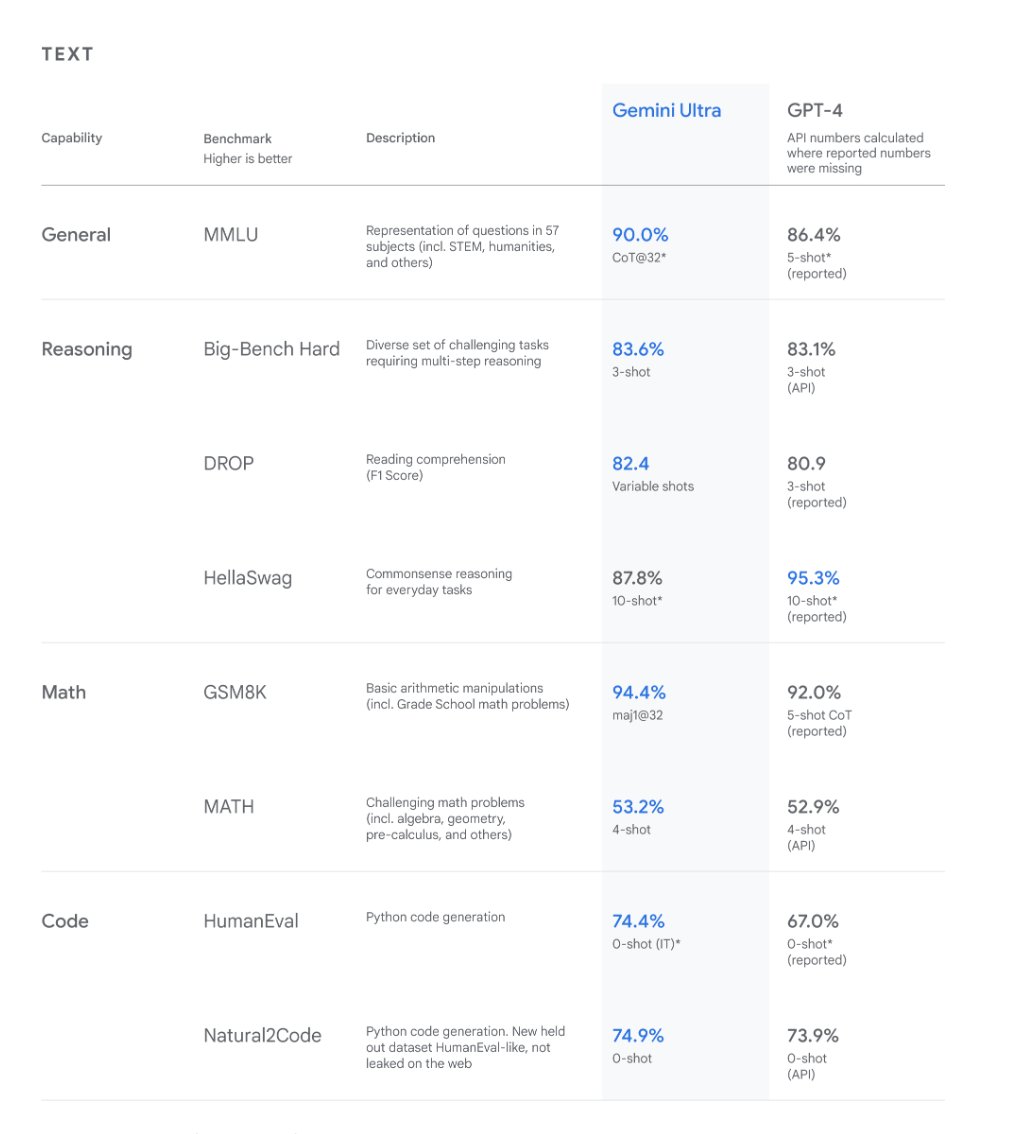
They just announced Gemini, and it has some impressive benchmark scores 👏👏
Gemini beats GPT4 in several benchmarks except HellaSwag. Interestingly, top open-source models score around 87-88 on HellaSwag. The 4-pt MMLU beat is significant!!
All in all, this is a GPT-4 class model!
Now, please, Google, can we get an API end-point? Finally, we have a model that can dethrone the king - GPT-4
Looks like the heads of a few asset managers (errr, I mean universities) looked the other way when asked about genocide.
Expect the boards of these asset managers (errr, I mean universities) to feel a lot of pressure to act and fire them.
ChatLLM - Building Enterprise Scale RAG Applications
The most common use of LLMs in the enterprise world has been Retrieval-Augmented Generation applications built on custom knowledgebase.
These applications look deceptively simple and are easy to prototype, but they can be painful to push to production.
The key challenges include
- Parsing complex docs and PDFs (most open-source libraries don't do a great job)
- Data pipelines: the LLM app should have access to any updates in the data
- Custom front-ends: Ideally, you need a custom front-end on top of your LLM app and/or access the LLM app from your Slack or Team channel
- Complex orchestration: You want to able to handle complex prompts and co-ordinate between different doc retrievers and/or vector stores
- SQL and Code Execution: Depending on the complexity of your LLM application, you may need to execute code or SQL
- LLM choice: Depending on your use case, you may want to use a cheaper open-source LLM or a closed-source API. It's ideal to be able to choose the right LLM for the proper use case
- Ease of iteration: Just like with any other ML app, you need a way to measure accuracy and iterate on the app. If you don't repeat and evaluate the app, the chances of it not being used are very high.
LLM apps, just like any software, need monitoring, testing, and maintenance.
Abacus AI has now put dozens of LLMs in production and handles all these challenges well. Using our ChatLLM you can build all these complex apps in hours or days.
Of course, you can also try and build or pull together all these components yourselves, but then you won't have time to focus on the fun part of creating these apps - experimenting with different LLMs, evaluating complex questions, and really understanding the language of AI 😉