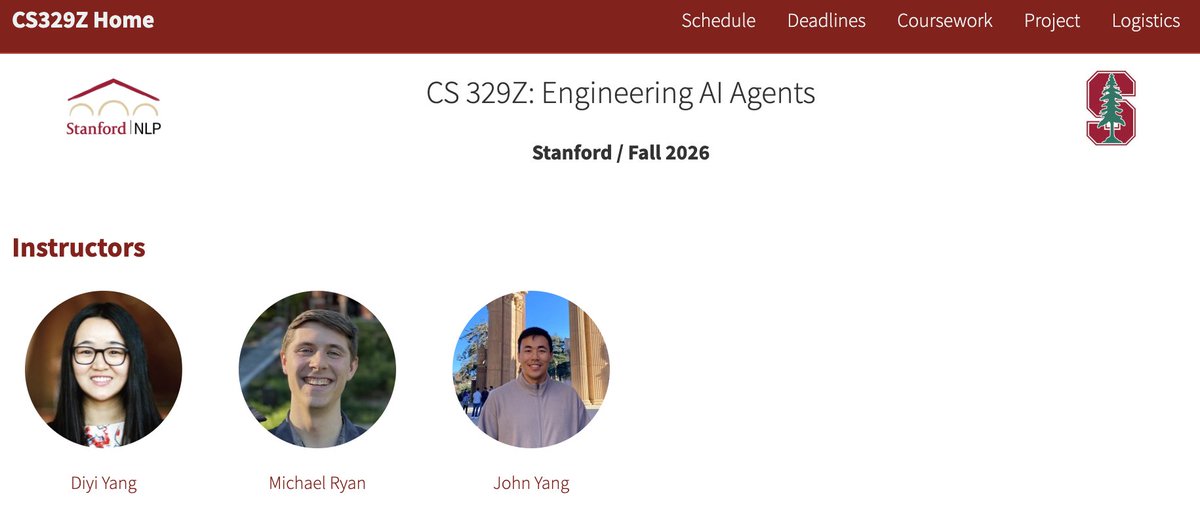
This fall @michaelryan207@jyangballin and I are teaching a new course CS329Z "Engineering AI Agents" on how to build AI Agents from scratch. Come join us and learn how to build them 🤖
Meet Apodex 1.1: Scaling Agentic Intelligence for Complex Work
Open Source Harness: https://t.co/4V9suLx8o5
Open Weights: https://t.co/9CNZ9E5drH
We’re excited to introduce Apodex 1.1, our new model family built to scale agentic intelligence for professional work.
🧠 Frontier-level intelligence for complex work
Apodex 1.1 brings frontier-level agentic performance across complex professional work, scientific research, financial analysis, and deep search.
🤝 Asynchronous Agent Team
Apodex 1.1 can break down complex tasks, coordinate multiple agents in parallel, continuously integrate their findings, and let you step in to guide or redirect the work at any time.
🔬 Open-source research workbench
We’re open-sourcing FrontierAgent—a locally deployable research workbench for the Apodex 1.1 family, including asynchronous Agent Team.
Available now:
🔹 Apodex 1.1 — our most capable frontier model, available through the Apodex online workbench
🔹 Apodex 1.1 mini — open-weight model for running complex work locally
🔹 FrontierAgent — open-source, locally deployable research workbench
🌐 Live workbench: https://t.co/w5l6YI2ZuP
🦾 API platform: https://t.co/kaxuSWvMB4
📃 Paper: https://t.co/CHc4L63U07
Scaling self-verification with DeepSeek V4 Flash beats Claude Fable 5 on Terminal-Bench 2.1, while being 11x cheaper 💰
As open-source models become more capable, they can now generate large numbers of high-quality candidate solutions and verify their own outputs at very low cost.
For example, we find that sampling just 5 solutions with DeepSeek V4 Flash and ranking them using the same model with LLM-as-a-Verifier can lead to a significant boost in accuracy (79% → 88%), outperforming closed frontier models on Terminal-Bench.
Try it out today: https://t.co/UhudjKDaYI
More on verification scaling in my previous post.
AI can now generate code much faster than we can understand it.
I think that changes the bottleneck in software engineering.
The problem is no longer:
“How do we write code faster?”
It is increasingly:
“How do we build an accurate mental model of a codebase — and verify that AI-generated changes are actually correct?”
So I built an open-source agent skill called investigate-codebase.
Instead of asking a coding agent to “explain this repo” and getting a confident directory tour, the skill pushes the agent to build the smallest evidence-backed, falsifiable model needed to answer a concrete question.
It supports four investigation modes:
🔍 ORIENT — understand a large or unfamiliar codebase
Trace the important components and produce a focused reading route instead of summarizing every directory.
🧵 TRACE — understand how something actually works
Follow a request, control flow, data flow, state transition, or bug through a thin vertical slice of the system.
💥 IMPACT — understand what a change really changes
Analyze a PR, commit, branch, or diff for behavioral delta, affected contracts, invariants, and blast radius.
✅ VERIFY — check whether generated or changed code is actually correct
Go beyond “tests are green” by looking for independent correctness oracles, boundary cases, invariants, differential checks, runtime evidence, etc.
One principle I care about a lot:
evidence ≠ confidence.
Every important claim is classified as:
SOURCE / RUNTIME / INFERRED / UNKNOWN / CONTRADICTED
So a statically inferred call graph cannot quietly become “this is what happens at runtime,” and an unavailable verification step becomes UNKNOWN rather than a confident guess.
The skill is also deliberately read-only by default.
My broader motivation is that as agents produce larger amounts of code, human understanding and verification throughput may become one of the most important constraints in software engineering.
We need agents that don't just generate more code.
We also need agents that help us compress a codebase into a mental model we can inspect, challenge, and trust.
The skill works with Claude Code, OpenAI Codex, and other hosts that support the skill format.
Open source here:
https://t.co/Cvo2F8ik9v
Would love feedback — especially from people working with large codebases or reviewing a lot of AI-generated code.
#AI #SoftwareEngineering #CodingAgents #LLM #DeveloperTools #OpenSource
Don’t know where to start with Local AI?
Read my Local LLMs From Zero to Hero series
It covers:
- Hardware
- Software
- Models Mechanics
- Everything else necessary
Needs no prior experience
Easy to understand for any background
Local / Opensource AI FTW
Announcing Discovery Loop!
I am very excited to announce that, along with my longtime friends and collaborators @Sanjay_Ghemawat, @OriolVinyalsML and @quocleix, we are founding Discovery Loop (@DiscoLoopAI), a Public Benefit Corporation whose mission is to automate machine learning, science, and engineering to accelerate discoveries and progress. The four of us have worked together for 14 to 30 years, and have helped build some of the world’s most used products, infrastructure and AI models, and we’re excited to turn our attention to this ambitious endeavor.
♾
Learn more at: https://t.co/Rv3LMdLluK
“harness is the MOAT” absolutely true.
since late 2025, the step up in model capabilities has been diminishing with every release. the real difference is how the system interacting with the model is engineered. the harness decides how the system will turn out, not the model anymore.
the anatomy of a typical harness:
> isolated sandboxes
> file system
> file and coding tools
> state manager
> orchestration runtime
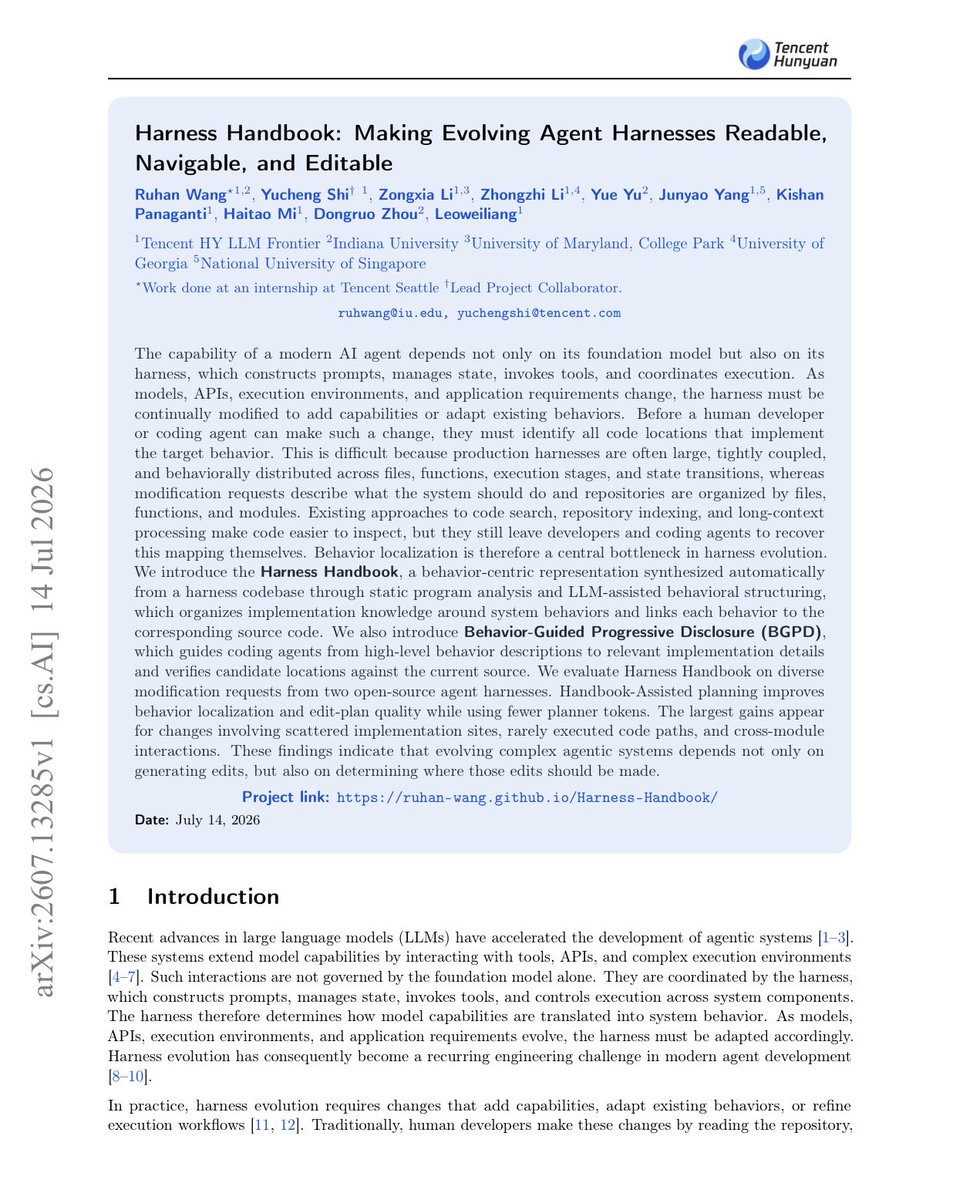
here’s a handbook that covers context engineering for harnesses
Matt Pocock 这个 60 秒视频,推荐了一本书,而且他认为在「战略编程」方面,毫无疑问排行第一。
Matt Pocock:#1 战略性编程书籍推荐
"AI 已经吃掉了日常编码和战术性编程。所以很多人问我:怎么学战略性编程?怎么学长期视角?怎么让你能提前看到代码库的问题,让 AI 在你的代码库里有效工作?
我的建议是回到这些老书。今天要说的是 The Pragmatic Programmer。
这本书是我永远推荐的一本。它可能是我读过布局最好的技术书。里面有太多关于'编程时如何战略性思考'的见解。我从中拿了很多东西直接塞进 system prompt 里,效果很好。比如可追溯性(traceability)、'不要超过你的车灯'(don't outrun your headlights)、巧合编程(programming by coincidence)——我们开发者用的很多术语,都源自这本书。
几个月前重读这本书让我确信:真正的软件基础仍然重要。 因为这本书里的每一条,都像是为 AI 时代写的。
So, The Pragmatic Programmer, David Thomas, Andrew Hunt. Get it."
视频:https://t.co/cFZ3z2ohsA
#AI时代 #工程文化 #战略性编程
I reviewed and reorganized notes from 99 AI Engineering talks into an open-source site.
The talks are grouped into 9 themes:
Agent evals and observability, agent architecture and reliability, context/memory/RAG, security and identity, data infrastructure, training and inference, AI coding, BI/semantic layers, and product strategy.
Each talk includes a short summary, full notes, and the original video.
One recurring lesson: production-grade agents are not mainly a “bigger model” problem.
The hard parts are usually:
— getting the right context
— defining data and semantics clearly
— making workflows observable and debuggable
— recovering or degrading gracefully
— enforcing identity and permission boundaries
— building trustworthy evals
Moving from PoC to production increasingly looks like a systems engineering problem.
The site supports English and Traditional Chinese, plus in-browser highlighting and saved notes.
Feedback and talk recommendations are welcome.
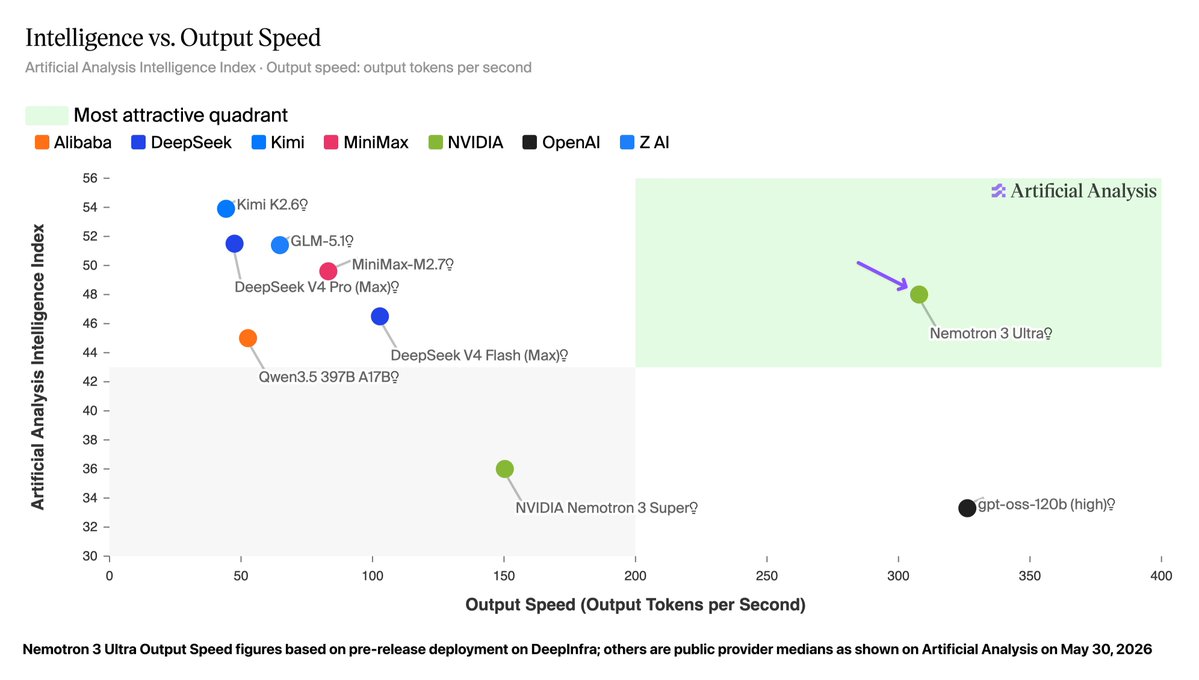
NVIDIA just announced the release of Nemotron 3 Ultra in Jensen Huang's Computex keynote: at 550B parameters (55B active), this is the largest Nemotron 3 model to date, and it is the most intelligent US open weights model
We partnered with @nvidia to evaluate this model for intelligence and speed - these figures use the model’s BF16 weights, but as with Nemotron 3 Super the model will be made available in NVFP4 quantization as well for higher inference performance.
➤ New leader for US open weights intelligence: Nemotron 3 Ultra scores 48 on the Artificial Analysis Intelligence Index. This is well ahead of the next strongest US open weights models, Gemma 4 31B (39), Nemotron 3 Super (36) and gpt-oss-120b (33), but behind the Chinese-led open weights frontier (Kimi K2.6 at 54).
➤ Leading speed for its intelligence: on a pre-release @DeepInfra endpoint, Nemotron 3 Ultra served over 300 tokens per second. Peer models in its size class from China-based labs such as DeepSeek and Moonshot (Kimi) are generally served at speeds of 50-100 tokens per second in the market today. gpt-oss-120b is served at speeds similar to this level, but with significantly lower intelligence.
➤ Largest Nemotron 3 model so far: at approximately 550 billion total parameters and 90% sparsity, Nemotron 3 Ultra is significantly larger than its siblings and is the largest recent US open weights model release
We’ll be sharing additional analysis and full benchmarks at release.
I’ve always had a deep passion for education.
From working as a tutor when I was a student, to designing learning materials and teaching high school students as part of an academic team in university camps, to now providing consulting services in the AI and data space — these experiences have repeatedly shown me how much I enjoy helping people understand complex ideas and grow through learning.
Today, I’m a software engineer, and I’m ready to bring that same passion for education into how we train and cultivate engineers.
I’m really excited about this.
I’m building something big: an education product for engineers that doesn’t exist in the market yet, designed entirely for the agent era.
Stay tuned. 😊