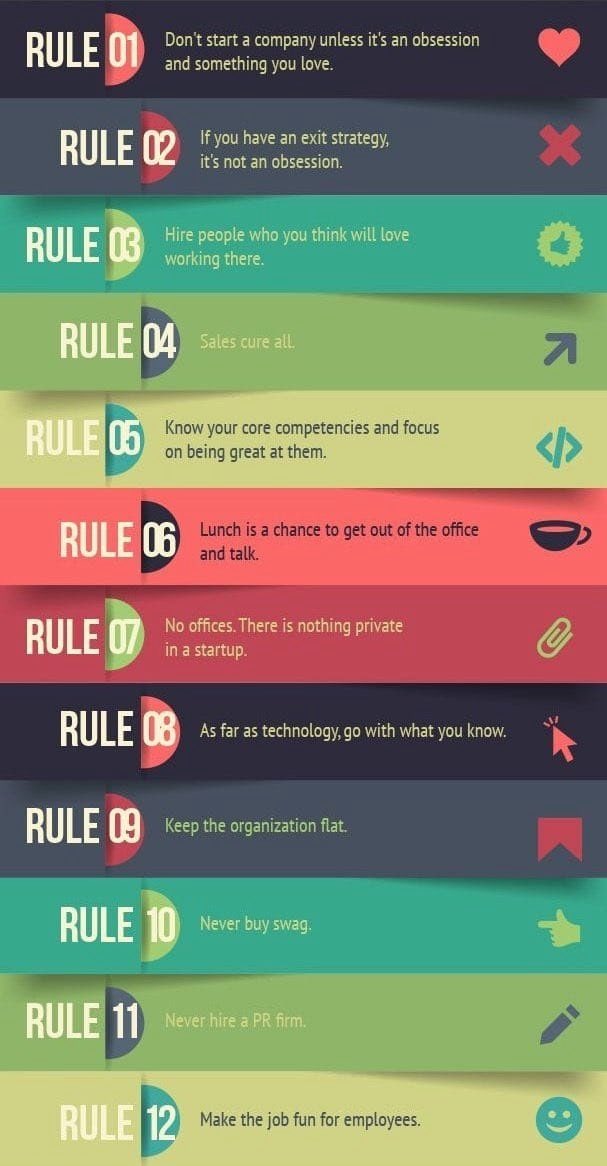
We went from 0 to 2,200 paying customers in under a year by following @ycombinator's 15 rules:
1/ Do things that don't scale. Get your first 10 customers by hand.
2/ Launch now, not when it's "ready". A mediocre product in front of real users teaches you more in a week than 6 months of polishing in the dark.
3/ Charge from day one. If nobody will pay, you don't have a startup, you have a hobby.
4/ Talk to users every single day. The roadmap you need is sitting in your customers' heads, and they'll hand it to you for free
5/ Always hunt the 90/10 solution. For almost any feature there's a way to capture 90% of the value with 10% of the effort.
6/ There are only two real jobs: write code and talk to users. Everything else (conferences, press, VC coffees, corp dev calls) is fake work.
7/ You pick your customers as much as they pick you. 10 users who love you beat 1,000 who kind of like you.
8/ Growth is an output, not a strategy. Grow before product market fit and all you're buying is churn.
9/ Do less, really well. Pick one or two metrics and judge every task against them.
10/ Know if you're default alive. Paul Graham's question: on current growth and current burn, do you reach profitability before the money runs out?
11/ Don't hire until it hurts. Headcount is not progress, it's burn. Every great startup was embarrassingly small for embarrassingly long.
12/ Momentum is the only real moat in year one. Ship something every week, even something tiny.
13/ Every great startup is badly broken at some point. The game isn't avoiding fires, it's how fast you put them out. Again. And again
14/ Ignore your competitors. Startups die of suicide, not murder. In year one, the only company that can kill yours is your own
15/ Startups rarely die from running out of money. They die because the founders fall out. Brutal honesty with your cofounder is the cheapest insurance you'll ever buy
Good luck !
Rick Rubin on the power of creating something truly for yourself
Elon Musk has said that Rick Rubin’s philosophy of creating something truly for yourself is how Tesla creates products.
Rick elaborates on this philosophy in the clip below:
“My only goal is to make something that I like, and I know that I can keep working on it until I like it. So in some ways there’s no pressure.”
Rick doesn’t consider the audience at all:
“The audience comes last… I’m not making it for them. I’m making it for me. And it turns out that when you make something truly for yourself, you’re doing the best thing you possibly can for the audience.”
He argues that this is why there are so many bad movies today:
“So many big movies are just not good. It’s because they’re are not being made by a person who cares about it. They’re being made by people who are trying to make something they think someone else will like. And that’s not how art works.”
Former Google CEO Eric Schmidt argues a similar point:
"If you think about the greatest products, they've almost always been designed for the benefit of the people who are actually building them.”
Uber started out as a private timeshare limousine service for Garrett Camp and his friends. Microsoft started when Bill Gates and Paul Allen wrote a Basic interpreter for the Altair so they didn’t have to write machine language to program it. Drew Houston built Dropbox to make his files live online after forgetting his USB stick. Larry Page and Sergey Brin built Google for Stanford—and particularly for themselves—with the first server in Larry’s dorm room.
Source: @LewisHowes (Nov 2023)
Kevin O'Leary: "The discipline is get $5 million and put it in T-bills and just look at it. Don't touch it because if poo poo hits the fan, you're still good"
talked to a bunch of current YC batch founders today
The ones hitting $1m+ ARR (there are several this batch) are just ripping the same outbound playbook every time:
1. build your lead lists using tools like Origami or Clay
2. Run an auto-connect + DM sequencer on LinkedIn
3. aim for 200 connects/week. linkedin is a goldmine
4. when writing Linkedin DMs, send 2-sentences, ideally with a warm thread (shared school, mutual, etc)
5. Post on LinkedIn 5x/wk minimum
6. get good at AEO (yes, you can get results in a few weeks )
Spend 20 hrs/wk doing this properly, and you will start consistently booking demos
David Sacks on why founders get distribution wrong
“The biggest mistake I see these days is brilliant founders who are brilliant product people, but they haven't thought about how they're going to make their product grow. They launch their product and it's like crickets chirping.”
Having a technique that gets you to scale is very important.
“If you're going to have a breakout startup, you've really got to think about how you're going to innovate on distribution, not just product.”
What’s tricky about this is what he calls The Law of Distribution Arbitrage:
“Successful distribution techniques are copied until they are no longer effective. Think about SEO. The first people to use that technique got a lot of traffic from Google. Then, a whole bunch of people started doing it and they started gaming the system. Eventually, Google did their notorious Panda release and everyone using SEO basically lost traffic.”
Friend virality is another example:
“If you look at Facebook, the friend virality was very powerful in the early days. Then people got sick of the spam and stopped paying attention… So the techniques that work initially to get distribution don't stay working because everyone copies them until the channels are spammed to death.”
Source: @draper_u (feb 2014)
Most people see a street. He sees $300-600 per block.
A 24-year-old from Chengdu figured out that every hotel, every apartment, every commercial space within walking distance is an untapped asset. One nobody has packaged yet.
He straps a rig to his back, walks in, spends twenty minutes scanning the space, and leaves with a file that lets anyone on earth stand inside that room from their couch.
The client pastes a link on their booking page. Guests tour the property before they arrive. Cancellations drop. Reviews go up.
He gets paid $400 for the scan. $99 every month for hosting.
The technology: 3D Gaussian Splatting. Free on GitHub since 2023. The app: Luma AI. Also free. The page he delivers: built by Claude in ten minutes.
Total tool cost: $20/month.
Month one: $3,500. Month six: $18,000.
The streets haven't changed.
He just started charging for them.
I'm 19 years old.
At 16 I sold my unblocked gaming website for $100k.
At 18 I sold Cal AI while at $40M ARR.
Now, my co just hit $300K MRR a month after launch.
The most important lesson I've learned to be successful in consumer is to dumb everything down.
1) Demonstrate the value of your product in 3 seconds or less in any advertising material.
2) Write messaging as if you are talking to a 3rd grader.
3) Make buttons so obvious that you can't get lost.
The is the key concept that makes apps viral and also high converting.
🇺🇸 Chamath just revealed the truth on Rogan… attention is what runs it all.
Google ranks the web by attention.
Facebook and Instagram are built to capture attention.
The most important AI paper ever written is literally called "Attention Is All You Need."
Every system that now runs the world reduces to the same single currency.
And at some point, that stops sounding like branding and starts sounding like a warning.
@joerogan, @chamath
Software is not a moat
Over the last 15+ years, nearly every innovation @EvanSpiegel and his team shipped got copied. Stories. AR glasses. Swipe-based navigation. The camera-first interface.
And yet @Snapchat is the only independent consumer social app that has lasted. Nearly 1 billion MAUs. ~$6B in annual revenue. Over 8 billion AI photos shared on Snapchat *every day*.
In our in-depth conversation, we discuss:
🔸 Why distribution—not product—is now the biggest challenge for startups
🔸 How Snap keeps inventing with a 9-to-12-person design team
🔸 How AI is changing the way designers work
🔸 Why humanity's comfort with AI will be a bigger bottleneck than the technology
🔸 Why Evan is calling this year a "crucible moment" for Snap
Listen now 👇
https://t.co/2KO5eH2GHC
It took me 35 years to learn this: If you’re half-in, you’re actually all-out. Even 90% in gets you nowhere. There’s something magical in that last little bit. It's where you unlock new levels to the game. Simply because so few have the courage to do it.
VC rejection excuses: •
• No moat
• Big labs will kill you
• Too much competition
• Valuation is too high
• TAM is too small
• Get a co-founder
• Not enough traction
• Your retention sucks
Translation: I don’t believe you’ll win.
Your reaction: Watch me.