New in @AmJPsychiatry — personally I think this is my best paper so far. Highest statistical rigor, strongest causal inference (via a series of natural experiments), and multiple clinical applications.
Thanks @KJBinSTL and team tagged below.
https://t.co/l5gyWQ7XSt
We all thought this study would fail, for different reasons.
Joe Taylor (1st author) thought it'd be a takedown of fMRI-guided TMS.
@foxmdphd and I (co-senior authors) thought the effect would be too small to detect in just 40 patients.
We were wrong.
https://t.co/MlFghE9hBX
A paper was just published in @NatureMedicine showing again the striking efficacy of pramipexole, the active component in ALTO-207, in a randomized trial of depressed patients with high anhedonia ! Congrats to Daniel Lindqvist, Filip Ventorp et al. A 🧵 https://t.co/9aG0d3J1mj
What’s the optimal TMS target for smoking addiction? @SK__PhD@Brain_Circuits and @tweetnicolepete@UCLA found that connectivity of 243 TMS sites to a lesion-based addiction remission circuit led to better response. Out now in @APAPubJournals
📢 Can noninvasive TMS reach & modulate the human hippocampus? 🧠⚡🧲 Multimodal evidence (TMS-iEEG + TMS-fMRI) from our new @NatureComms paper says YES: https://t.co/tDGpm8Tvil
Here’s what we did and why it matters. 👇
#TMS#iEEG#fMRI#Hippocampus#Memory#Emotion
If confirmed, this fascinating finding would be rare occasion when neuroscience has strong impact on clinical practice.
Could destigmatize schizophrenia/suggest new treatments/deepen understanding of hallucinations in other psych disorders.
Fingers crossed that finding is real.
A common med hair-loss med (finasteride) causes depression/suicide, concludes 8 studies in report that examines why this signal was suppressed for 20 years.
Likely mechanism = lowers allopregnanolone, neurosteroid that modulates GABA (benzo) receptors:
https://t.co/qSs2JA5eDy
Effectiveness of Noninvasive Brain Stimulation Protocols on Drug Craving and Consumption/Relapse in Substance Use Disorders: A Systematic Review and Meta-analysis of 208 Clinical Trials and 36 Protocols.
A great teamwork in @INTAM_Network@SoleimaniGhazal
https://t.co/AQOtYllxrP
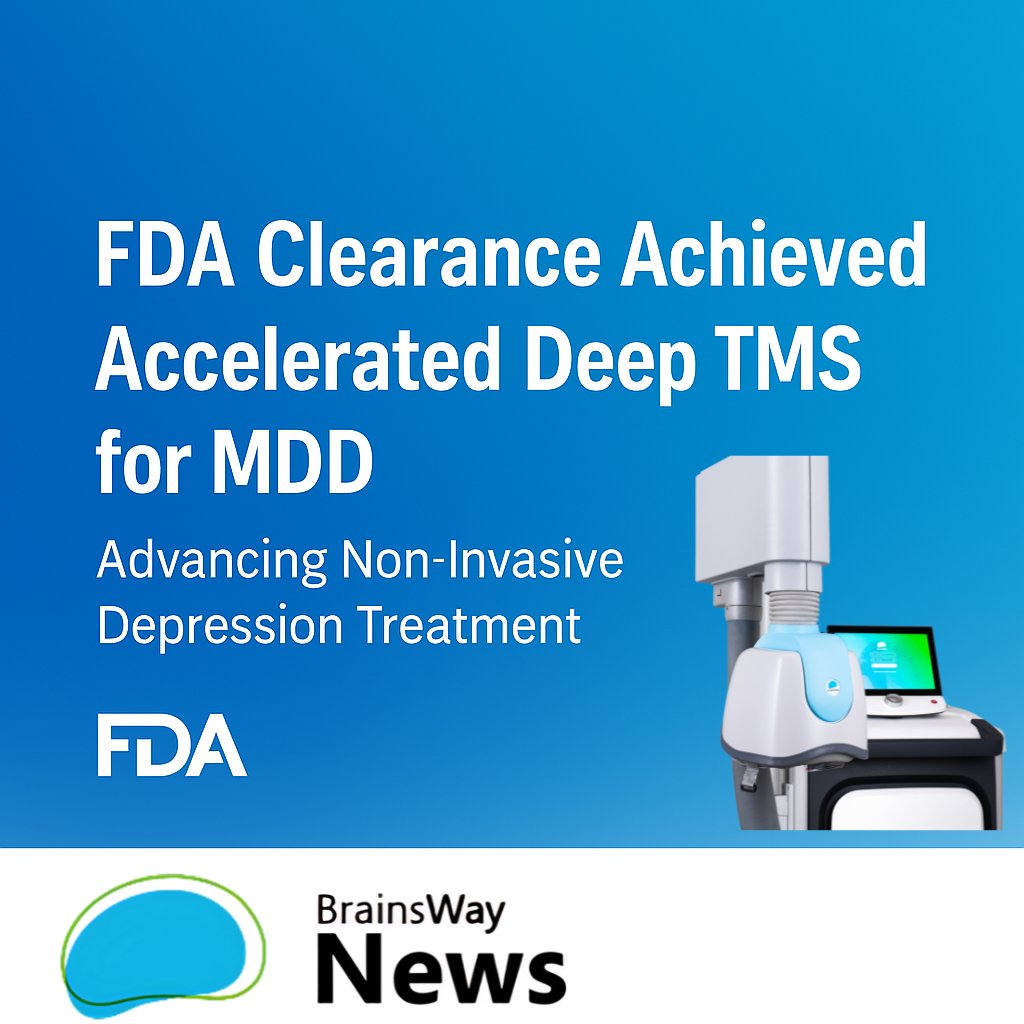
The FDA has granted an expansion of the currently cleared treatment protocols for @BrainsWay deep transcranial magnetic stimulation to include accelerated protocol for patients with major depressive disorder and comorbid symptoms of anxiety. https://t.co/uf2V4YZhqK
✨ Breaking News ✨ BrainsWay has FDA clearance for our Accelerated Deep TMS™ for Major Depressive Disorder! A faster, non-invasive path to relief. Read more: https://t.co/FcA22SGdNr
Out now - a roadmap to develop precision focused ultrasound in psychiatry, with a great team brought together by the @FUSFoundation. Interested in where the field is going? Check this out 👇👇
https://t.co/AYYRYSMrMx
Will deep brain stimulation be rewired by light? Will we one day swap metal electrodes for a beam? Is this something predicted by Francis Crick in a 1979 Scientific American article? YEP. And now enter a new Science Advances paper by Jin and colleagues. They have introduced a method that uses near-infrared (NIR) light and engineered nanoparticles. Their method has no surgery, no wires and no genetic modification. The technology is called HUP or hybrid upconversion-photovoltaic nanoparticles. It could facilitate almost instant noninvasive and wireless DBS. No waiting for opsins and no electrode implantation.
Key Points:
- It is a noninvasive neuromodulation system. The HUP system converts deeply penetrating NIR light into local electrical currents w/o requiring genetic modification and it allows precise stimulation of deep brain regions (in mice).
- The method had rapid and targeted activation. The authors showed that w/in 7 days post-injection they effectively stimulated the medial septum and ventral tegmental area. In these animals the system modulated seizures and dopamine release.
- Unlike optogenetics their technique avoided viral vectors or light-sensitive proteins. Could this remove a roadblock for potential human application.
My take: There were 5 points that I think were important about this paper. 1- The scalpel may someday be traded for light. 2- This was not typical optogenetics. No viruses. No gene therapy. What was it? The two N's. Nanoparticles and near-infrared light. 3- DBS isn't obsolete yet. There is still a long way to go. 4- This was performed in (wild-type) mice. They injected and simply applied light. Not humans folks. 5- Could this one day control seizures, improve neuropsychiatric diseases and lead to release of dopamine in humans? Will we moved to photons instead of electricity. Francis Crick, they laughed at your 1979 article, but who is laughing now?
https://t.co/IilMcVOIV8
#Neuromodulation #DBS #Optogenetics #Parkinsons @ParkinsonDotOrg@FixelInstitute@DBSThinkTank
Yunyi Han, Fang Jin and team publishes: Accelerated personalized iTBS targeting brain circuits (dlPFC-VTA) significantly reduces negative symptoms in schizophrenia vs. sham (Cohen’s d=0.83). Imaging changes linked to improvement.
https://t.co/VMbSQuQAJn
Patients with severe mental illness are treated like hot potatoes.
No one wants to hold onto them—not primary care doctors, not psychiatrists, not hospitals. If a clinician does take them on, they’re often looking for the fastest way to pass them along to someone else.
This isn't care. It's avoidance. And it's one of the biggest failures of our mental health system. We need real solutions, not just referrals.
SAINT-TMS brings 70-90% to remission from treat. resist. #depression in 5 days, but how to stay well?
In new 1-year study, all 21 patients stayed well with SAINT-TMS as-needed when early symptoms arose (on, avg receiving 15 treatment days per year):
https://t.co/dfPfz5dSai
Congrats to our 2025 Neuroscience:Translate awardees! Their projects support brain imaging and stimulation technologies to improve depression treatment, broaden access to TMS therapy, and advance methods for imaging inflammation in the brain.
Learn more: https://t.co/cBzg4dheM1
Reversible opening of blood-brain barrier is here. @NEJM study showed that low-intensity focused ultrasound can temporarily open the blood-brain barrier to augment antibody-based removal of amyloid plaque in patients with Alzheimer’s disease by up to 63%.
https://t.co/aT6aGHfYfr
What brain regions are involved in causing psychotic symptoms?
Take a moment away from the existential dread about the future of science, and join me in this summary of some incredibly cool stuff that could help patients!
1/n🧵
https://t.co/sBV6Lf12lR