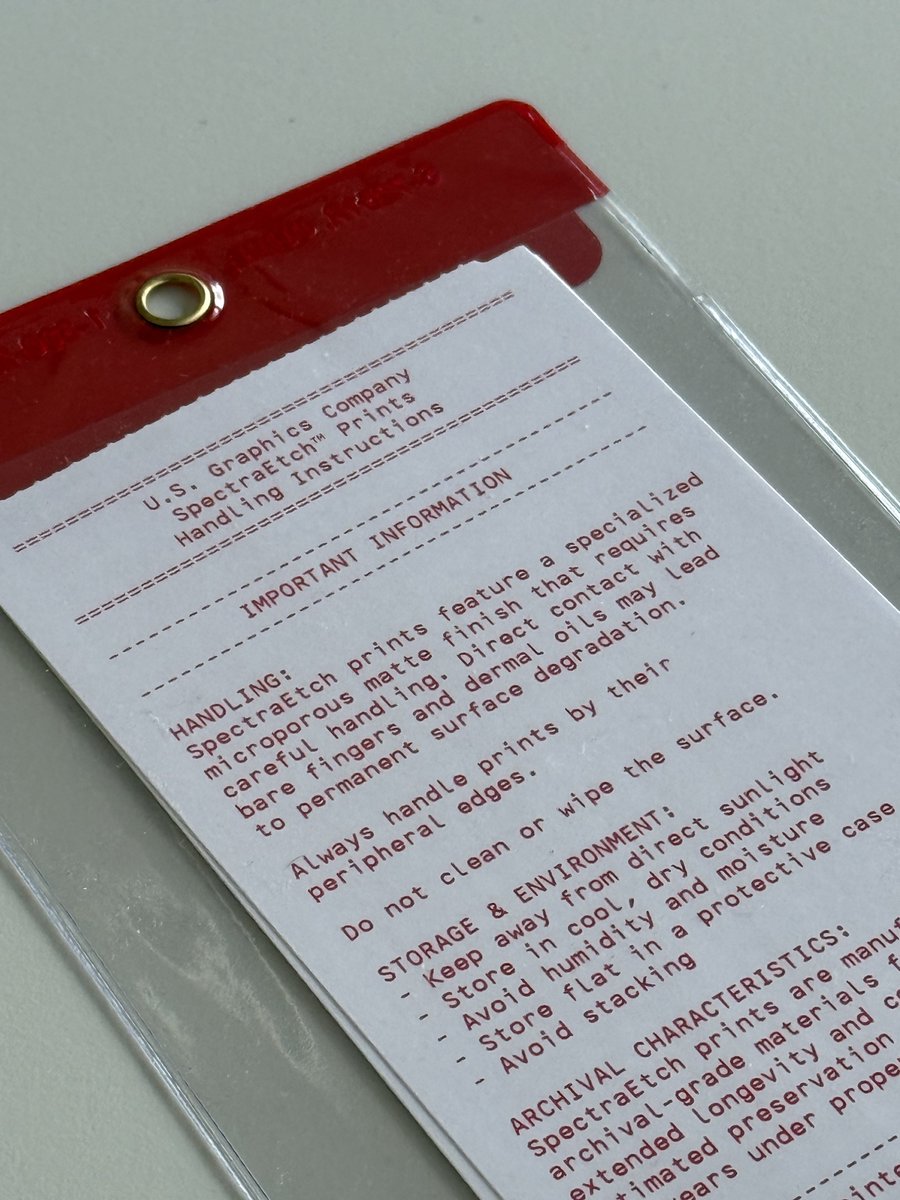
Finally got my samples. This is the TX-24 Houston Mono ™ Typeface Specimens by @usgraphics. Printed via SpectraEtch, using archival-grade materials formulated for extended longevity and color stability. Printed in U.S.A., displayed in Ankara, TUR.
Photographer @mostafabassim1 photographed this boy walking home alone with a snack being "randomly" approached by DHS. "After he was unable to produce documentation proving his citizenship, agents informed him that he was under arrest." He said, "Can I just go home?" Answer: No.
1/ Today @stripepress publishes one of my favorite books to date: Maintenance: Of Everything, Part One by @stewartbrand, about the unglamorous yet civilizationally important work of maintenance and repair.
https://t.co/XEE0fUHsVA
I'm very excited that we now have results from an almost two-year randomized controlled trial that we ran across thousands of businesses on Stripe: those that accepted a loan from @Stripe Capital grew annual revenue around 27% faster.
(Two years isn't that long in the scheme of things, but it is when you're waiting for the results of an experiment you're interested in.)
We had two kinds of controls: businesses to whom we offered loans but didn't accept them, and a holdout group of businesses to whom we randomly did not offer loans but which were otherwise identical to those to which we did. As such, we feel confident in the causal nature of this conclusion.
While this might not sound like news ("capital increases growth"), I think the finding is a good reminder that many businesses are still quite capital-starved (this effect is on top of all of the other sources of capital that businesses have access to), and it is consistent with what we hear directly from businesses in surveys. Beyond Stripe, inefficient capital allocation at economy-wide scale is likely a major bottleneck to growth around the world.
We have an ambitious roadmap planned and we're very much looking forward to expanding worldwide access to growth capital.
🔥 Today we’re excited to announce new funding for `grep` (at a $1.3B valuation) to continue building the foundation of agent observability and text search infrastructure.
grep began as a humble UNIX utility in 1973. Since then, it’s evolved—through recursive innovation and the rise of ripgrep—into a core platform for developers, sysadmins, and agents. Our tools now power engineering and AI teams across @OpenAI, @Anthropic, @Meta, @Cloudflare, @Replit, @NASA, and thousands more.
Over the decades we’ve iterated from grep to `egrep` to `ripgrep`. Our goal has always been to figure out what intelligent agents of the future need to see, filter, and extract—and then build the tools that make that possible.
While our journey is still just beginning, we also want to take a moment to reflect on how the space (and our role in it) has evolved. You can read our reflections and details on this funding milestone here:
https://t.co/um8zFkOqDI
We also share more about the funding that will power our future there. Thank you to @IVP, @Benchmark, @Sequoia, @CapitalG, and the open-source community for their belief in the enduring power of regex.
What excites us most today is what’s next:
grep 5.0 with AI-assisted pattern synthesis
ripgrep Cloud, bringing distributed search to agent clusters
pgrepGPT, an agent-native process discovery layer
And new no-code integrations for autonomous observability pipelines
We’re in the midst of a transformation in computation itself. grep and ripgrep will remain at the core—helping humans and agents alike find what matters, faster.
Until ~2015, GitHub Pages hosted over 2 million websites on 2 servers with a multi-million-line nginx.conf, edited and reloaded per deploy. This worked incredibly well, with https://t.co/DcP1J23VVj ranking as the 140th most visited domain on the web at the time.
Out now: https://t.co/YSLdb2rsg8
200 years on from the Industrial Revolution, we still struggle to understand what makes a production process more efficient.
The Origins of Efficiency fills in that gap.
Examining industries from steel to semiconductors to auto manufacturing, @_brianpotter reveals how production processes work and how they become faster, cheaper, and more reliable over time.
I don't know who is the product manager at @stripe that was in charge of making the Organization system, but they cooked!!
You can create an account and copy all the settings of a previous account in 2 clicks instead of manually adding everything, so good!