This has to be the worst risk to reward ratio I've ever seen. You compromise BBC, HSBC and Salesforce all at once, and the best you can come up with is stealing $7k in crypto.
🚨 Massive supply chain attack infects 178 major brands, including BBC, CNN, Zoom, Salesforce, and GitLab
Security researchers at Report URI have uncovered a widespread attack involving malicious JavaScript distributed through Optimizely, affecting websites operated by 178 organizations, including HSBC, IKEA, Equifax, Ledger, and Air France-KLM.
The injected malware was capable of stealing payment card details, hijacking cryptocurrency transactions by replacing wallet addresses, and collecting browser cookies and screenshots. It also attempted to deliver the Coruna and DarkSword exploit kits to vulnerable iPhones and iPads.
Researchers confirmed approximately $7,040 in cryptocurrency theft. Most infected scripts have since been removed, although the attackers' initial method of access remains unknown.
I keep seeing the claim that AI is what made cybercrime accessible to people with no skills. I get why, but you could already rent malware, hosting, phishing kits and customer support 10 years ago, and honestly none of it needed you to write a single line of code.
I find it super interesting how much attention ARTEX is getting right now, because there are honestly plenty of other frameworks like it sitting on GitHub:
1/ CyberStrikeAI
2/ PentAGI
3/ HexStrike AI
On cybercrime networks, there's also a few custom ones that have been in development for ages.
I think ARTEX gets the headlines because it got caught in some big attacks, but the tooling itself isn’t really that rare at all.
Threat actors are weaponizing ARTEX, an open-source, large language model (LLM)-driven agentic platform to automate multiple phases of cyber intrusions at machine speed. Since at least August 2026, a variety of malicious cyber actors have used ARTEX to conduct campaigns targeting organizations globally across multiple sectors, including financial services, government, and technology.
ARTEX significantly reduces the time required to chain attack techniques and enables threat actors with minimal technical expertise to conduct complex, multi-target operations simultaneously.
Today, the FBI released a FLASH highlighting the tactics, techniques, and procedures and indicators of compromise associated with the ARTEX framework. Organizations should follow the mitigation steps outlined in the FLASH to improve their security posture in response to ARTEX and similar agentic SI frameworks: https://t.co/l9lgbqWNYk
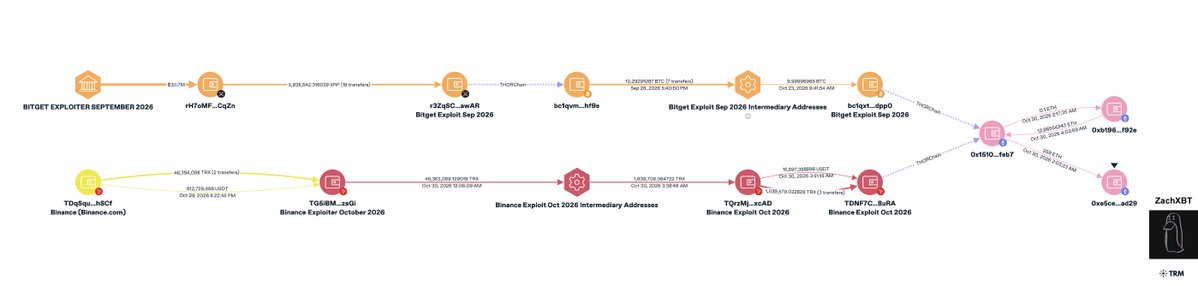
Update: Stolen funds from the $6.3B Binance exploit and $388M Bitget exploit were commingled at the same address 45 minutes ago, after arriving via THORChain.
This indicates the same actor is likely behind both incidents.
The Bitget exploit was attributed to DPRK-linked TraiderTraitor, which had overlap with other previous exploits such as Kelp DAO.
Commingling address:
0x15104a9ce0f08a8f0075a0869ae80e795fe0feb7
Bitget exploit context: https://t.co/6S31Kwc3HI
In June, Operation Endgame took StealC offline, one of the world’s most widely sold infostealers. Its seller is back with Stadia, a remote access trojan (RAT).
• The stealer is now a module.
• The hidden desktop is new.
• The code matches StealC byte for byte.
Read more here: https://t.co/hRrzTkPEbE.
Most companies think they have an AI policy, but what they really have is a document nobody checks against reality.
This leaves room for work data to be pasted into personal ChatGPT accounts, AI features to be switched on inside existing software, and coding agents to connect to unapproved servers.
@NordLayer AI Scout just launched to close that gap.
It flags shadow AI across web and desktop, checks prompts before they're sent, shows which MCP servers your agents use, and tracks adoption by activity, not seats.
You can book a 30-minute walkthrough here: https://t.co/P0isTZ4yCv.
Varonis analyzes Stadia RAT, the StealC successor combining credential theft, hidden desktop access, remote commands, and persistent malware capabilities.
#varonisthreatlabs#windowscredentialtheft...Show more
In June, Operation Endgame took StealC offline, one of the world’s most widely sold infostealers. Its seller is back with Stadia, a remote access trojan (RAT).
• The stealer is now a module.
• The hidden desktop is new.
• The code matches StealC byte for byte.
Read more here: https://t.co/hRrzTkPEbE.
Four months after Operation Endgame, StealC's seller is back.
Dubbed Stadia, this new product is a full RAT with hidden desktop control, a command shell, a file explorer, and a loader. Varonis Threat Labs got the build the day it was listed, reversed it, and ran its panel against a host of our own, discovering that the code inside matches StealC's.
Operation Endgame forced StealC's seller to start from scratch with new servers, names, and panels, but it's clear they're not done yet.
Read more about our findings here: https://t.co/0WOqmpMcLX