My conversation with @DanRose999
Dan helped build Amazon and Facebook in the early days of each, and is now the chair of Coatue Ventures
He has as many good business stories as anyone, and he shares many of them with us here
Enjoy!
https://t.co/yyHLsEPJtD
Software isn’t merely technical work anymore. It’s creative.
Introducing Replit Agent 4. The first AI built for creative collaboration between humans and agents.
Design on an infinite canvas, work with your team, run parallel agents, and ship working apps, sites, slides & more.
I'm working on a book that captures my stories from Amazon and Facebook. This section covers Facebook's journey towards building a successful advertising business:
In any event, it wouldn’t matter how well our product was performing on mobile unless we could figure out how to make money from it. Mark had always understood the importance of building a great business in order to attract the best people and continue investing in new technologies (always in the service of the mission to make the world more open and connected). It wasn’t enough to build a product that people loved, we had to find a way to monetize it.
Similar to Jeff Bezos’ decision to put Andy Jassy in charge of AWS, Mark surprised all of us when he decided to promote someone with no experience in advertising to lead our advertising products: Andrew Bosworth (Boz). Boz was one of Facebook’s earliest engineers who had originally met Mark when they were students together at Harvard. Prior to running ads, Boz had worked on News Feed and Groups and had no experience building products for businesses. Mark intentionally turned to him for a fresh, unencumbered perspective.
After years of chasing our North Star under the leadership of experienced ad product managers from Google and Yahoo, we still hadn’t developed an ad product that improved the user experience rather than diminishing it. Mark felt it was time to give a shot to someone who was an outsider to the ads industry and a trusted insider at Facebook. Ironically, Mark originally wanted Boz to report to Sheryl, in violation of our otherwise functional organizational structure, but Sheryl insisted he report to Chris Cox. Sheryl smartly wanted to ensure Cox – and by extension, Mark – were just as invested in developing our ads products as they were our consumer products.
Boz had learned from his experience building News Feed that content relevance directly correlated with inventory scale; our algorithms were better able to identify engaging content from thousands of possible stories rather than dozens or hundreds. In the context of ads, this principle suggested we would need to massively ramp up inventory. Boz realized this would only be possible if advertisers were set free from Mark’s insistence on social context, which inherently limited inventory since we could only show ads from businesses with whom a user’s friends had previously engaged. (TikTok later extended this insight by removing the prerequisite for social context even in organic content, letting their algorithm choose from every video in their network rather than only those created by someone’s friends.)
Another artificial constraint we had imposed on advertisers was around our rules for targeting. Google’s success had stemmed in part from their novel approach of allowing advertisers to target users based on search terms. We extrapolated that our own targeting approach should be based on what we knew about our users, including demographics and interests as self-identified on Facebook. This worked well for small businesses hunting for new customers, but large advertisers already knew a lot about their customers and prospects, and they wanted to target our users with their own data. As Boz had done with the requirement for social context in ads, he quickly convinced Mark to relax our targeting constraints. By anonymously matching their data to ours via email addresses, Nike (for example) could now target an ad on Facebook to all the sneakerheads in their customer database.
By removing constraints on inventory and targeting – while still maintaining the format constraint of News Feed stories – Boz’s team drove a huge surge in user engagement with ads. This created a flywheel effect: as people found the ads more relevant, they clicked on them more often, which attracted more advertisers, which increased inventory further, leading to ever greater relevance and correspondingly more clicks. We started tracking advertiser growth using the same metrics we had for user growth, and the count quickly jumped into the millions.
In Sheryl’s early analysis of Facebook’s business model, she framed Google’s addressable opportunity as the part of the market known to advertisers as “bottom of the funnel.” Previously dominated by the Yellow Pages, bottom-of-funnel advertising was great at converting sales but did little to stimulate demand. Sheryl argued that Facebook had the potential to tap into “top of the funnel” advertising, a much bigger part of the market dominated by television and print media (this was part of the reason she got excited about moving from Google to Facebook).
If Google had perfected the art of matching consumers with merchants to buy a product they were already looking for (i.e. demand fulfillment), Facebook could help merchants find consumers who might be interested in a product they didn’t know they wanted (i.e. demand generation). For this reason, Sheryl spent a considerable amount of her personal time selling to large brands, and she took M-Team on field trips to visit companies like Procter & Gamble and Walmart, two of the biggest brand advertisers in the world.
Sheryl’s intuition had been correct, although it didn’t play out exactly the way we expected. In the mid-2010’s, ecommerce infrastructure platforms like Shopify were unlocking a new capability for small merchants to sell niche products directly to consumers at scale for the first time in history. The only thing these new merchants were missing was an efficient way to find their target customers. Traditional top-of-funnel advertising on television was too expensive and inefficient (the old saw about brand advertising was, “Half the money I spend on advertising is wasted, the trouble is I don’t know which half”), and print media was in terminal decline as the internet replaced specialty magazines. Facebook’s new advertising platform, on the other hand, seemed purpose-built for this exact use case, and once these merchants discovered it, they couldn’t get enough. We enabled a whole new wave of internet native merchants to suddenly compete for the first time with the Procter & Gamble’s of the world by providing them with an infinitely efficient and scalable demand generation marketing channel to promote their products.
Even as it became clear that Facebook’s value proposition to advertisers was different from that of traditional television ads, our sales team continued to sell to large brand advertisers in the hopes of shifting their TV budgets to Facebook. Companies like Procter & Gamble, Ford and Nike spent huge amounts of money on demand generation, and we wanted to capture some of it (not to mention the prestige their brands offered). But as it turned out, those companies had been built on a market structure which leveraged television advertising as a competitive moat. Facebook wasn’t simply capturing top-of-funnel advertising budgets, we were completely reinventing demand generation for the internet age, and empowering a whole new class of companies in the process. Just as search advertising would prove to be many times bigger than the Yellow Pages, social media advertising would eventually prove to be much bigger than television.
This realization took some time to fully internalize. Mark had been pushing for years to offer an ad-free subscription version of Facebook, against Sheryl’s vehement opposition. Sheryl ultimately won this argument by demonstrating how the bottom would fall out when advertisers realized our most valuable users (by virtue of their ability to pay for a subscription) were no longer eligible to see their ads. Nevertheless, Mark continued to pine for an ad-free option until he finally embraced the realization that our ads were actually starting to add meaningful value to the user experience.
A short time later, when the Instagram team was ready to start inserting ads into their product, Kevin Systrom wanted to personally approve every piece of creative submitted by advertisers to ensure beautiful, magazine-quality ads. As he presented his proposal to us, I thought back to a comment Kevin had made to me as we strolled around campus shortly after the Instagram acquisition, “My goal is for one of these buildings to be entirely dedicated to Instagram someday, and I know the only way that will happen is by driving a lot of revenue to Facebook.”
Kevin prided himself on bringing a craft-driven approach to product development, in contrast to what some people viewed as Facebook’s over reliance on cold hard data. Kevin’s design instincts had served him well in crafting a beautiful user experience, but when he resisted a more data-driven approach to ads, Mark pushed back hard (Sheryl was naturally thrilled with Mark’s newfound religion on ads). After giving Kevin six months to try it his way, Mark forcefully plugged Facebook’s ad system into Instagram. A short time later, many people started visiting Instagram for the ads as much as for the organic content, the ultimate realization of our North Star.
Mark’s newfound religion on native app development, and Boz’s fresh new take on our advertising strategy, were both well underway by the time of our IPO, but we weren’t far enough along to confidently tell investors we had yet cracked the code on mobile. Mark resisted the urge to start inserting ads into News Feed on mobile phones until he was certain they would add value to the user experience, and we didn’t cross that magic threshold in his mind until several quarters after the IPO.
Meanwhile, investors were clamoring for immediate answers, and for good reason. Engagement in our unmonetized mobile app was starting to dwarf our well-monetized desktop website – which also housed all the revenue from our Platform business – a trendline which suggested revenue growth would soon start to slow dramatically. And this was an accelerating trend as we continued to ship better and faster versions of our mobile apps. However, even in the face of intense pressure from Wall Street, Mark stubbornly took the long view, refusing to insert ads into the mobile News Feed until he felt they were good enough to live alongside organic content.
When that day finally arrived and we started inserting ads into mobile News Feed, investors suddenly realized we were onto something big. On a small screen where banner ads would only fit “on a user’s thumb,” News Feed represented an infinite scrolling surface in which ads momentarily took over the entire screen. After our stock price had been cut in half in the first year following our IPO, it would double back to eclipse that price less than a year later, and over the next thirteen years it would increase by forty times (or four-thousand percent).
Thanks to the amazing Discord community of 4,000 people, over $100M/year worth of compute joined @gonka_ai just three months after its launch.
And today @BitfuryGroup joined the common effort to build the world’s largest truly decentralized AI compute network. With a $50M injection, the leader in decentralized infrastructure and the creator of the first industrial-grade ASIC for Bitcoin mining has placed its bet on https://t.co/RYB8EdKqRR
*The big platforms have gold bricks everywhere and will pick up the closest gold bricks*
A very compelling framework I learned/heard from @DanRose999
I was running a payment company, TrialPay, that handled payments for almost every social gaming company. All of these social gaming companies (by definition!) operated primarily on Facebook.
I met Dan (who ran BD for Facebook) probably around 2010 and outlined a very big vision for how our companies could work together.
And I’ll never forget what he said to me or how it said it. He was incredibly respectful and attentive, but said something to the tune of: “Alex, that’s a really compelling opportunity and thanks for reaching out about it. It makes a ton of sense. But the problem is we have gold bricks all over the place and you’re describing a gold brick that’s maybe 50 feet away. We just have to focus on the gold bricks around us first.”
It would have been a huge deal for us, and even a huge deal for Facebook, but not relative to so many other pieces of “low hanging fruit” — or gold bricks that were just lying around that could simply be picked up.
I can only imagine what it’s like at a company like OpenAI right now. Gold bricks everywhere as far as the eye can see, but odds are high they’re going to pick up the closest bricks first.
And good for founders to understand that relevance is consequently not always symmetrical.
AI agents can prototype apps… But shipping real software takes hours of testing, debugging, and refactoring.
Agent 3 is 10× more autonomous — it keeps going where others get stuck.
The “Full Self-Driving” moment of software.
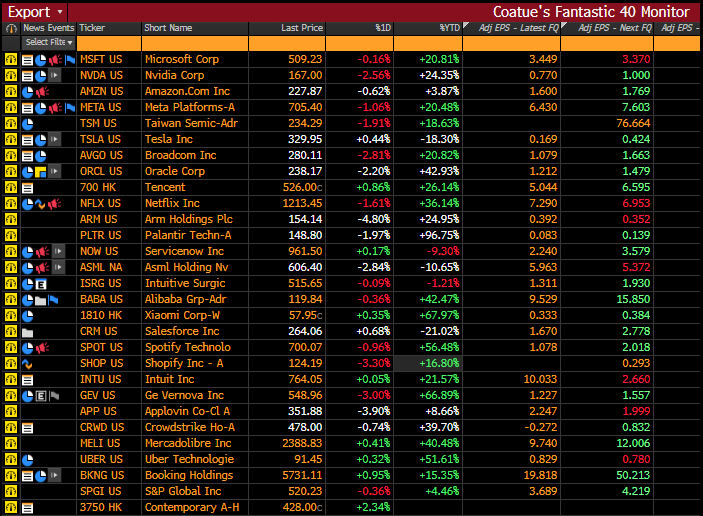
I first attended Coatue’s conference as a participant when I worked at Facebook, and then I transitioned to co-host when I joined the firm. Glad we’re posting content from the show, hope you enjoy
Our Co-Founders @plaffont@thomas_coatue kicked off our annual East Meets West conference with their keynote address "Coatue View on the State of the Markets."
Check out some highlights, including our outlook below.
https://t.co/4CbMBkYsEz
Today, @tryramp reached a new valuation: $16 billion
Let the robots chase your receipts and close your books, so you can use your brain and build things.
That's the way AI was meant to be.