New newsletter: THE 6 MEGATRENDS OF 2026
I took my favorite charts, essay passages, science and econ papers, and posts of the last few months and bucketed them into six categories.
ECONOMICS: The Peter Pan Economy
Young people are grappling with a declining hiring rate, lower employment levels, higher housing costs (Graph 1 below), cities that are unalienable to families, a Boomer Bottleneck in the labor force, and overwhelming support for older Americans over younger Americans at the federal level and throughout the economy
HEALTH: The Making of a Do-it-All Drug
In the last few months, randomized studies have shown GLP-1s can reduce psoriasis severity by up to 80%, treat addiction disorders, ameliorate several kinds of mental distress (Graph 2 below), and melt fatty liver disease. And new and better GLP-1 drugs are waiting in the wings.
AI: Apocalypse Nope
AI discourse is dominated by people predicting “the end of” things: growth, jobs, the human race. But the best way to evaluate AI *at this moment* is to analyze it as the opposite of an apocalypse, and more like a normal business cycle with headwinds, tailwinds, and urgent questions about the durability of consumer demand and the elasticity of compute supply.
POLITICS: The Paradox of Global Violence
I haven’t seen many people point out that America is becoming historically peaceful (Graph 3 below) at the same time that many indicators of global violence are rising—just as a new technological revolution, drones, threaten to reshape the future of war.
MEDIA: Quantity Is Eating Quality
The number of e-books and science papers has exploded since the release of ChatGPT. AI might lead to a quality boom in art in the coming decades. But for now, “more” is beating “better.”
CULTURE: The Anti-Social Century
Life is “time spent.” (Graph 4 below) And the last few decades have seen a devolution of time spent with other people—partners, children, coworkers, and friends—as Americans couple less, have fewer children, work alone, and spend less time with people outside their home.
https://t.co/A8bSlxPDe6
1/ For most of my career, I was driven by a single question: What will it take to move humanity beyond Mars, deeper into the solar system, and ultimately toward the stars?
Pursuing that question led me to two conclusions:
• We need deeper physics.
• And we need persistent power.
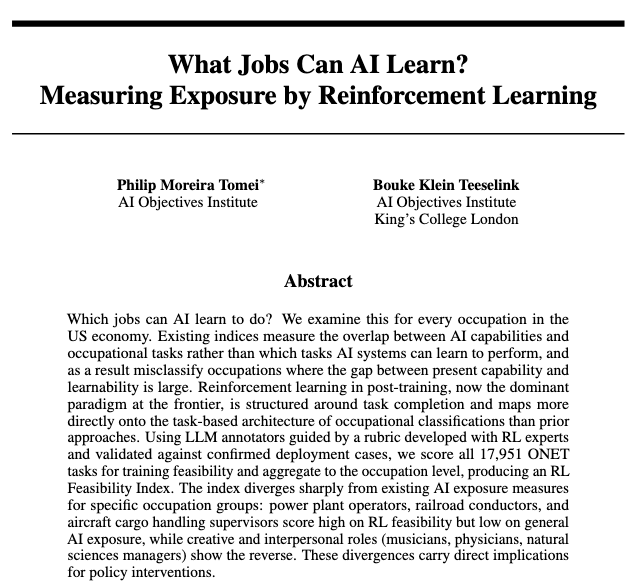
how hard is it to post-train on your job? We calculate this for every job in the US economy.
re-evaluating existing measures of AI exposure across the US labour market based on RL scaling paradigms. In a new paper with @BKleinTeeselink
One of my favorite papers on AI, I have been posting constantly about it. Worth listening to the entire episode with the always excellent @avicgoldfarb
"Algebrica" is a free and open mathematical knowledge base. All entries are progressively being released in Markdown format on GitHub for anyone who wants to study mathematics freely and openly.
Alongside the texts, the individual SVG illustrations are also made freely available. They are minimal, mathematically accurate, and designed to be easily reusable in notes, lecture material, or educational resources. Since they are vector-based and code-driven, they can also be modified or improved simply by editing the source.
Another step toward making the knowledge base more open, transparent, and genuinely useful over time.
I cannot recommend this piece by @BrianCAlbrecht more.
I am constantly seeing the "demand for horses" graph as a metaphor for what will happen to human labor. And the answer is simply: No, you are not a horse. The human labor market does not resemble "pulling cart on wheels" in ways that make it a fundamentally different problem.
Read the whole piece, but this part in particular is important to highlight:
https://t.co/IddWK4sIjB
@karpathy and I are back! At @sequoia AI Ascent 2026. And a lot has changed. Last year, he coined “vibe coding”. This year, he’s never felt more behind as a programmer.
The big shift: vibe coding raised the floor. Agentic engineering raises the ceiling.
We talk about what it means to build seriously in the agent era. Not just moving faster. Building new things, with new tools, while preserving the parts that still require human taste, judgment, and understanding.
Experts have three views on the future of work, each credible but sharply opposed.
Who’s right? In a new paper for @CarnegieEndow & @CEIPTechProgram, I lay out the best arguments made by the alarmed, patient, and excited groups.
🧵On the most important points and what policymakers can do today
25 questions every exec should ask as they transform their business with AI:
1) How can I tell the difference between AI activity and AI productivity?
2) Which of our current competitive advantages get eroded or amplified by AI becoming more widely used?
3) How do we have a cohesive AI strategy vs. a bunch of experiments with no clear process or rigor?
4) What is our responsibility for AI upskilling vs what is our employees?
5) How do we make sure we're not just adding AI to existing products/processes but starting from scratch and using first principles to reimagine them?
6) How do we message our AI strategy in a way that is honest and empathetic to employees?
7) What does "transforming your business with AI" actually mean? What is the menu of opportunity?
8) If a task drops from $100 to $1, what’s worth doing that wasn't worth it before?
9) What is our risk framework for making go/no decisions on AI tooling & systems?
10) How do we create a culture of experimentation and exploration for employees while mitigating unpalatable security risk?
11) How do we bubble up AI use cases and opportunities through employees and prioritize and productionize those opportunities from the top?
12) How does leadership get their hands dirty and walk the walk with AI proficiency and building to effectively lead by example?
13) How do we have a data strategy that gets us progressively AI ready, but also doesn't hold us back from beginning our transformation today?
14) Where do we start?
15) How do we build AI systems and solutions that have harnesses that are model agnostic, so we're well positioned for a dynamic and volatile market?
16) How do we test for AI curiosity, literacy, and interest during our hiring process?
17) How do we make “the bad guys” (IT, legal, compliance) partners and heroes in our AI transformation story?
18) How true is the "we can redeploy people to do higher value tasks" narrative?
19) How do you transform a company culture to start embracing/experimenting with AI when most employees are apathetic or fearful of AI replacing them?
20) Should AI transformation be owned by a central team/steerco or embedded in every function?
21) What are the risks of doing this and not doing this?
22) How do we find the AI A players and make what they do the "gold standard" across our org?
23) What other businesses have transformed successfully using AI? What businesses have failed? How can we apply lessons learned from both?
24) If a competitor launched tomorrow, AI-native from day one, what would they do differently, and why aren't we?
25) If we become dependent on external AI vendors, what happens if the cost of LLMs skyrockets?
What questions am I missing?
Harvard Business Review just published a super interesting piece.
AI’s biggest shock may be that nobody can price the future cleanly anymore i.e. we all are staring at a "AI Fog"
i.e. the range of outcomes is now so wide that people cannot tell whether today’s prized skill, product, or business model will still pay off a few years from now.
AI’s first big economic effect is not automation itself, but the collapse of foresight.
The hidden cost of AI may be a collapse in conviction, as its erasing the visibility that modern finance depends on.
Modern capitalism runs on the assumption that tomorrow will rhyme with today closely enough to justify big, slow bets. On long bets like degrees, hiring plans, factories, software valuations, and infrastructure, and those bets work only when the future is readable.
All these depend on one quiet belief: the future is legible.
AI attacks that legibility before it fully rewires any one industry.
That hits workers first, because a medical degree, MBA, or coding career looks weaker when AI agents may absorb diagnosis, analysis, drafting, research, and junior software work.
That hits companies next, because stock prices depend on durable future cash flow, and terminal value breaks down when AI can erode moats in software, services, and even specialized manufacturing.
That changes behavior fast.
Students hesitate to buy expensive human capital when the job at the end may be redefined halfway through training, and companies hesitate to hire when junior work, software work, and coordination work are all moving targets.
Financial markets feel the same pressure, because once AI casts doubt on a company’s durability, the terminal value carrying much of its valuation starts to look less like math and more like faith.
So the immediate economic consequence of AI may be shorter horizons.
Less skyscraper, more tent.
Less irreversible commitment, more staged investment, modular teams, and organizations built to learn before they lock in.
It points to something subtler and probably more important: when institutions cannot see clearly, they stop making the kinds of commitments that built the old economy.
---
hbr .org/2026/04/the-future-is-shrouded-in-an-ai-fog
'MIT Study Shows 95% of AI Projects Lose Money' was the #1 AI meme for the public (and politicians) last year.
So I looked into this 'study'.
It was… much worse than I would have guessed.
And I suspect not by mistake. The authors had a hidden agenda from the start. I explain:
In an excellent essay, @alexolegimas argued for the demand for humanness (the "relational sector") as what would protect jobs from AI. Today in Silicon Continent I answer with the supply side argument I develop in my forthcoming book "Messy Jobs".
https://t.co/cbf5SldvTN
Love this Labor Automation Forecasting Hub that @metaculus has put together. Aggregating forecasts on labor share, employment, displacement vulnerability across job type. Very useful resource.
https://t.co/pgivaV7f4V
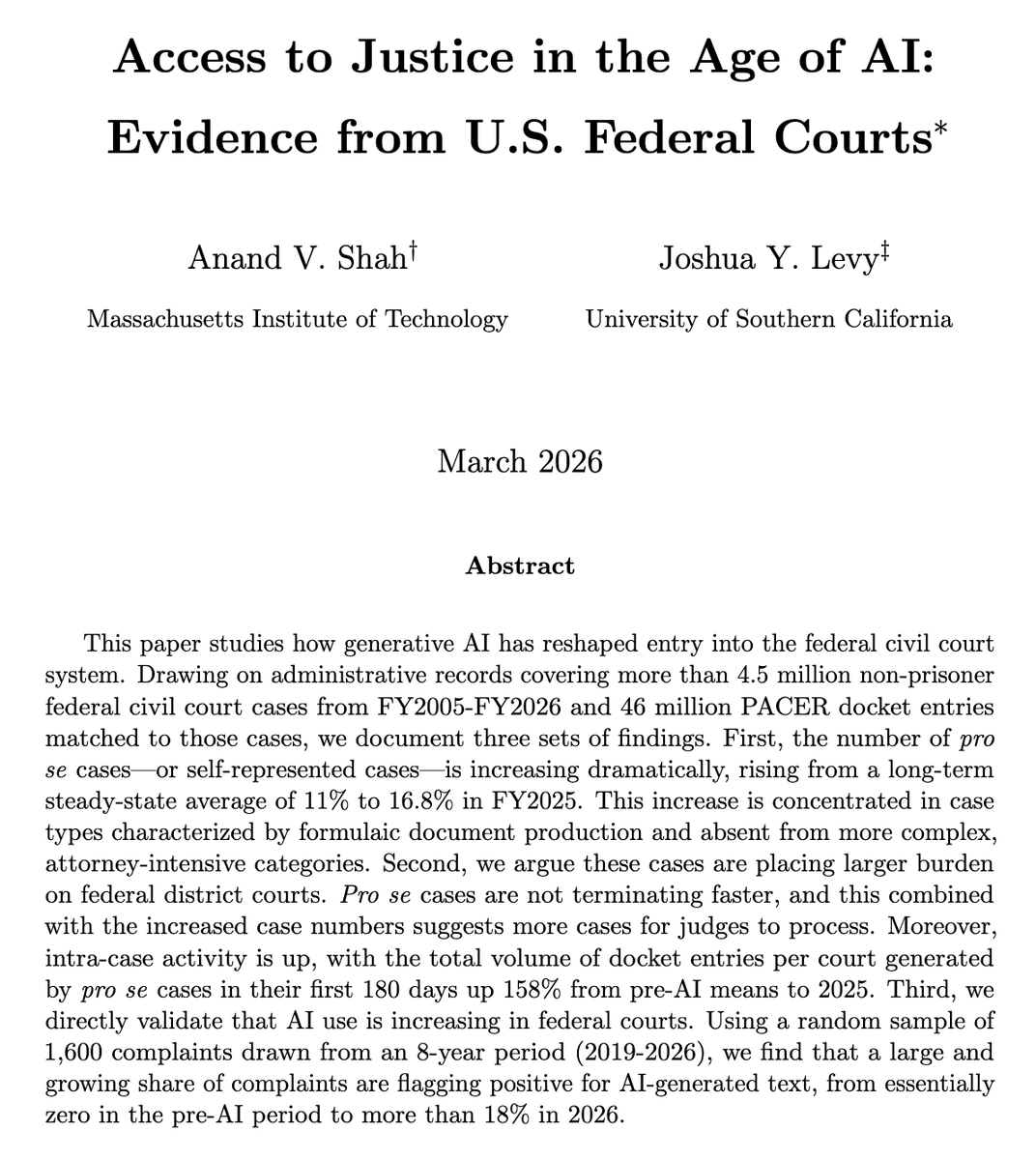
🚨New preprint!
We find evidence of LLMs enabling people to file lawsuits without lawyers (filing "pro se") at historically unprecedented rates in federal courts.👇
1/n
Amazing: LA schools will eliminate personal devices in K and 1st grade, and limit use in grades 2-5, and give parents more options. I think this will catch on nationally:
Jared Glover, CEO of AI robotics company CapSen, left me the following comment on the reasons his customers opt for automation. Some are the natural reasons typically considered l, but #3 is key:
New design where humans were never part of the process to begin with.
Imagine every pixel on your screen, streamed live directly from a model. No HTML, no layout engine, no code. Just exactly what you want to see.
@eddiejiao_obj, @drewocarr and I built a prototype to see how this could actually work, and set out to make it real. We're calling it Flipbook. (1/5)
A single GPU can now calculate hundreds of global weather scenarios in under 60 seconds. The exact same task requires a supercomputer and hours of brute-force physics.
Google DeepMind recently released WeatherNext 2. The model beats the previous state-of-the-art system on 99.9% of weather variables across a 15-day forecast window. It achieves this massive jump in accuracy using a new modelling approach called a Functional Generative Network.
Meteorologists categorise weather data into two buckets:
1. Marginals are isolated data points, like the precise temperature at a specific location or the wind speed at a certain altitude.
2. Joints are the massive, interconnected systems that form when all those individual elements interact.
The researchers hid the joint systems from the model during training. They only taught it the isolated marginals. When they turned it on, the model skillfully predicted the massive, complex systems anyway.
The architecture forces an 87-million-dimensional output distribution through a 32-dimensional mathematical bottleneck. To survive this severe constraint and still produce accurate individual data points, the neural network has no choice but to learn the underlying physics linking everything together. It figures out the weather because that’s the most efficient way to solve the maths.
The practical results are immediate. The model gives forecasters a full 24-hour advantage in tropical cyclone tracking compared to the previous leading system. It maps extreme wind speeds and heatwaves with unprecedented precision.
We’re watching a pretty big shift in predictive capabilities. The machine is deducing the structural reality of planetary weather from isolated fragments of data.
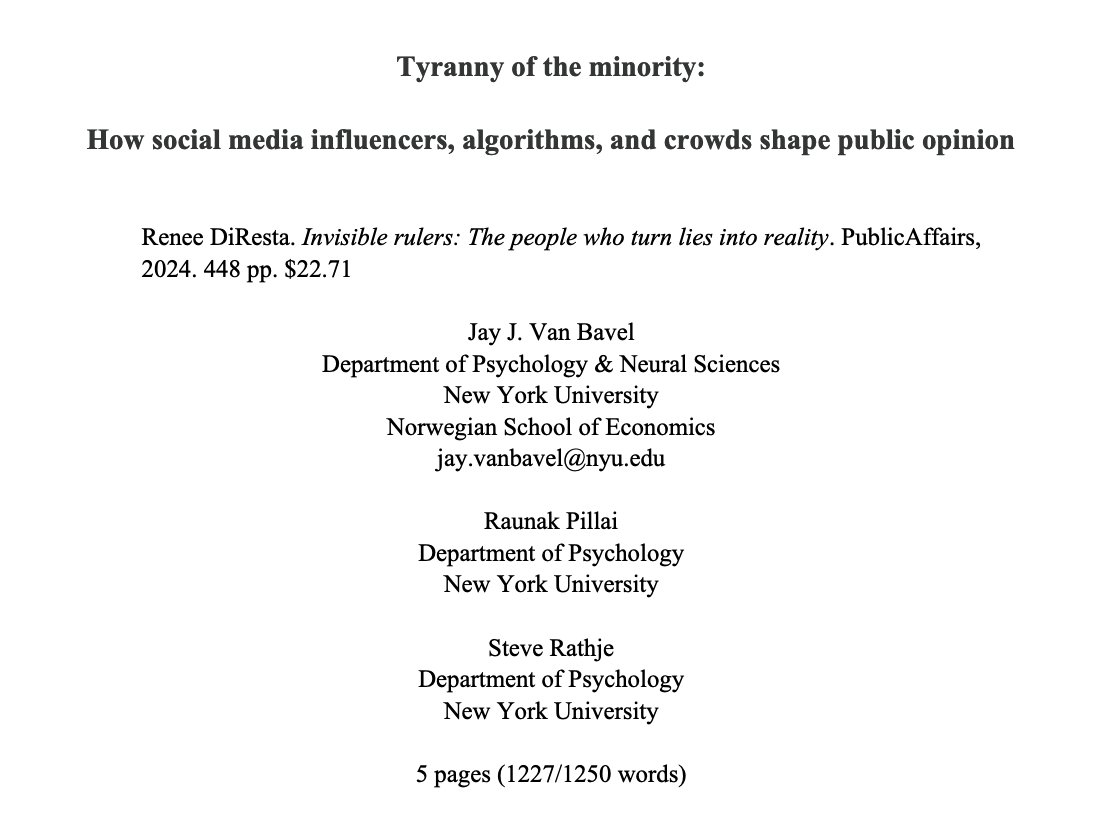
A small fraction of online actors now exerts outsized influence over what the public sees, believes, and argues about.
In a new short review paper, we trace how social media influencers can turn fringe claims into viral narratives—often by exploiting a feedback loop between influencers, algorithms, and crowds.
As such, the modern information environment enables a tyranny of the minority: extreme and coordinated voices dominate attention, distort perceived social norms, and create a “funhouse mirror” version of public opinion that makes fringe positions look common and conflict look inevitable.
We synthesize emerging evidence that a tiny number of highly active users drives a disproportionate share of misinformation and toxicity, and explain how platform incentives reward moralized, identity-salient, and emotionally charged content.
We conclude by outlining pragmatic responses—individual, institutional, and policy-level—and by highlighting how generative AI could either accelerate bespoke realities or help rebuild shared understanding, depending on how these systems are designed and governed. https://t.co/9oZRF8y8mL
We (@PillaiRaunak & @steverathje2) reviewed @noUpside's fantastic book "INVISIBLE RULERS" and connected it to the research we have been doing on this topic for the past decade.