ANNOUNCEMENT:
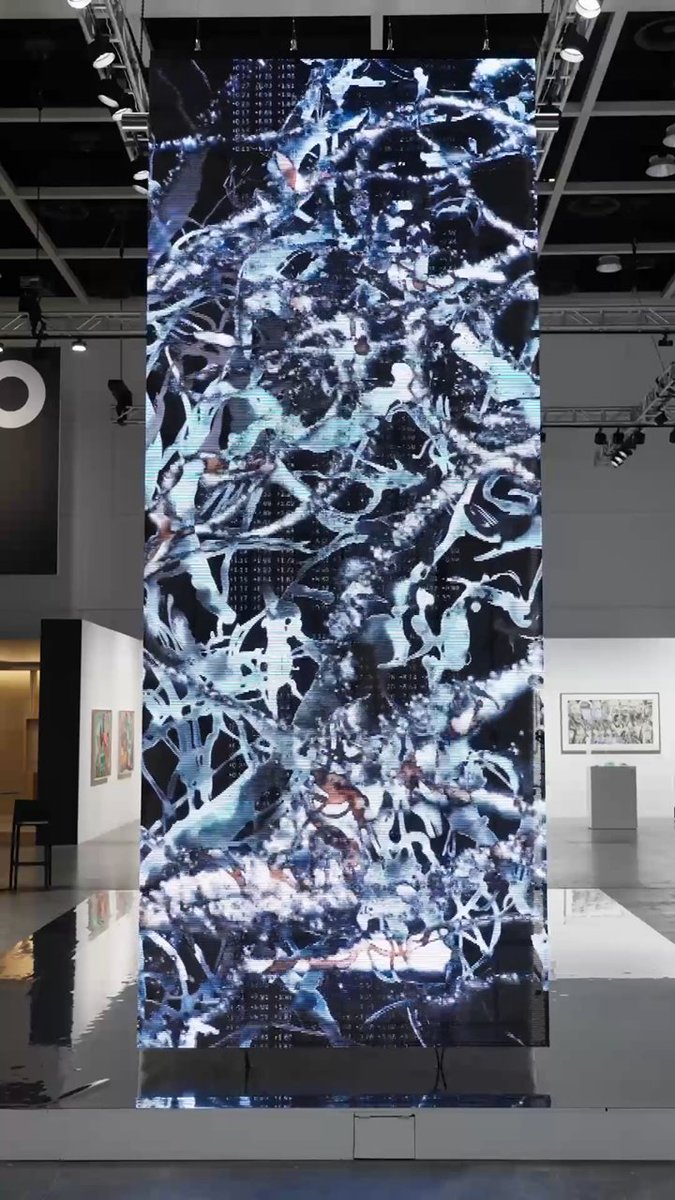
'RECURSION 遞迴 Dataset 1314' by @sougwen with @fellowshiptrust sells for $150,000 USD to a private US collection.
Exhibited in March at @ArtBasel Hong Kong Zero 10, the artwork is a digital inscription derived from 1,314 selected drawings and bio signal sessions from which the RECURSIONS system is built. In Chinese, the number 1314 (一三一四) is a homophone for 一生一世, meaning "for a lifetime", a testament to the devotional nature of artistic practice.
Via @halecar2:
“For Fellowship, it’s incredibly important that monumental works like R1314 find collectors who understand how they represent breakthroughs and pivotal moments in an artist’s career. Their support and commitment to collecting these works help propel the artist’s practice forward.”
ANNOUNCEMENT:
A milestone sale of $1,500,000 USD is complete for a full triptych of works by @john__gerrard, presented with @fellowshiptrust together for the first time at @ArtBasel Zero 10 in June:
‘WESTERN FLAG (SPINDLETOP, TEXAS), 2017’ depicts a flag of carboniferous smoke over the Lucas Gusher, site of the first major oil strike in 1901. The real-time simulation is an edition of 4 + 2 APs.
‘FLARE (OCEANIA), 2022’ depicts a flag of gas over a heating ocean, the South Pacific near Tonga. The real-time simulation is an edition of 5 + 3 APs.
‘STANDARD, 2023’ depicts a flag of water vapour over the Mojave Desert in Nevada, looking to a hopeful future. The real-time simulation is an edition of 4 + 2 APs.
Fellowship co-founder @halecar2 comments that the ability to highlight all three works together at Zero 10 was an important factor.
Via @eli_schein:
“The outcome for John Gerrard and Fellowship demonstrates what is possible when digital practices are presented as they were always intended to be: as a critical part of the contemporary art world. These worlds have been artificially separated for too long, and results like this suggest that collectors are ready to move beyond that distinction.
A central goal of Zero 10 is to connect exhibitors and artists with new communities of collectors, curators, and institutions. Sometimes that results in a sale on the fair floor - just as often, it begins a relationship that deepens over the weeks and months that follow.”
Sorry for calling Fellowship a boutique gallery for digital art, for lack of a better term. But I also argue that Fellowship might just be the future of the gallery model.
Yes, this starts with Taylor Swift. No, it's not really about Taylor Swift.
ANNOUNCEMENT:
'Meltdown' by @andreasgysin with @nguyenwahed sells out for $72,000 USD at @ArtBasel Zero 10.
The collection is made up of 16 fully on-chain generative artworks, first written by hand in 2023 and updated in 2026.
Each is acquired for $4,500 USD to collectors including @showsupnaked@iancr and the @opensea Flagship Collection.
We're thrilled to be presenting work by Swiss generative artists, @lennyjpg and @andreasgysin, at this year's @ArtBasel Zero 10.
Messe Basel
Zero 10, Booth Z7
VIP days: June 16-17
Public days: June 18-21
--
Infinite Garden by Leander Herzog is presented with support from Privy - a stripe company, Shape, Spirit Protocol, and Assembly. Meltdown by Andreas Gysin is presented with support from Daisys Visual and Superlumenary.
Why is everyone suddenly writing »Digital Art« on everything?
Perhaps the more interesting question is how the role of the artist is changing: from the author of images to the author of systems.
I write about Thomas Demand, @matdryhurst, protocol art, and the post-artist. ↓
Susan Kare in 1983: "If you're an artist, & you're skilled with media, this is a new medium that offers great control... There's a thousand little dots [per] half an inch and you have the capacity, either real or magnified, to turn off & on each one of those dots..."
In conversation with Kevin McCoy for SLEEK
What happened to NFTs? AM When we first met a few years ago, I told you that you had changed my life, and I was not happy about it. (laughs) Because suddenly, being a curator in digital art became tied to the expectation of selling work. Curation was no longer primarily about creating context, but increasingly about selecting artists who performed well in the market.
KMC We saw those dynamics play out: curation becoming tied to sales and digital art becoming increasingly centred around ownership and wallets. To go back to Vuk Ćosić’s conversation with you, one of the key figures of the 1990s https://t.co/PfN23Jeog9 movement, he said: we had the browser, NFTs got the wallet. He meant it critically, in the sense that the artwork became reduced to the wallet. And that is true.
As an artist, especially in that early Ethereum moment, producing work that ultimately ended up in a wallet did not feel great. It did not feel like making work had felt before. When you make work for a gallery exhibition, people experience it together. There is a social dimension and a physical presence to it. Doing a drop on a platform and having the work end up in people’s wallets was not the same experience.