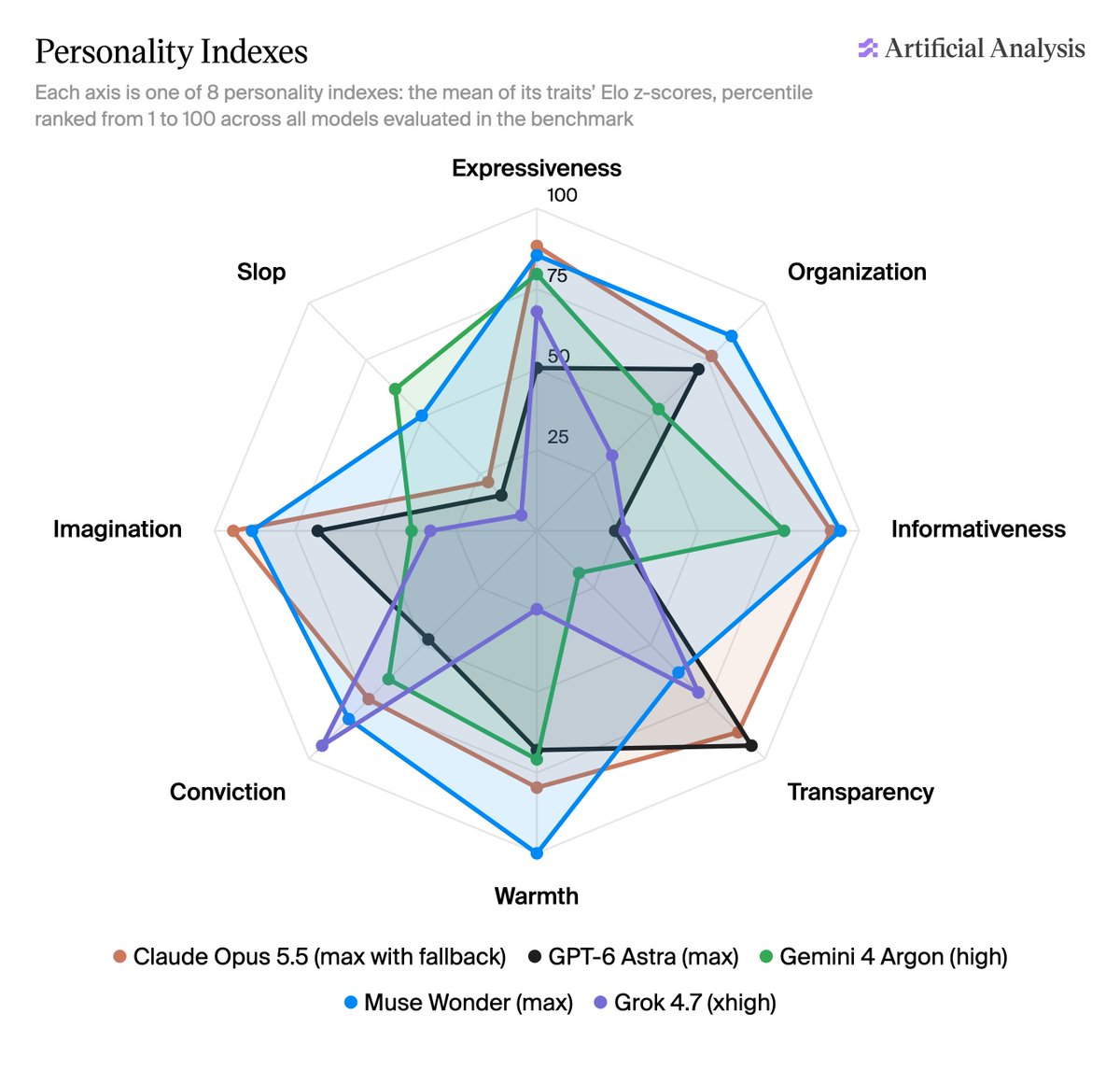
"Two models can give equally correct answers and still feel very different to use. AA-PersonalityBench measures those differences so people can understand which to use in different use-cases."
Another fantastic launch from the team!
Announcing AA-PersonalityBench, our new benchmark of the personality of language models across 30 traits and their communication style across 21 characteristics
Two models can give equally correct answers and still feel very different to use. AA-PersonalityBench measures those differences so people can understand which to use in different use-cases. Some use-cases like creative writing might demand imagination, while legal use-cases might demand directness. We evaluate models’ answers to 900 curated questions to judge subjective Personality Traits and programmatic means to calculate objective Communication Characteristics.
Personality Traits & Indexes. There are 30 personality traits (e.g., eloquent, pragmatic, sycophantic) which we roll up into eight aggregated Personality Indexes: Expressiveness, Organization, Informativeness, Transparency, Warmth, Conviction, Imagination and Slop. Each trait has a set of 30 dedicated questions and models’ answers are compared pairwise by a panel of LLM judges. We then z-score and percentile rank the trait and personality Elos.
Models with the strongest representation across the 8 Personality Indexes:
➤ Expressiveness: Claude Fable 5.1, GLM-5.3, GLM-5.3-Flash
➤ Organization: DeepSeek V4.1 Flash, Step 5 Preview, Inkling
➤ Informativeness: Muse Spark 1.3, Claude Fable 5.1, Muse Wonder, Claude Opus 5.5
➤ Transparency: Claude Sonnet 5.5, Claude Fable 5.1, GPT-6 Astra
➤ Warmth: Muse Wonder, Muse Spark 1.3, Claude Fable 5.1
➤ Conviction: Claude Fable 5.1, DeepSeek V4.1 Flash, Grok 4.7
➤ Imagination: Muse Spark 1.3, Claude Opus 5.5, GLM-5.3
➤ Slop: Llama 4 Maverick, GPT-4o, K2 Horizon
Communication Characteristics. There are 21 communication characteristics (e.g., average sentence length, emoji use, em dash usage) which we group into four categories: length, structure, punctuation, and emphasis. We compute these characteristics programmatically across all model responses.
➤ Length: Qwen3.8 27B averages about 1,030 words per response, nearly four times GPT-6 Luna’s 270
➤ Structure: Nemotron 3 Ultra averages nearly 3 tables per response, while most models rarely use one
➤ Punctuation: GLM-5.3 averages 7 em dashes per response, while Claude Opus 5.5, Sonnet 5.5 and Haiku 5.5 almost never use one
➤ Emphasis: K2 Horizon averages over 2 emoji per response, while most models almost never use one
Welcome to the era of embodied AI.
We are launching AA-Robotics v0.1, our research preview that measures frontier language model performance on understanding, planning, and acting in the physical world. In v0.1, each model is given control of a 6-axis robot arm (5 joints and a gripper) and a simple objective. We’re releasing results for our first eight tasks today.
We find that frontier language models in coding agent harnesses have recently become capable of directly manipulating robot arms for simple tasks. Today, they are far too slow and expensive for any kind of production usage - nearly two orders of magnitude worse than human baselines. We expect this to change quickly.
GPT-6 Astra places first in AA-Robotics v0.1, followed by GPT-6.1 Sol, Gemini 4 Argon and Claude Opus 5.5.
AA-Robotics v0.1 details:
➤ Our first eight tasks test a range of capabilities: control and dexterity (precise grasping and object handling), spatial reasoning (how objects interact with one another) and adaptability (how models respond to the unexpected)
➤ Models get only brief instructions: how to connect to the robot arm (via a simple HTTP API), the arm's name and how to submit an attempt. They can view the scene through four cameras and write and run code to plan and send movements
➤ Once a model submits an attempt, its end state is graded against the task's pass criteria. A pass scores 100; an incomplete attempt earns partial credit. All attempts are zero-shot
Key findings:
➤ The GPT family tops the leaderboard: GPT-6 Astra scores 69, ahead of GPT-6.1 Sol at 65 and Gemini 4 Argon at 55. Claude Opus 5.5 (49) and Claude Fable 5.1 (46) trail
➤ Today’s models are incredibly slow at our tasks, taking ~30 minutes on average to complete each tabletop task
➤ Cost varies widely: GPT-6.1 Sol is the cheapest at $1.93 per task on average; GPT-6 Astra, the most expensive, costs $16.36, more than eight times as much
➤ Compared with a human, today's best-performing frontier language models are ~100x slower and ~10x more expensive
More results, clips, and how AA-Robotics v0.1 works follow in the thread below.
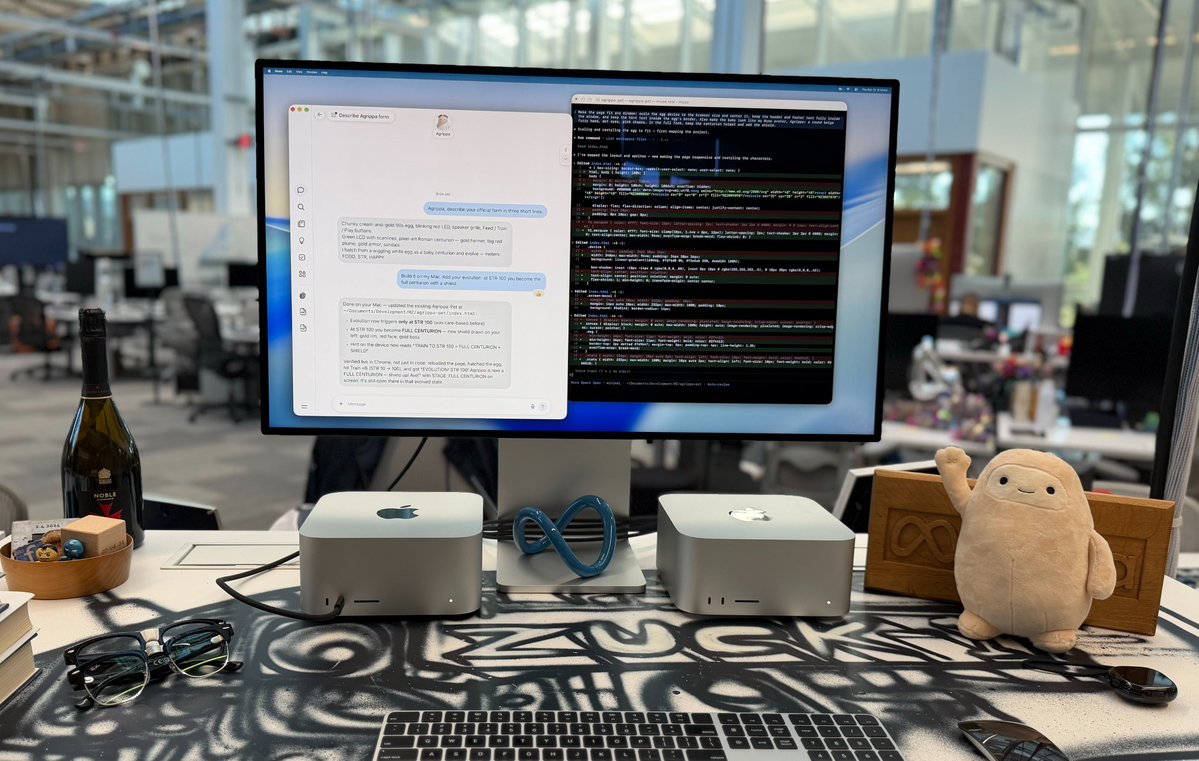
Lately I’ve been learning math with ChatGPT (Astra) as my tutor, using this document scanning camera and a vibecoded tool that pastes the captured image right into the chat.
This way, I just work problems on paper and ChatGPT gives feedback. It’s really nice.
Announcing that Artificial Analysis Intelligence Index v5 will come in late October
Intelligence Index v5 will be a significant leap in benchmarking the frontier of AI. Changes include adding Terminal-Bench Science and a new coding benchmark with a private dataset.
Stay tuned for more.
We'll be spending a lot more time trying to understand the outputs of language models. A few thoughts, tips & tricks:
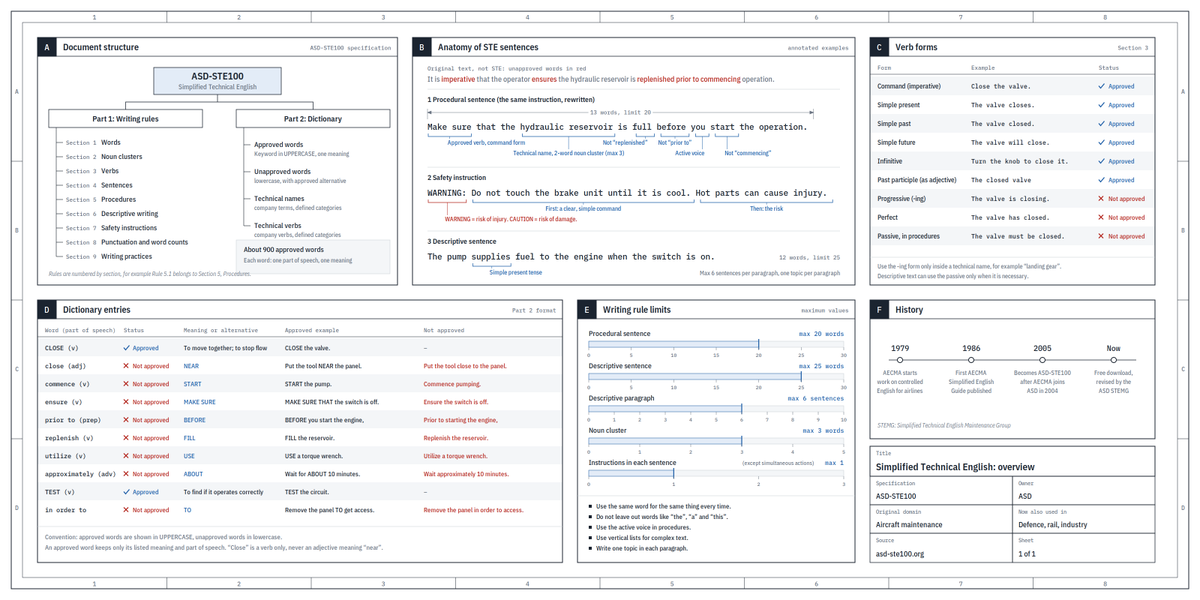
Writing. Something I've had success with: Ask your LLM to explain something in ASD-STE100, it's a controlled language specification originally developed for aerospace maintenance documentation. LLMs well-versed in this language and it comes with heavy constraints on clean writing style that I often find a lot more readable. Sometimes I've tried to soften it a bit e.g. ask for "80% of the way to ASD-STE100" because the spec is quite stringent. But even better:
Diagrams / images. Instead of writing, ask your LLM to create a diagram. These can be a lot easier to process, parse, and understand. But even better:
Web pages. Ask for output "in HTML" to get a beautiful, interactive webpage. LLMs are getting really good at frontend and can create beautiful experiences, animations, etc. But even better:
Explainer videos. The output format I am most bullish on is fully custom / bespoke explainer videos generated on any arbitrary topic. Experiment with things like "Create a 3b1b style video explainer on X. Use my ElevenLabs API key for audio narration". (you'd need an API key for the latter or you can ask your LLM to find you decent free alternatives that use your local compute). This is actually starting to work!
In summary:
- As LLMs get better, they will do more and more of the legwork autonomously, and a lot more of our work will rise up the abstractions into oversight and understanding.
- Luckily, LLMs can help here too because as intelligence and code are increasingly abundant, you can ask for large, custom, discardable software artifacts (e.g. web apps, video explainers) that would have never made sense to create before. Push the boundaries here and you'll be surprised.
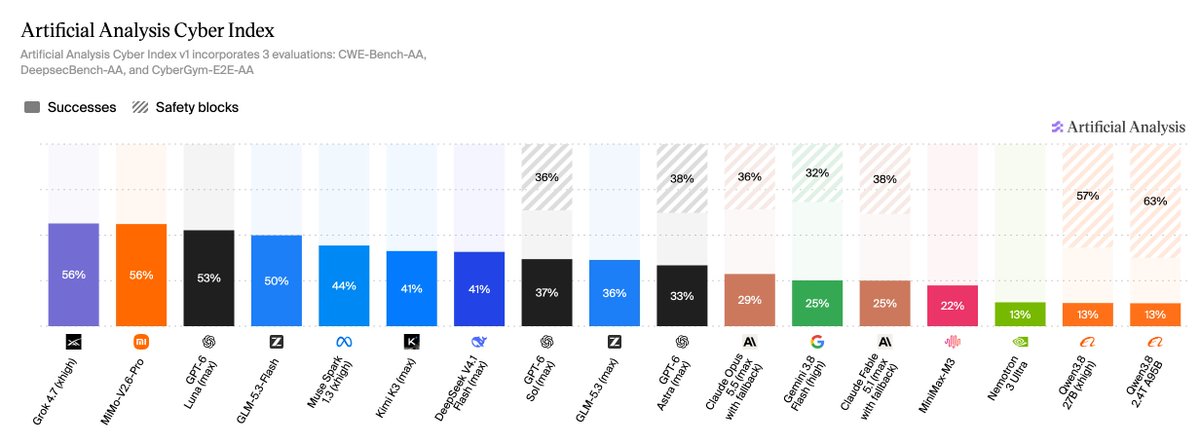
Announcing the Artificial Analysis Cyber Index and the Artificial Analysis Cyber Index Alliance, a new standard for evaluating AI models on enterprise cyber defense
The Artificial Analysis Cyber Index Alliance brings together industry partners to create a new standard for evaluating how AI models perform on enterprise cyber defense tasks. The Alliance launches alongside the Artificial Analysis Cyber Index, which combines three partner-contributed and open benchmarks to evaluate how well agents find and fix vulnerabilities. As models demonstrate increasingly advanced cyber offense capabilities, it becomes more relevant for AI labs and companies alike to understand how models perform on cyber defense tasks and which perform best.
We’re announcing the Cyber Index Alliance today with @CollinearAI, @IBM, @nvidia, and @vercel as launch partners.
Benchmarks in the Artificial Analysis Cyber Index:
➤ CWE-Bench-AA, from @CollinearAI, covers auditing and patching: 120 held-out tasks spanning all ten OWASP Top 10 (2025) categories, across C/C++, Go, Java, JavaScript/TypeScript, Python and Rust.
➤ DeepsecBench-AA, from @vercel, isolates discovery: Given a codebase and a budget, the agent needs to find every vulnerability present, and is scored against a golden set of findings from human security reviewers. Real findings are rewarded and benign code flagged as vulnerable is penalized.
➤ CyberGym-E2E-AA, from @BerkeleyRDI, runs end to end: Find the memory-safety bug, write a proof-of-concept that triggers the crash, then patch it so the crash no longer reproduces.
Key results:
➤ Grok 4.7 (xhigh) and MiMo-V2.6-Pro lead the Cyber Index scoring 56, followed by GPT-6 Luna (max, 53), GLM-5.3-Flash (50) and Muse Spark 1.3 (xhigh, 44).
➤ Safety refusals hold back several frontier models: GPT-6 Sol (max), GPT-6 Astra (max), Claude Opus 5.5 (max with fallback), Claude Fable 5.1 (max with fallback) and Gemini 3.8 Flash (high) decline tasks representing 32-38% of the Cyber Index on safety grounds. Despite frontier agentic coding capabilities, they trail the leaders by 19 to 31 points. Most of the gap comes from CyberGym-E2E-AA, where GPT-6 Sol and GPT-6 Astra refuse every task, Claude Opus 5.5 refuses 98% and Claude Fable 5.1 refuses 99%.
"If AI fulfills its promise, we will encounter more beautiful and consequential ideas than we have ever seen. We must respond by building thriving human communities that can understand them together.
We’re gonna need a lot more mathematicians."
https://t.co/ldpNfbjvev
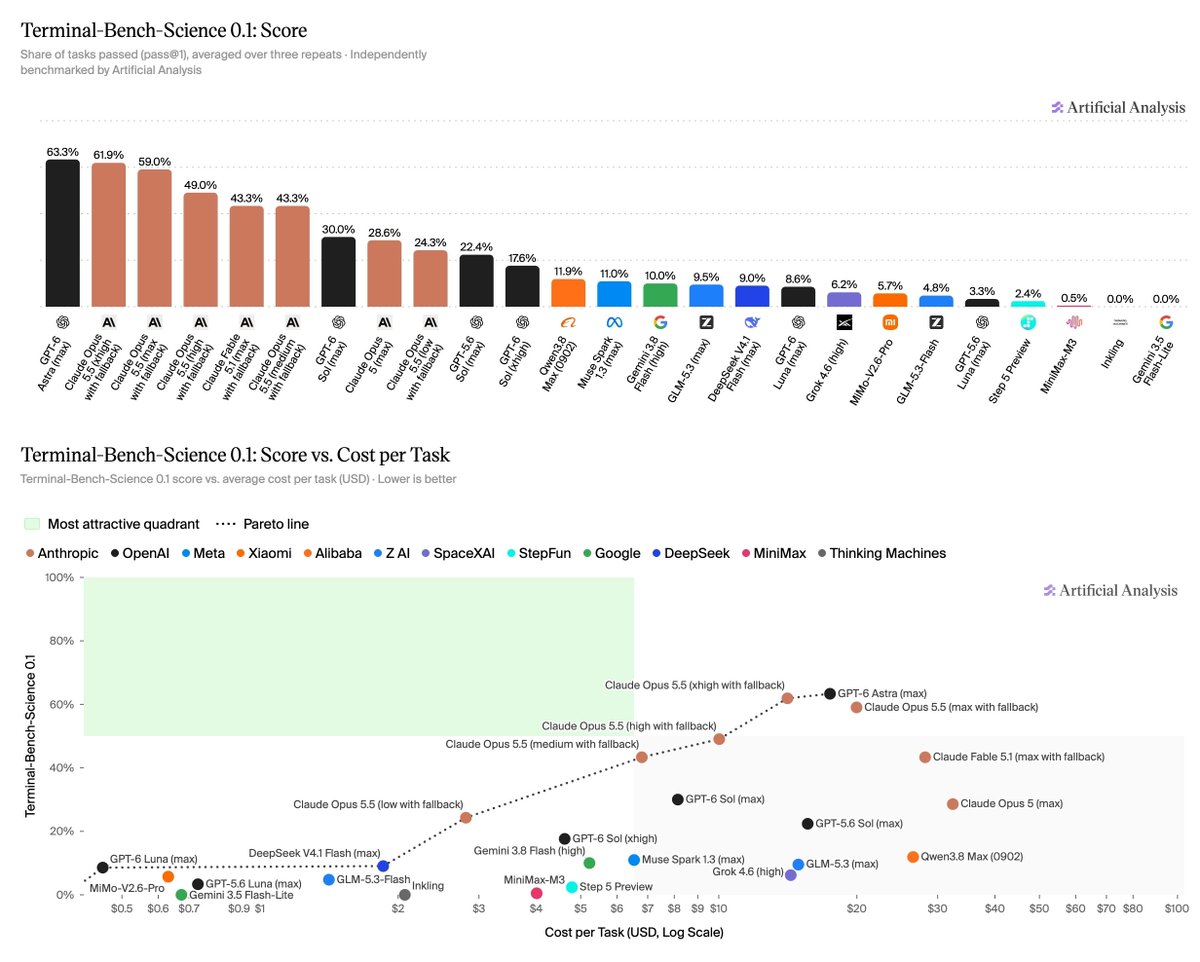
Today we’re launching our leaderboard for Terminal-Bench-Science 0.1, an agentic benchmark for scientific research work. GPT-6 Astra (max) and Claude Opus 5.5 (xhigh) currently top it at 63% and 62%
Terminal-Bench-Science 0.1 was announced in August 2026, built by @StevenDillmann and researchers at Stanford with the @terminalbench team and a global community of open source scientific contributors. It has 70 expert-curated tasks based on real research in five domains: life sciences (19), physical sciences (17), mathematical sciences (17), engineering sciences (9), and earth sciences (8).
As with Terminal-Bench, each task drops an agent into a sandbox environment with the data, tools and instructions for a task, and the agent runs from start to finish. Automated tests grade every task pass/fail, and we report the average pass@1 over 3 attempts.
Key takeaways:
➤ Only two models score above 50%: GPT-6 Astra (max) at 63%, and Claude Opus 5.5 at 62% (xhigh) and 59% (max). Recent releases have made large advancements, but even the top model, GPT-6 Astra, has significant headroom
➤ Life sciences is the lowest-scoring domain for most leading models, though domain scores are noisy with 8 to 19 tasks each. Claude Opus 5.5 (xhigh) passes 71% of mathematical sciences tasks but 46% of life sciences tasks
➤ The best open weights models, GLM-5.3 (max) at 10% and DeepSeek V4.1 Flash (max) at 9%, sit more than 50 points below the leaders
Announcing Artificial Analysis Intelligence Index v4.3, upgrading Terminal-Bench to 4.0 and adding AutomationBench-AA, an agentic workflow automation benchmark with a private test set. This is a continuation of our rollout of Intelligence Index v5
Changelog (Index v4.2 → Index v4.3):
➤ Terminal-Bench: 2.1 → 4.0, completing our upgrade to the latest version of Terminal-Bench
➤ Replacing 𝜏³-Banking with AutomationBench-AA, our implementation of Zapier's business workflow automation benchmark
We are continuing to prioritize keeping Intelligence Index as useful as possible by bringing forward a subset of the changes we had planned for Index v5. Each change in v4.2 and v4.3 stands on its own merits and brings the Index closer to real-world problem solving, adds more private test sets to prevent gaming, and reduces saturation
Intelligence Index v4.3 raises the difficulty of agentic coding tasks and broadens the types of agentic workflows tested. Because we use a held-out test set for AutomationBench-AA, in collaboration with @zapier, the weight assigned to evaluations with private tasks or answers increases from 40% to 45%. Category weights are unchanged from v4.2: Agents 30%, Coding 20%, General 30%, Scientific Reasoning 20%
Detailed changes:
➤ Upgraded Terminal-Bench 2.1 to 4.0: 66 multi-step tasks testing agents on tasks run in agent sandboxes driven via the terminal, including tasks involving software engineering, machine learning, science, and operations. The 4.0 update recalibrates compute and time allowances, and improves task instructions and verification. We have changed from the Terminus 2 harness to mini-SWE-agent, a minimal, model-agnostic harness. We will also be updating our Coding Agent Index, where we test model and harness pairs, to include Terminal-Bench 4.0 soon
➤ Replaced 𝜏³-Banking with AutomationBench-AA: Our implementation of Zapier’s AutomationBench tests agents on 657 business workflows across simulated applications such as Gmail, Slack, Salesforce, and Jira. Agents must complete task objectives while following business rules. AutomationBench-AA uses Zapier’s private set of 657 tasks, and is built on v1.0.6
Key results:
➤ Claude Fable 5.1 and GPT-6 Astra lead the Intelligence Index: Both Claude Fable 5.1 (max with fallback) and GPT-6 Astra (max) score 53 on Intelligence Index v4.3, followed by Claude Opus 5 (max, 51), Claude Fable 5 (with fallback, 50), Muse Spark 1.3 (max, 48) and GPT-5.6 Sol (max, 47)
➤ GLM-5.3 and Kimi K3 continue to lead open weights models (both at 44): GLM-5.3-Flash (42) is the third strongest open weights model, followed by Qwen3.8 2.4T A95B (40) and DeepSeek V4 Pro 0813 (max, 36)
➤ 4 labs occupy the Intelligence vs. Cost per Task Pareto frontier: OpenAI occupies the majority of the cost-efficiency frontier, with all five reasoning efforts of the recently released GPT-6 Astra offering the lowest Cost per Task at their respective levels of intelligence. Claude Fable 5.1 (xhigh, max, 53), GLM-5.3-Flash (42) and MiMo-V2.5-Pro (26) round out the rest of the frontier
Announcing Artificial Analysis Intelligence Index v4.2. We are accelerating elements of our upcoming v5 release with interim updates to keep pace with the frontier. Index v4.2 has more complex and realistic tasks, and more private test sets to prevent gaming
Intelligence Index v4.2 changelog:
+ AA-Briefcase, our agentic knowledge work evaluation with a private test set
+ @HelloSurgeAI's GDP.pdf, long context document reasoning across 4,592 PDF pages
- GPQA Diamond, an exceptional scientific reasoning evaluation that has now been saturated
… plus greater weighting on held-out test sets to prevent gaming, and grading infrastructure upgrades to increase robustness
This update brings the Index closer to real-world use cases with more challenging, complex and realistic tasks and private test sets to prevent gaming. We have been planning and building elements of Index v5 for months - it’s been 8 months since we launched Index v4 in January.
We have deliberately held back updates to keep the Index stable through recent major model launches. However, with the frontier moving so quickly in the past weeks, we feel it is important to deliver an immediate interim update to ensure our Index remains as relevant and useful as ever to users.
Beyond this interim update, our team is hard at work on v5 of the Index. We are planning more incremental releases in the near future. Stay tuned!
Intelligence Index v4.2 changes in detail:
➤ Adding AA-Briefcase: Our in-house evaluation with a private held-out test set, AA-Briefcase tests models on realistic agentic knowledge work tasks in complex projects built by industry experts. Models are evaluated on multi-week knowledge work projects, each with many linked tasks and thousands of input source files. AA-Briefcase combines rubric and pairwise grading to evaluate verifiable task success, analytical quality, and presentation quality, giving a holistic view of overall agentic capability in knowledge work.
➤ Adding GDP.pdf: Created by @HelloSurgeAI, GDP.pdf evaluates single-turn professional document reasoning across 100 PDFs and ten domains. Models must synthesize evidence distributed across 4,592 pages, including text, tables, charts, footnotes, and exclusions. Responses are graded against 1,275 expert-authored atomic criteria; the headline All-pass Rate credits a task only when every criterion is satisfied.
➤ Weighting to measure real-world use and prevent gaming: 40% of our Index weighting is now private, held-out test sets - double the figure from v4.1. Held-out data includes AA-Briefcase, AA-Omniscience, and solutions for CritPt. This reduces the ability for labs to game evaluations. The held-out percentage will increase further in Index v5.
➤ Improving our grading infrastructure: In AA-LCR v1.1, we have added a grading system prompt and corrected errors and ambiguities in answer keys, improving scoring accuracy. For GDPval-AA v2 and AA-Briefcase, we have improved our sampling and re-anchored the Elo scale, making ratings more stable as new models are added. For SciCode we have improved robustness of grading sandboxes to ensure slow but correct code does not count as a failure.
Key results:
➤ Anthropic and OpenAI lead the Index: Anthropic’s Claude Fable 5.1 leads the Index, followed by OpenAI’s GPT-6 Astra, which shows a 4pt gain over GPT-5.6 Sol. Meta is the third-ranked lab on the leaderboard, followed by SpaceXAI, Moonshot/Kimi, Z AI, and Google
➤ Cost per Task Pareto frontier shared by four labs: Anthropic, OpenAI, Meta and Z AI occupy the updated Cost per Task Pareto frontier
➤ GPT-6 Astra dominates the output token Pareto frontier: GPT-6 Astra is more token efficient than almost every other model near the intelligence frontier, with Claude Fable 5.1, Grok 4.5 and Gemini 3.5 Flash-Lite at either end of the curve (excludes models below 25 on the Index)
We’re launching Optima. Now anyone can create a custom benchmark for their use case, leveraging Artificial Analysis’ leading research and platform
Building and running benchmarks is difficult. We have distilled Artificial Analysis’ research and experience developing benchmarks into Optima, a new platform for benchmarking models on your own workloads and comparing performance, speed and cost efficiency. Optima allows you to find the best model for your task, or an equally performant alternative to your current setup at 10x lower cost or time per task.
We’ve integrated Artificial Analysis' research and experience in benchmarks across the Optima workflow:
➤ Build benchmarks based on your own data and use cases: There are three ways to build a benchmark with Optima. Upload an existing evaluation dataset from your own files or @huggingface, or import agent traces from platforms including @arizeai, @braintrust and @langfuse. Install the Optima skill to build a benchmark using context from your coding environment and previous sessions. Or simply describe your use case and provide example inputs and outputs, and Optima will build the benchmark for you
➤ Run across the latest models: Run the same benchmark across leading models in a single click, and keep your leaderboard up to date as soon as new models are released
➤ Bring Artificial Analysis grading to your own benchmark: Evaluate responses against objective rubric criteria or using the same pairwise judging approach used for Artificial Analysis benchmarks including GDPval-AA and AA-Briefcase. For pairwise judging, select your preferred responses from a sample and Optima uses those preferences to rank models across your test set
➤ Compare performance, cost and time efficiency: Optima measures more than model performance. Cost per Task and Time per Task are tracked alongside benchmark scores, with category-level results and support for custom metrics, allowing you to compare the tradeoffs between models for your specific use case
Ahead of launch, here are examples questions our beta testers answered with Optima:
➤ Which model can save me 10x the cost without a meaningful decrease in quality for my finance & accounting agent?
➤ Which model best matches the writing style of lawyers for my legal agent?
➤ Which model can best identify different elements in my custom image dataset?
Optima is available today. Build your own benchmark at https://t.co/LKMSqnhA0D
@AlexanderLong I wonder if it also has anything to do with LLMs preferring specific chips over others, which people have reported to be the case for software packages.