Finally out in @NatureComms thanks to all the contributors. Special thanks to Tim and Ali as well as the labs that have supported me and this work over years (none on social media). @RobsInstitute https://t.co/c6d7T01hJS
@anshulkundaje@MoKhalilLab It’s worth considering that zero length x-links and spatial constraints will have roles in biases of ChiP-seq and also cut&run(tag). Estimates of TF molecules/cell are often much less than ChiP-seq peaks soooo perhaps the ground truth isn’t so solid…
We have developed a cysteine-free, highly thermostable tagging system, UTag, that enables single-mRNA translation tracking in live cells. You may wonder how different tagging systems affect translation kinetics—we addressed this by performing a systematic comparison.
Generative design of sequence specific DNA binding proteins.
Most fun paper I have ever written, with @enishasehgal and @YPolitansk15183 and the team, on a project which is a testament to the power of RFdiffusion3.
https://t.co/iYmdXRDBhQ
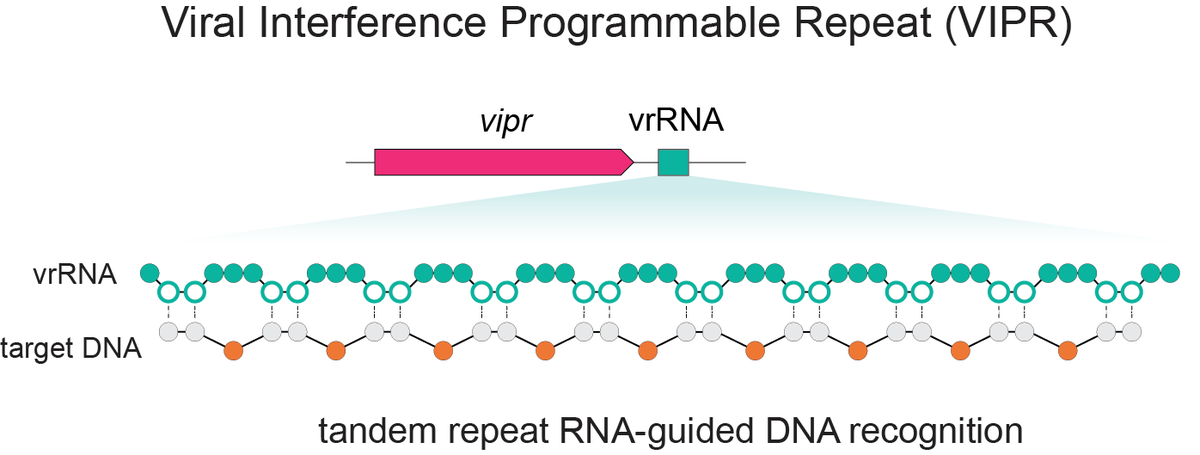
Excited to share our discovery of a new programmable RNA-guided DNA-targeting system hiding inside bacteriophages that predates CRISPR.
We call it VIPR (Viral Interference Programmable Repeat), and it uses an entirely new logic to find its targets.
Thread + link below.
@anandcpatelmdms@FelixHorns@natrevbioeng This is somewhat addressed in their initial publication in cell (protection from Rnases) and discussed in this commentary (I.e. circRNA and saRNA). In addition transient is often what is preferred (i.e. editors etc). Additional modalities and approaches would be useful though
In my latest column, I explain some of my reasons for being deeply skeptical about AI models that claim to understand DNA, genes, and genomes: https://t.co/83cv4HqVMB
@mkoeris Actually... 250K structures was overkill. Technically, one structure with a good alpha/beta mix should've been enough. AlphaFold didn't solve the protein folding problem, it solved the low-resolution to high-resolution problem. (1/2)
We are pleased to share a paper from our lab out in this week’s issue of @Nature, where we show that HT + ML can dramatically speed up the synbio DBTL cycles, profiling gene circuit design spaces at unprecedented scale: https://t.co/7FwDVN4259 (1/16)
Excited to share that the most recent paper from my PhD is now online in @NatureComms! We made new inroads to further our understanding of how the estrogen receptor is regulated and mechanistic conservation across vertebrates. https://t.co/2iNaPtMAyR
Beautiful as you could only expect from Mikko’s lab….. but we are also clearly only scratching the surface re-assaying the most well characterised pathways. The juice will really come from broader more scalable iterations. Not a critique BTW, love the paper!!
Our new preprint is online! Viruses, bacteria and parasites use effector proteins to evade immunity and rewire host cell pathways. Together with @AlexanderStark8, we wondered if we could systematically map what these effectors, regardless of their origin, do in human cells. 1/8
Our new preprint is online! Viruses, bacteria and parasites use effector proteins to evade immunity and rewire host cell pathways. Together with @AlexanderStark8, we wondered if we could systematically map what these effectors, regardless of their origin, do in human cells. 1/8