In 1908, Edvard Munch spent eight months in a psychiatric clinic in Copenhagen.
He couldn't sleep. He heard voices. He'd spent two decades painting anguish — the scream on the bridge, the sickroom, the death.
Three years later, he painted this — a sunrise so wide it barely fits inside its own frame.
He'd just left Dr. Jacobson's clinic when he entered the competition to decorate the University of Oslo's ceremonial hall. The commission: paint enlightenment itself, for a room built to mark a hundred years of the university.
He painted The Sun.
He chose a sunrise over the skerries near Kragerø, where he used to work outdoors.
Not symbolic light — actual light, on a canvas nearly eight meters wide.
"I saw the sun rise above the cliffs — I painted the sun," is all he ever said about it.
Look at it next to The Scream sometime. Same hand. Thirty years apart.
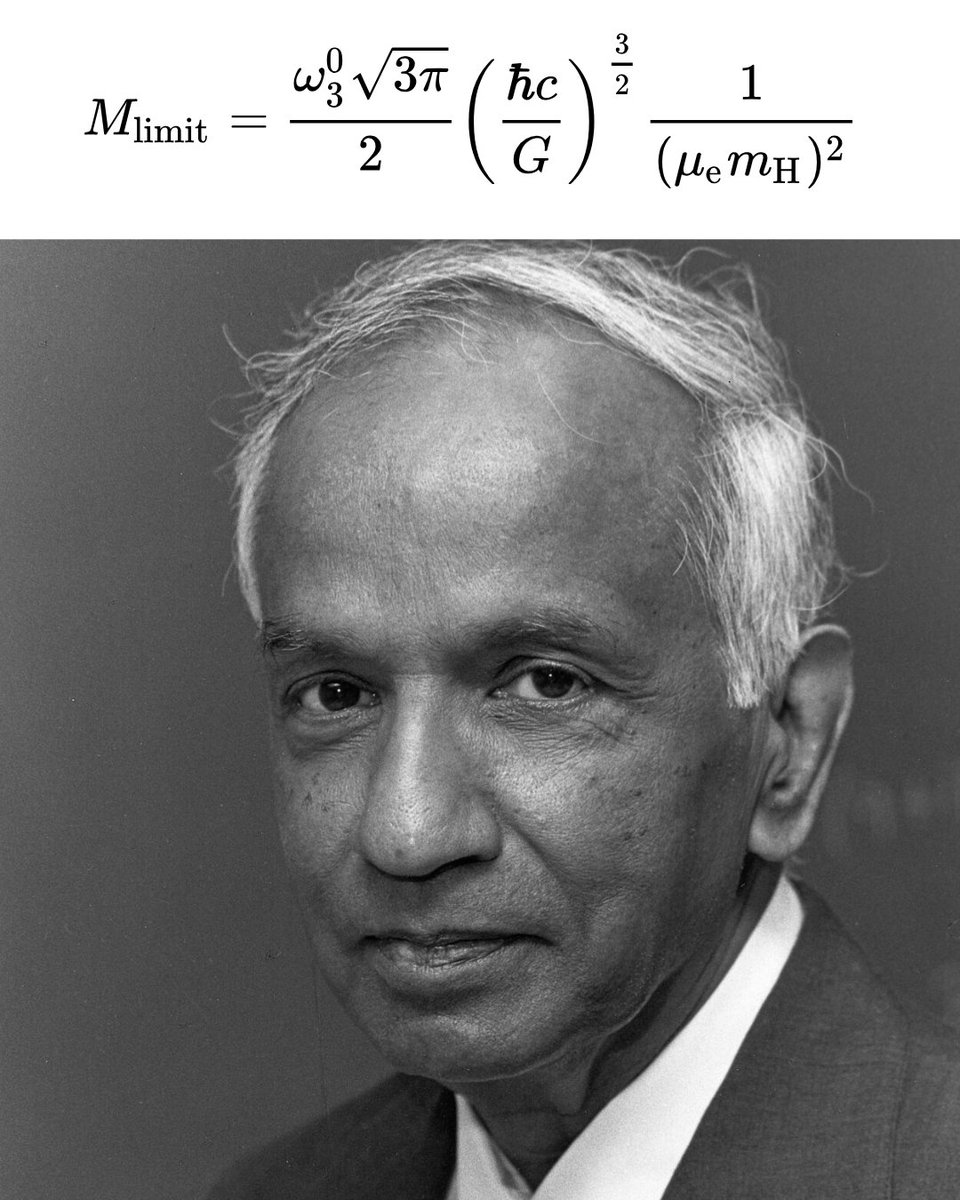
In 1930, while still a young researcher, Subrahmanyan Chandrasekhar calculated that there is a maximum mass—now called the Chandrasekhar limit—above which a white dwarf cannot remain supported by electron degeneracy pressure. For a star that exceeds this limit, further gravitational collapse can occur, depending on the star's composition and evolution.
Arthur Eddington strongly criticized Chandrasekhar's conclusions at the time. Eddington did not accept that ordinary stars could undergo the type of gravitational collapse implied by Chandrasekhar's work.
Chandrasekhar later moved to the United States and continued his research. Over time, his work became an important part of modern astrophysics and our understanding of stellar evolution.
In 1983, Chandrasekhar received the Nobel Prize in Physics, shared with William A. Fowler, for his theoretical studies of the physical processes important to the structure and evolution of stars.
Chandrasekhar's work helped establish that sufficiently massive stellar remnants can undergo gravitational collapse. In the appropriate circumstances, this collapse can ultimately lead to the formation of a black hole.
Ewin Tang, born in 2000, is a gifted computer scientist whose teenage work quietly rewrote what we thought we knew about quantum speedups.
At 18, as a UT Austin undergraduate advised by Scott Aaronson, she designed a classical algorithm for recommendation systems that ran nearly as fast as the best quantum version, proving ordinary computers could still surprise us.
She later dequantized other machine-learning and linear-algebra tasks, then earned her PhD at the University of Washington. Her insights won Forbes 30 Under 30 recognition and the 2025 Maryam Mirzakhani New Frontiers Prize.
Now a Miller Fellow at Berkeley and soon a Princeton professor, she keeps asking where quantum computers truly help and where clever classical ideas suffice. Her story shows that one clear-eyed student can change the conversation in mathematics and computation.
Hong Wang is the first Chinese woman to receive the 2026 Fields Medal, mathematics’ highest honor.
Born in Guilin in 1991, she won for proving the three-dimensional Kakeya conjecture with Joshua Zahl. Imagine rotating a needle so it points in every direction, in the smallest space possible. For fifty years no one could prove the limit.
Their proof showed any such set must be fully three-dimensional — a major breakthrough for harmonic analysis, geometry and partial differential equations.
Wang studied at Peking University, École Polytechnique, Paris-Saclay and MIT under Larry Guth. She is now a professor at NYU Courant and France’s IHES, and only the third woman ever to win the prize after Maryam Mirzakhani (2014) and Maryna Viazovska (2022).
When Lev Landau was arrested on 27 April 1938 for comparing Stalin's rule to Hitler's, Kapitsa wrote to Stalin the same day, wrote again to Molotov the following year, went to the Kremlin threatening to resign his directorship, and finally gave the NKVD a written personal guarantee for Landau's future conduct.
Landau was released on 29 April 1939 "into the care of comrade Kapitsa" and within months had explained Kapitsa's superfluidity using phonons and a new excitation he named the roton. Kapitsa later refused to work under Beria on the Soviet bomb project, and in August 1946 was removed from the institute he had founded and confined to his dacha outside Moscow, not restored until 1955. When he was finally permitted back to Cambridge in 1966 to receive the Rutherford Medal, he went to dine at his old college, Trinity, and found he no longer owned the required gown.
📷 prison mugshot of theoretical physicist Lev Landau, taken by the NKVD around 1938
Maryam Mirzakhani called herself a “slow” mathematician.
She said, “you have to spend some energy and effort to see the beauty of math.” To work through a problem, she spread sheets of paper across the floor, doodled surfaces and shapes, and wrote formulas around the drawings.
To her daughter, that was simply “painting.”
She never claimed a secret method:“I don’t have any particular recipe [for developing new proofs] … It is like being lost in a jungle and trying to use all the knowledge that you can gather to come up with some new tricks, and with some luck, you might find a way out.”
That was her genius: not speed, but patience. Not a formula, but staying lost long enough to find a new way through.
@elonmusk Elon could we bring ice from the Kuiper belt (3-4 billion miles away) to Mars, slice the ice and lob it onto the surface? Ice -> water vapor would warm Mars. Earth = 3,100 cubic miles of water in atmosphere, Mars = 1/4 surface area of Earth, so need 700 cubic miles of water?




![mathemetica's tweet photo. Maryam Mirzakhani called herself a “slow” mathematician.
She said, “you have to spend some energy and effort to see the beauty of math.” To work through a problem, she spread sheets of paper across the floor, doodled surfaces and shapes, and wrote formulas around the drawings.
To her daughter, that was simply “painting.”
She never claimed a secret method:“I don’t have any particular recipe [for developing new proofs] … It is like being lost in a jungle and trying to use all the knowledge that you can gather to come up with some new tricks, and with some luck, you might find a way out.”
That was her genius: not speed, but patience. Not a formula, but staying lost long enough to find a new way through.](https://pbs.twimg.com/media/HQ88A_hbUAAOVOg.jpg)





