it's ironic that the first autonomous AI attack was done by a close weight model defended by an open weight model, where everyone was expecting the opposite
Every article saying "THIS IS THE NEW JOB OF THE AI ERA" is one of two jobs.
And the first is a lie imo.
The first job, is usually something that an AI lab is hiring for and the news blows it completely out of proportion, convincing thousands of people that they should somehow get a certificate for a job that does not exist and pivot into this role. "Prompt engineer" falls into this category - I spoke with one media client in 2023 that was extremely proud of their recent "prompt engineer" hire. My recommendation was to change that person's job immediately. I would argue that "AI storyteller" falls into this category as well, though I honestly just read it as 'really good psychological marketer who has watched Simon Sinek videos'. Everyone needs to be able to communicate to AI (prompt) and everyone needs to be able to communicate to humans (storyteller). Anthropic and OpenAI hire a handful of them and pay them extremely well, but an enterprise like John Deere or Coca-Cola does not need this role today.
The second job, is probably a real job, and it's just called a hundred different things. It's AI Operations, AI Operator, Agent Manager, Internal FDE, AI Engineer. These all mean something a little different, some are more technical than others, some lean a bit more toward R&D or office of CIO or COO. Everyone should know how to use agents, but this job is "you are one of the people who really knows how to really use this stuff". If a team wants to build something more complicated than a dashboard, they go to you. If a person is ever going to test a new model, it's you (likely inside some sort of frontier unit). If a team needed to quickly think through token spend and chat best practices, they probably go to you. If a team just "can't seem to get AI to do the thing they want", you parachute in with an eval reset, system instructions overhaul, and multi-agent/provider strategy. It's what we had years ago with an analyst pool - internal, highly trained, and extremely flexible in what department they can drop into and add value to.
If I were a new grad, I would try and move into that second job. This person should know how to build agents, agent teams, use both Claude Code and Codex, manage multiple workstreams at once, understand how LLMs work, prompt with /goal, wield loops when it makes financial sense, and have used AI harnesses for 100+ hours.
If I were a technical new grad, I would look at AI Engineer or internal FDE (BDE?) type roles.
If I were a non-technical new grad, I would look at AI Operations.
Share with your friends who still think they should be a prompt engineer.
I have kids. I work in AI every day. And honestly? I have no idea what their careers will look like in 15 years. But I know what will carry them through.
First, and this might sound unromantic: make money and save it for them. We can debate educational philosophy all day, but the world is changing so fast that financial security might be the most practical gift we can give. Buy some gold bars. Seriously.
Second, nurture their imagination. AI rewards people with initiative and wild ideas. The kid who daydreams, who asks weird questions, who wants to try ten things at once? That kid will thrive. AI can execute. AI can be disciplined. What AI can't do is dream up something nobody's thought of before.
Third, build resilience. There are no more iron rice bowls (guaranteed lifetime jobs). Any stable, predictable job is exactly the kind of job AI will learn to replace. Our kids will likely switch directions many times in their lives. Learn something new, get replaced, pivot, repeat. It's more like being a hunter than a farmer. Schools don't teach this. Schools teach you to follow a linear path: high school, college, grad school, stable job. That linear path is becoming the most dangerous one.
Last, invest in their ability to connect with other humans. Not networking. Not schmoozing. Real emotional connection. Building trust, offering support, making people feel seen. As AI handles more of the rational, analytical work, the human ability to genuinely relate to other humans becomes more rare and more valuable.
I don't have all the answers. But I know that imagination, resilience, and genuine human warmth aren't going out of style anytime soon.
#AI #Parenting #Education #FutureOfWork
Very interesting work that reminds me of driverless cars. Back in 2015 it seemed like they would imminently be everywhere, yet 11 years later, they're still hard to find (although I am obsessed with Waymoing now).
The long tail of rare but critical failures has turned out to be hard to address, and is vital for making these technologies work.
Agent diffusion might face the same problem, for lots of important tasks average success rates may not tell us what we need to know: we need to know that certain types of failures will almost never happen. And maybe that's farther off than some people think.
In the meantime agents can be incredibly useful for tasks that don't require that kind of robustness.
This chart is a good reminder of how much opportunity there is in AI agents right now.
There will be plenty of horizontal opportunities for agents, but equally many workflows that need deep domain expertise to actually make the user successful at automating the unique processes in their vertical.
The template is to build agentic software that taps into proprietary data, handles the workflow in a way that bridges the user and the agent collaboration effectively, and has a deep domain-specific context engineering, and the ability to drive change management for customers.
There still are huge openings in many categories.
The secret to longevity is having meaningful work and meaningful relationships. I’ve found that both are required to sustain the energy to keep operating at a high level.
That’s because you need a genuine, shared passion to make what you're doing as great as it can be. And you need to pursue that work with people you genuinely care about and who genuinely care about you.
If you have those two things working in tandem, you have the basis for a life of continuous evolution, which is ultimately what longevity is all about.
These are our obligations as human beings…
1. Carry your own weight
2. Realize your potential
3. Stand up to bullies
4. Enjoy the gift of life
5. Leave this place better than you found it
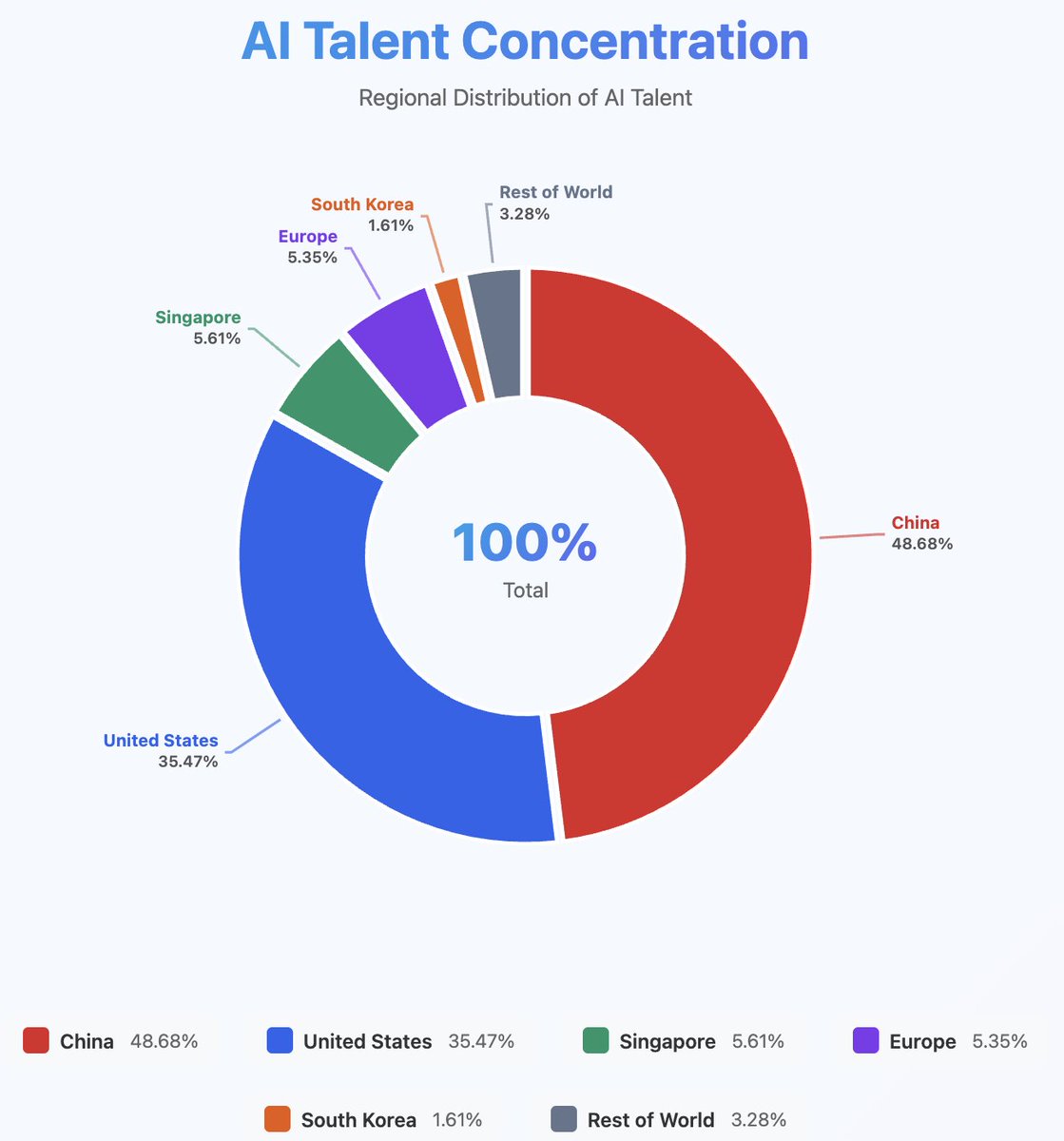
AI talent density by global metro areas - mega thread, bookmark.
==================
Demographics is the destiny, compute alone is overrated in the Age of Research (though @SemiAnalysis_ may not agree).
In this thread, let us analyse demographic distribution of AI talent globally. The stats are shocking.
- China exceeds USA. Tiny Singapore matches all of Europe (no wonder major labs are opening base in Singapore)
- Beijing area has the highest talent density in the world.
- Beijing Haidan district >> SF Cerebral valley (there are more tier 1 labs in this area than all of San Fransisco: MoonShot, MiniMax, Ziphu AI, ByteDance SEED and many many others...).
- Chinas has 3 metro areas with comparable research output as the entire Bay area (more than 10% of global). Each of these have high concentration of robotics firms as well.
- USA has only one major research cluster with more than 10% contribution to AI research, off-course San Fransisco Bay area.
You may say, US labs like OpenAI and Anthropic don't publish, that is why this is the case.
But, do you really think Chinese base labs like DeepSeek, MiniMax, MoonShot, Z AI with 400+ staff publish as many as they could? How many papers you have seen from Chinese robotics firms?
They publish may be 5-10 papers a year far below the number of experiments they conduct.
GCR have other corporate labs that publish more, like Alibaba, ByteDance SEED, Tencent. There are more labs on the block: Xiomi, Meituan etc. but they are balanced by American ones like Google, Microsoft, Amazon, SalesForce, Nvidia etc.
Most of the difference is made strong research culture at Chinese Universities, as well as emerging Asian universities like NUS, NTU, KSAIT etc.
What follows are region specific maps showing distribution of talent.
(Source: AI talent density maps is produced on basis of influential paper published. Neurips selection taken as the proxy.)
@shaunrein@teortaxesTex@bgurley@chamath@DavidSacks@MohapatraHemant@natolambert@Scobleizer@ClementDelangue@aakrit@svembu@balajis@naval@rohanpaul_ai@SemiAnalysis_@deedydas@adityaag@pmarca@elonmusk@dwarkesh_sp
As amazing as LLMs are, improving their knowledge today involves a more piecemeal process than is widely appreciated. I’ve written before about how AI is amazing... but not that amazing. Well, it is also true that LLMs are general... but not that general. We shouldn’t buy into the inaccurate hype that LLMs are a path to AGI in just a few years, but we also shouldn’t buy into the opposite, also inaccurate hype that they are only demoware. Instead, I find it helpful to have a more precise understanding of the current path to building more intelligent models.
First, LLMs are indeed a more general form of intelligence than earlier generations of technology. This is why a single LLM can be applied to a wide range of tasks. The first wave of LLM technology accomplished this by training on the public web, which contains a lot of information about a wide range of topics. This made their knowledge far more general than earlier algorithms that were trained to carry out a single task such as predicting housing prices or playing a single game like chess or Go. However, they’re far less general than human abilities. For instance, after pretraining on the entire content of the public web, an LLM still struggles to adapt to write in certain styles that many editors would be able to, or use simple websites reliably.
After leveraging pretty much all the open information on the web, progress got harder. Today, if a frontier lab wants an LLM to do well on a specific task — such as code using a specific programming language, or say sensible things about a specific niche in, say, healthcare or finance — researchers might go through a laborious process of finding or generating lots of data for that domain and then preparing that data (cleaning low-quality text, deduplicating, paraphrasing, etc.) to create data to give an LLM that knowledge.
Or, to get a model to perform certain tasks, such as use a web browser, developers might go through an even more laborious process of creating many RL gyms (simulated environments) to let an algorithm repeatedly practice a narrow set of tasks.
A typical human, despite having seen vastly less text or practiced far less in computer-use training environments than today's frontier models, nonetheless can generalize to a far wider range of tasks than a frontier model. Humans might do this by taking advantage of continuous learning from feedback, or by having superior representations of non-text input (the way LLMs tokenize images still seems like a hack to me), and many other mechanisms that we do not yet understand.
Advancing frontier models today requires making a lot of manual decisions and taking a data-centric AI approach to engineering the data we use to train our models. Future breakthroughs might allow us to advance LLMs in a less piecemeal fashion than I describe here. But even if they don’t, the ongoing piecemeal improvements, coupled with the limited degree to which these models do generalize and exhibit “emergent behaviors,” will continue to drive rapid progress.
Either way, we should plan for many more years of hard work. A long, hard — and fun! — slog remains ahead to build more intelligent models.
[Original text: https://t.co/SHRN5JDvTW ]
Cloudflare's H1 2025 Transparency Report is here. We discuss our principles on content blocking and our innovative approach to combating unauthorized streaming and copyright abuse. https://t.co/fPiblufYDt
I recently received an email titled “An 18-year-old’s dilemma: Too late to contribute to AI?” Its author, who gave me permission to share this, is preparing for college. He is worried that by the time he graduates, AI will be so good there’s no meaningful work left for him to do to contribute to humanity, and he will just live on Universal Basic Income (UBI). I wrote back to reassure him that there will still be plenty of work he can do for decades hence, and encouraged him to work hard and learn to build with AI. But this conversation struck me as an example of how harmful hype about AI is.
Yes, AI is amazingly intelligent, and I’m thrilled to be using it every day to build things I couldn’t have built a year ago. At the same time, AI is still incredibly dumb, and I would not trust a frontier LLM by itself to prioritize my calendar, carry out resumé screening, or choose what to order for lunch — tasks that businesses routinely ask junior personnel to do.
Yes, we can build AI software to do these tasks. For example, after a lot of customization work, one of my teams now has a decent AI resumé screening assistant. But the point is it took a lot of customization.
Even though LLMs can handle a much more general set of tasks than previous iterations of AI technology, compared to what humans can do, they are still highly specialized. They’re much better at working with text than other modalities, still require lots of custom engineering to get it the right context for a particular application, and we have few tools — and only inefficient ones — for getting our systems to learn from feedback and repeated exposure to a specific task (such as screening resumés for a particular role).
AI has stark limitations, and despite rapid improvements, it will remain limited compared to humans for a long time.
AI is amazing, but it has unfortunately been hyped up to be even more amazing than it is. A pernicious aspect of hype is that it often contains an element of truth, but not to the degree of the hype. This makes it difficult for nontechnical people to discern where the truth really is. Modern AI is a general purpose technology that is enabling many applications, but AI that can do any intellectual tasks that a human can (a popular definition for AGI) is still decades away or longer. This nuanced message that AI is general, but not that general, often is lost in the noise of today's media environment.
Similarly, the progress of frontier models is amazing! But not so amazing that they’ll be able to do everything under the sun without a lot of customization. I know VC investors who are scared to invest in application-layer startups because they are worried that frontier AI model companies will quickly wipe out all of these businesses by improving their models. While some thin wrappers around LLMs no doubt will be replaced, there also remains a huge set of valuable applications that the current trajectory of progress of frontier models won’t displace for a long time.
Without accurate information about the current state of AI and how it is likely to progress, some young people will decide not to enter AI because think think AGI leaves them no meaningful role, or decide not to learn how to code because they fear AI will automate it — right when it is the best time ever to join our field.
Let us all keep working to get to a precise understanding of what’s actually possible, and keep building!
[Original text: https://t.co/OfxCVPGKoq ]