When I first invested in Kalshi, the idea of launching regulated perps felt ambitious yet attainable after meeting n of 1 engineers like Lior. For those not deep into market structure and derivatives, this is a very big deal. After years of waiting, perpetual futures are coming onshore, only on Kalshi.
I expect this category to do tens of billions in volume a month. Derivative markets are now a lot more interesting and happy to see one of my portfolio companies leading the charge to revolutionize finance in America 🇺🇸
My favorite Kalshi value is "Climbing the steeper mountain."
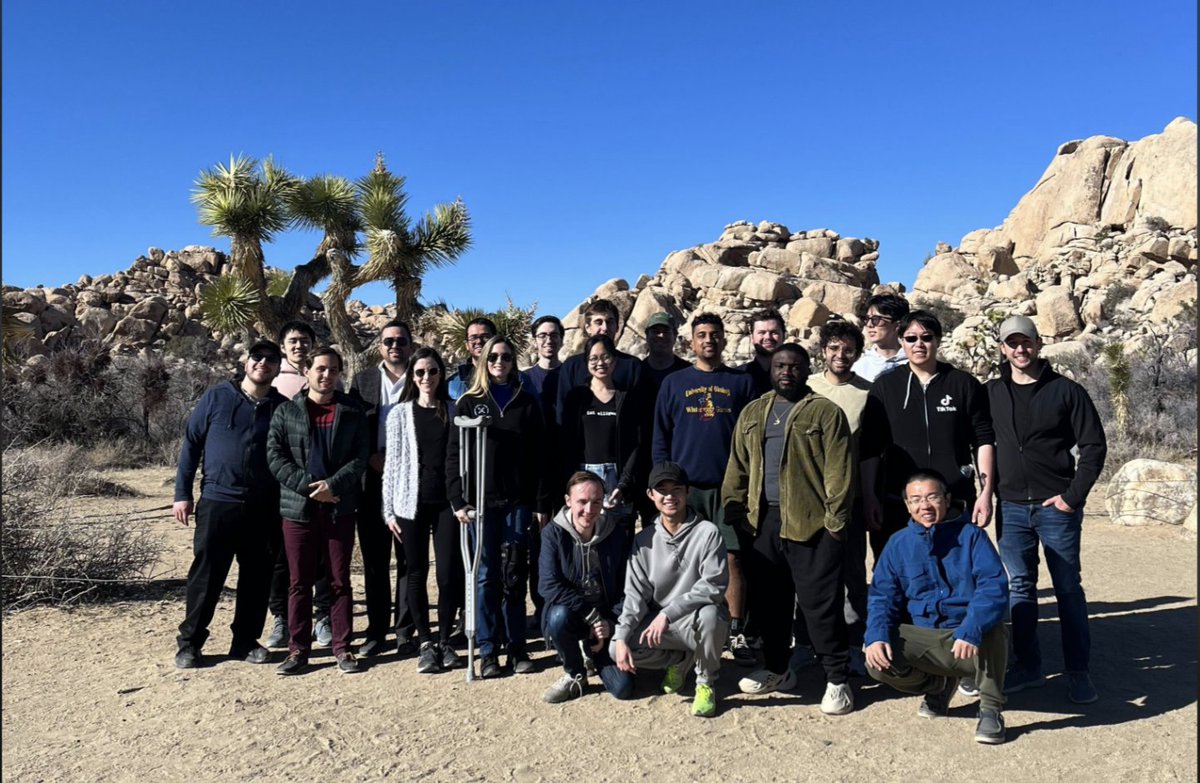
As testament, a few years ago during tougher times, our team climbed a literal mountain of boulders (with @luanalopeslara on crutches!!) to get us back on track. On the climb we learned:
Time moves slower: what looks like a quick success is the result of people never taking a single day for granted.
Motivation comes from within: seeing a peak is gratifying, but you only get there by believing first.
Never give up: the only risk to not reaching the peak is to stop moving.
Better with friends: @mansourtarek_ refusing my excuses, and @liorhir walking with me when I struggled.
Don't leave the group: individual success isn't better than building something greater than the collective.
Today's raise marks new peaks, friends (maybe you 👀), challenges, and beautiful moments along the way. This journey has been the privilege of my life, and I'm grateful for each step.
Kalshi raised $1B at a $22B valuation led by Coatue, with participation from Morgan Stanley, Sequoia, a16z, and others.
In 2018, we were two kids who loved math, markets, and debate. And we had a dream: build the next generation financial market, where we capture a broader set of questions and harness the power of the masses to price them better than Wall Street.
Kalshi was born to fulfill that dream.
Today, most of these questions are traded indirectly, priced through imprecise proxies or negotiated bilaterally in opaque, restricted, relationship-driven markets. But thanks to our incredible community of users who make our markets work, Kalshi has the opportunity to change that by turning historically fragmented and untradeable risk into open, liquid, and standardized markets.
We’ve seen this movie before. When interest rates, currencies, commodities, and crypto moved from dark to lit markets, volume did not just migrate: access expanded, new use cases emerged, and the opportunity grew by orders of magnitude.
Today, Kalshi represents over 90% of US prediction market volume and the majority of activity globally, with annualized volume growing to $178B over the past 6 months.
What started as retail is quickly becoming institutional — hedge funds, asset managers, prop firms, and insurers are beginning to trade, provide liquidity, and hedge real-world risk directly. The scope and scale of prediction markets are just beginning to take shape.
We’re using this new capital to accelerate the institutional adoption underway — unlocking trillions in capital to facilitate active trading and risk management.
Prediction markets are moving from early adoption to core financial infrastructure. This is just the beginning.
When I joined Kalshi back in 2020, the company had just received the regulatory designation it needed to act as a prediction market in the US (after years of work from @luanalopeslara and @mansourtarek_ ), but we still had to actually build the exchange.
As an engineer, it felt like such a gift to be a part of that process: the whole team had such conviction in these markets. We dreamed of the day they would be hooked up to trading terminals and referenced by news anchors worldwide. I thought: “if we can just get the systems up and running, people will come.”
When we processed our first trade, it felt amazing. But I was also hit with the reality that what we had was not enough: how could we scale to millions of markets a day? How could we support collateral return and margin on events? How do we make even low volume markets liquid? Unlike building a matching engine, these were (and some remain) open questions that hadn’t been solved by a financial exchange before.
Thankfully, the team is composed of many of the most hardworking and passionate people I’ve ever met, so though tackling these problems has meant a lot of late nights, it’s never meant a late night alone (shout out to @_rainerds who has been my grinding buddy since the beginning). I'm so grateful to be working alongside each one of you.
There is still so much left to do. If you’re interested in joining us, I’d love to chat!
I wanted new bedsheets last month, so I turned to Amazon and ChatGPT but got taken in circles through SEO slop and had to churn. Yesterday I got off the Zamana waitlist and 15 minutes later had a new set of bedsheets on the way. Killer app!
I have a confession to make.
We thought Kalshi would be an instant success. Of course we did; our team was full of evangelists and missionaries who believed in prediction markets. Better yet, Tarek and Luana had already done the hard part: spending two years to get an exchange license.
But... we had no exchange. What followed was an eight-month gauntlet of technical challenges, business negotiations, and regulatory whiplash. When we finally launched, we thought we’d made it. But no one cared.
This is one of many stories that defines Kalshi. Even through painful, consistent, and creative work, growth was never promised. But the hard times built us up—they taught us how to create from nothing. We fought for every inch of growth and figured out what worked by trying everything that didn't.
When no one else wanted to, we built our own clearinghouse, brokerage, and liquidity. We yearned for growth so badly that we risked the company to democratize elections.
$11B sounds surreal, but we all knew we'd make it here. And we still have so much more to give.
Time to put our money where our mouth is. I like our odds.
Your website should build itself. It should adapt to your visitors and competition in real time.
Introducing Flint: autonomous websites.
We’re already powering pages for @Cognition and @Modal. Today we announce our $5M seed from @Accel and break out of stealth. More below.
If you haven’t seen much of me lately, it’s because I’ve been spending my days scrolling through our beautiful new brand imagery. Now you can too! And grab some compute while you’re at it..
Foundry → Mithril (@mithrilcompute): The AI Omnicloud.
Now generally available!
We’re redefining GPU cloud economics, workload flexibility, and ease-of-use—for the compound AI & agentic era. 🧵 (1/8)
I’m excited to announce our $185M Series C valuing Kalshi at $2B.
The round was led by Paradigm with participation from Sequoia, Multicoin, Peng Zhao, Neo, and Bond Capital.
People choose to work at Kalshi not because of the money we've raised, but because of our ambition: build the most important financial market on the planet.
Today, we celebrate our team and community who have taken prediction markets mainstream and made Kalshi one of the fastest growing companies in America.
What once felt impossible now looks inevitable.
Labric (@LabricPlatforms) is building data and AI infrastructure for scientific labs, streaming and organizing experiment data from all sources (instruments, Excel, etc) into one searchable, AI-ready platform.
Congrats on the launch, @co__ho and Caitlin!
https://t.co/GXekVHNtVu