How do autoworkers choose their battles during the EV transition? My new paper @IR_Berkeley looks at the divergent paths of U.S. and Canadian unions. The key takeaway: Beyond power resources, we must look at internal politics to explain strategic choices. https://t.co/LdH3AkTjh0
How do autoworkers choose their battles during the EV transition? My new paper @IR_Berkeley looks at the divergent paths of U.S. and Canadian unions. The key takeaway: Beyond power resources, we must look at internal politics to explain strategic choices. https://t.co/LdH3AkTjh0
My article "Pushed by Markets, Pulled by Machines" is now published online in *European Union Politics*. It shows how automation risks, when combined with export-driven market pressure, deepen Euroskepticism across Europe. Link to the paper below. (1/5)
📰Our report for the @ilo is out now!
@vdoellgast, Wen Li Thian, Jeonghun Kim, Dina Ginzburg, and I collected case studies from across 5 continents. Read how worker representatives are challenging and transforming AI for more equitable workplaces here👉 https://t.co/vzf79V5z3m
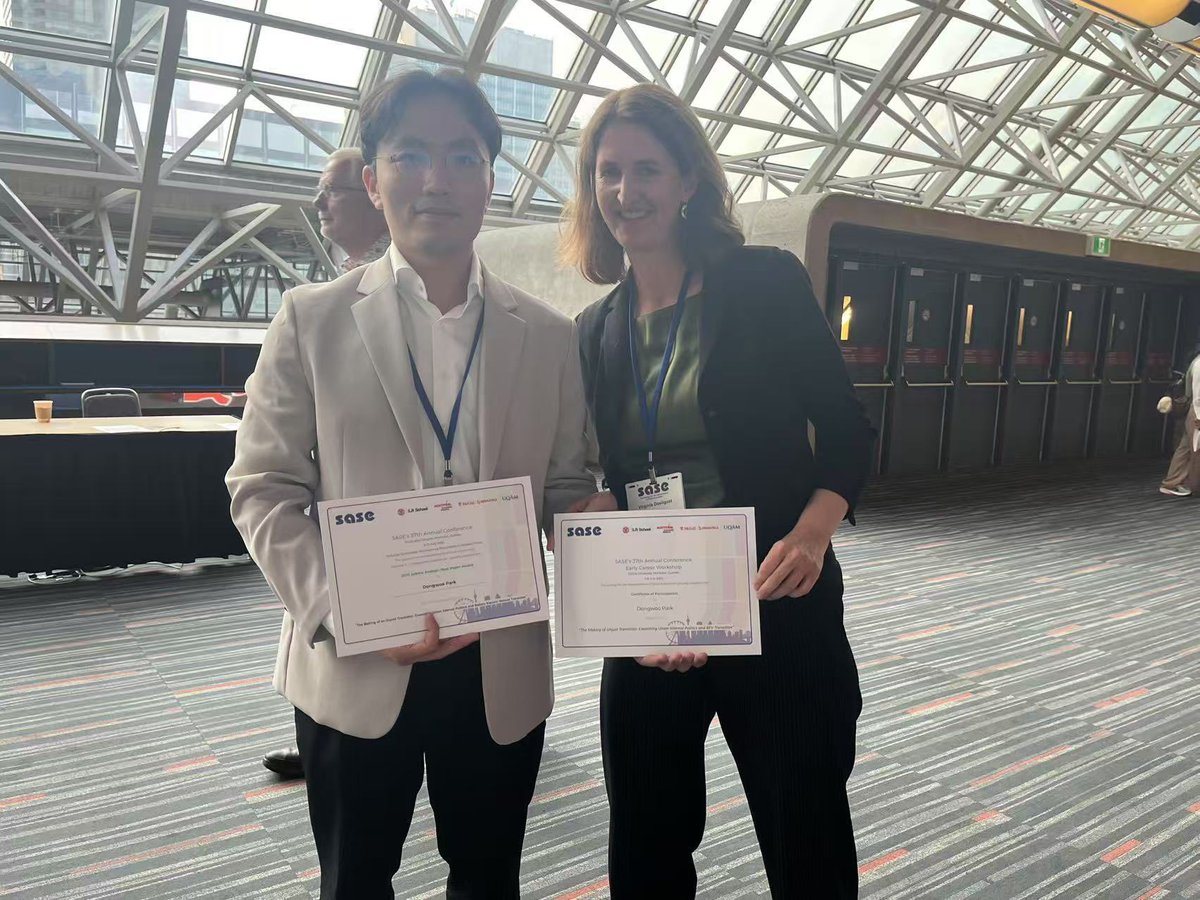
Attending conferences is always meaningful. Even more so when your work receives recognition—this time, with two awards. Honored to receive the 2025 Early Career Award and the Sabina Avdagic Prize for Best Paper in Comparative Capitalism @SASE_Meeting, for my dissertation chapter
🚨This one is very dear to my heart. Social media voice is a promising venue to push workplace changes, but it needs the support that is based on associational and institutional power.
An exciting post doctoral position on labor and AI is open at @cornellilr.
⌛️Deadline: May 15, 2025
🗓️Begins: August 2025
🗒️For more: https://t.co/rY3fUbO6ki
📢Call for papers for a conference and special issue honoring Harry C. Katz is now open!
#⃣ Issue: Labor Relations at a Crossroads: Charting the Course Forward
🗓️Deadline: 1 Oct 2025
📝Editors: Ariel Avgar, @alexjscolvin & Danielle van Jaarsveld
🔍More: https://t.co/ioZs6XNvFo
Our book is finally out. The edited volume: Global Shifts in the Automotive Sector. Markets, Firms and Technologies in the Age of Geopolitical Disruption – co-edited with M. Krzywdzinski (@WZB_GlobalWork), J. Humphrey, T. Pardi (@GerpisaA). And, of course: thanks to the incredible group of chapter authors.
It was a long journey – and an exploration of a quickly evolving landscape. What began as a short research project on the policy implications of the COVID-19 pandemic in the automotive industry soon expanded, as the crisis merged with another one: the rising geo-economic tensions.
Still, the key driver of change in our book is new product technology. Automotive value chains, markets, and corporate strategies are undergoing dramatic shifts with the transition to new powertrains and digitalization. But for all the techno-optimists out there: No, the global picture is still far from uniform. The transformation is unfolding with some significant regional varieties.
In the final chapter, we leave the reader with an open question: Will the political pressure on the industry to adopt alternative powertrains persist – and if so, in what form? On the one hand, environmental regulations are tightening, with potential new measures such as life-cycle emission assessments and carbon border adjustments – particularly in the 🇪🇺. On the other: the socio-economic cost of transformation is fueling political contestation. Which was quite evident in the 🇺🇸, now leading to new debates in Europe.
We're working on these topics further – with new publications in the pipeline. Stay tuned 😎.
Learn about recent research by @yaminettediaz & @TomKochan of @MIT_IWER@MITSloan, @_AMinster, @dongwooparkk , & Duanyi Yang on measuring the connection between worker voice and job quality: https://t.co/h86KW0Jbok
Trending in #IndustrialRelations:
https://t.co/dEOM2ZfGcZ
1) What Defines Our Unique Precarity? (@ILRReview)
2) Measuring Voice as a Dimension of Job Quality
3) Workers, Power & Society
4) A Mighty Toll (@J_HumanResource)
5) Worker Voice in the Platform Economy (@HRMJournal)
My review of @stephross_mac & @Prof_Savage's book on Canadian autoworker unionism in @jacobin provoked a response from some founders of Unifor, posted below. Ross and Savage responded to their claims in a separate piece, which I will also post.
https://t.co/bzJE4ZwGhn
What happens when workers have less voice than they expect? Surveying 1,307 U.S. workers, we found that gaps in worker voice are tied to lower job satisfaction, poor well-being, higher burnout, turnover intentions, and stronger interest in unionizing. https://t.co/5Yl2Mw3e6p
This project is supported by the Families and Workers Fund, @cornellilr@MIT_IWER. Grateful for their support in advancing research on worker voice and job quality. @yaminettediaz @TomKochan@_AMinster Duanyi Yang
Our study aims to bridge Industrial Relations (IR) and Organizational Behavior (OB) perspectives, redefining the 'voice gap' as a measurable dimension of job quality. We highlight the need to address voice gaps for equitable decision-making and improved job quality.