Light Anchor (@lightanchor_ai) builds fully autonomous e-commerce brands at the speed of compute.
Today, Light Anchor operates one flagship brand and multiple experiment stores, all run by AI agents on a shared platform that compounds with every new brand launched. The vision is thousands of consumer businesses, operating with little to no human intervention.
Congrats on the launch, @sanghaya1 and @chasingjohnn!
https://t.co/5VxToM0aBX
The hardest spot in venture is to a Series A/B company that is not growing.
You are at 10-20M ARR, 20-50 employees but are growing sub 25%.
This setup is ngmi (not going to make it). You are not going to optimize and iterate your way out of that.
My provocative take here is that instead of trying to iterate here...you should return back to Minus One. Figure out the core assets you have and what you can build that might be a bigger shot on goal.
This will be very very hard. Frankly, I am not sure that many founders have the courage and fortitude to pull it off.
But it is worth trying.
Because the other path just leads to a slow decline and death.
And that is much more painful.
When I get asked by execs how to AI pill their team I tell them 3 things:
- public token leaderboard
- skills marketplace
- everyone can cook
@doshkim has done all three, and more, in his pursuit of turning everyone at @SendBird and @GetDelightAI into an "AI God"
In this ep we cover:
- how he's gamified AI at the company
- turning marketers into the best builders on the team
- why leaders have no excuse & should be consuming 100s of millions of tokens
If you think your bar for AI adoption is high: think again.
As always, ty ty ty to our great sponsors:
@WorkOS - Make your app enterprise-ready today https://t.co/7TkTWqVCqv
@thoughtspot - Build AI-powered analytics into your product: https://t.co/d5G9MeEel3
Full episode on YT: https://t.co/zt9PkJaPTu
If you think AI replaces software engineers, here’s a quick thought experiment.
Imagine you’re a life sciences company. 10 years ago you want to invest heavily in lab automation, processing data at scale, and other software. You look at the cost of doing so and realize you can’t compete with tech for as many engineers as you need, so you pare down your goals and do what you can. Every new software project has a fixed cost of a certain sized team, so you can only do so much given budgets, ability to compete for talent, and other trade offs.
Now, AI comes along. And all of a sudden you have the *exact same* output tokens as the best tech companies in the world. Your engineers are using the same AI models as the tech industry, which means you have just boosted your engineering team by a some meaningful amount, while also neutralizing your differences with tech.
Do you continue with your pared down approach, or do you start to hire more engineers because each engineer is 2X or 5X more capable than before? In almost every company I’m talking to, they’re doing the latter.
Now extrapolate this to every bank, manufacturer, industrial company, retailer, and on and on. And extrapolate it not to just large enterprises, but also every SMB up and down the stack of these value chains. Oh, and also extrapolate this to other job functions, not just engineers. Resource scarce domains in marketing, legal, finance, design, and so on.
If you’re wondering why new jobs show up because of AI this is the reason. Any other view of what happens doesn’t contemplate the variety of unmet needs there are in the economy.
most people have no idea what is coming
- genome sequencing just crossed $100, down from $100M in 25 years
- peptides just went from felony to federal policy
- psychedelics just got a presidential executive order
- epigenetic reprogramming just entered human trials for the first time in history
- embryo editing is no longer a thought experiment: it is a clinical conversation
every single thing bio/acc has been bullish about for 2 years is breaking out simultaneously
honestly not a trend anymore
this is an inflection point
the next 6-12 months will be the most important period in the history of human biology
bio/acc
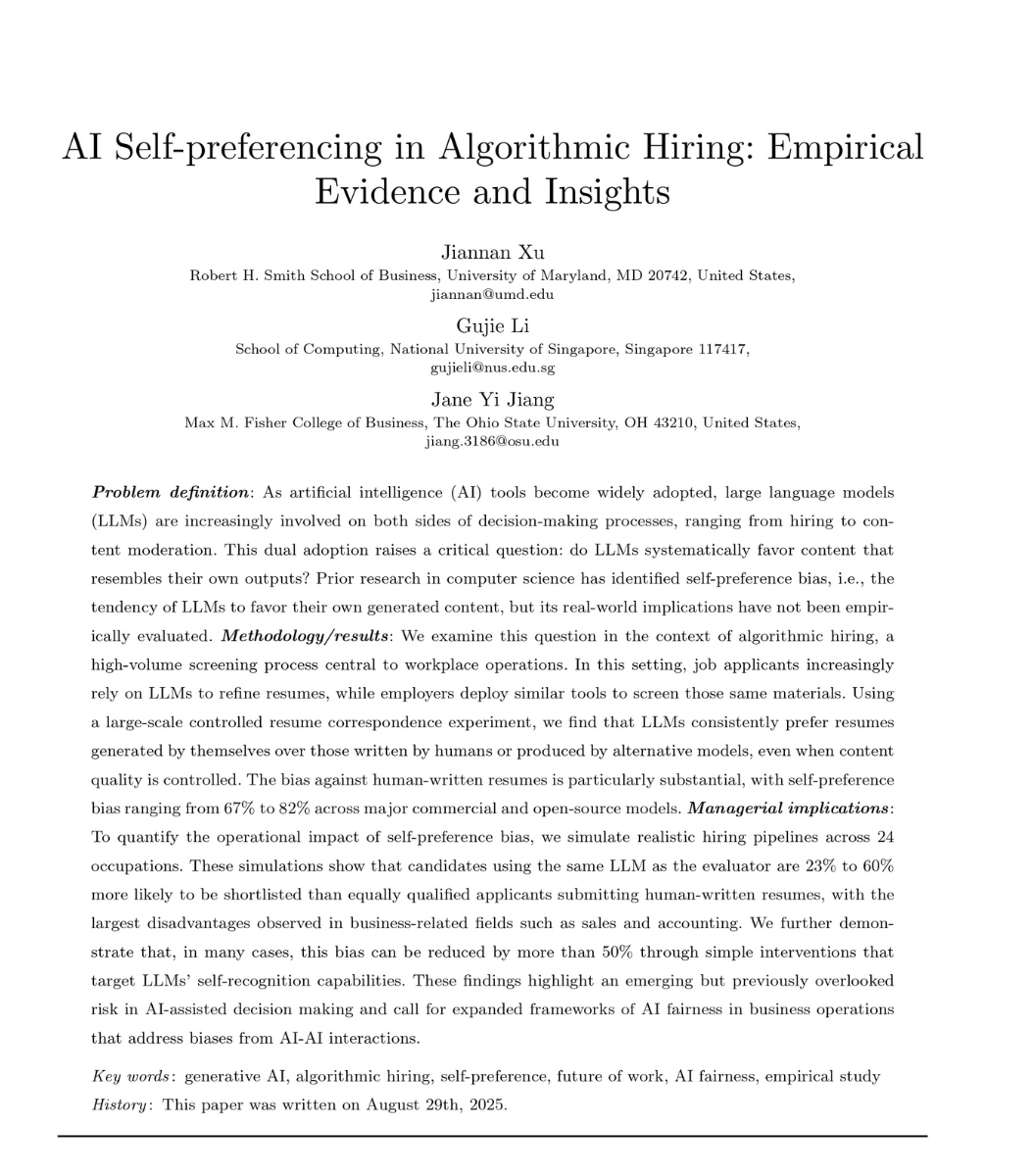
Researchers sent the same resume to an AI hiring tool twice. Same qualifications. Same experience. Same skills. One version was written by a real human. The other was rewritten by ChatGPT.
The AI picked the ChatGPT version 97.6% of the time.
A team from the University of Maryland, the National University of Singapore, and Ohio State just published the receipt. They took 2,245 real human-written resumes pulled from a professional resume site from before ChatGPT existed, so the human writing was actually human. Then they had seven of the most-used AI models in the world rewrite each one. GPT-4o. GPT-4o-mini. GPT-4-turbo. LLaMA 3.3-70B. Qwen 2.5-72B. DeepSeek-V3. Mistral-7B.
Then they asked each AI to pick the better resume. Every model picked itself.
GPT-4o hit 97.6%. LLaMA-3.3-70B hit 96.3%. Qwen-2.5-72B hit 95.9%. DeepSeek-V3 hit 95.5%. The real human almost never won.
Then the researchers tried the obvious objection. Maybe the AI is just better at writing. So they had real humans grade the resumes for actual quality and ran the experiment again, controlling for it. The result was worse. Each AI kept picking itself even when human judges rated the human-written version as clearer, more coherent, and more effective.
It gets worse. The AIs do not just prefer AI over humans. They prefer themselves over other AIs. DeepSeek-V3 picked its own resumes 69% more often than LLaMA's. GPT-4o picked its own 45% more often than LLaMA's. Each model can recognize and reward its own dialect.
Then the researchers ran the simulation that ends careers. Same job. 24 occupations. Same qualifications. The only variable was whether the candidate used the same AI as the screening tool. Candidates using that AI were 23% to 60% more likely to be shortlisted. Worst gap was in sales, accounting, and finance.
99% of large companies now run AI on incoming resumes. Most of them use GPT-4o. The paper just proved GPT-4o picks GPT-4o 97.6% of the time.
If you wrote your own cover letter this week, you did not lose to a better candidate. You lost to a worse candidate who paid OpenAI 20 dollars.
Your qualifications do not matter if the AI prefers its own handwriting over yours.
we built self-serve feature development: describe what you want → agent writes PRD/TDD/diagrams → approve → it codes and opens PR → test in prod-identical preview → ship. vercel preview + supabase branches made this possible. the bar to ship just dropped by half.
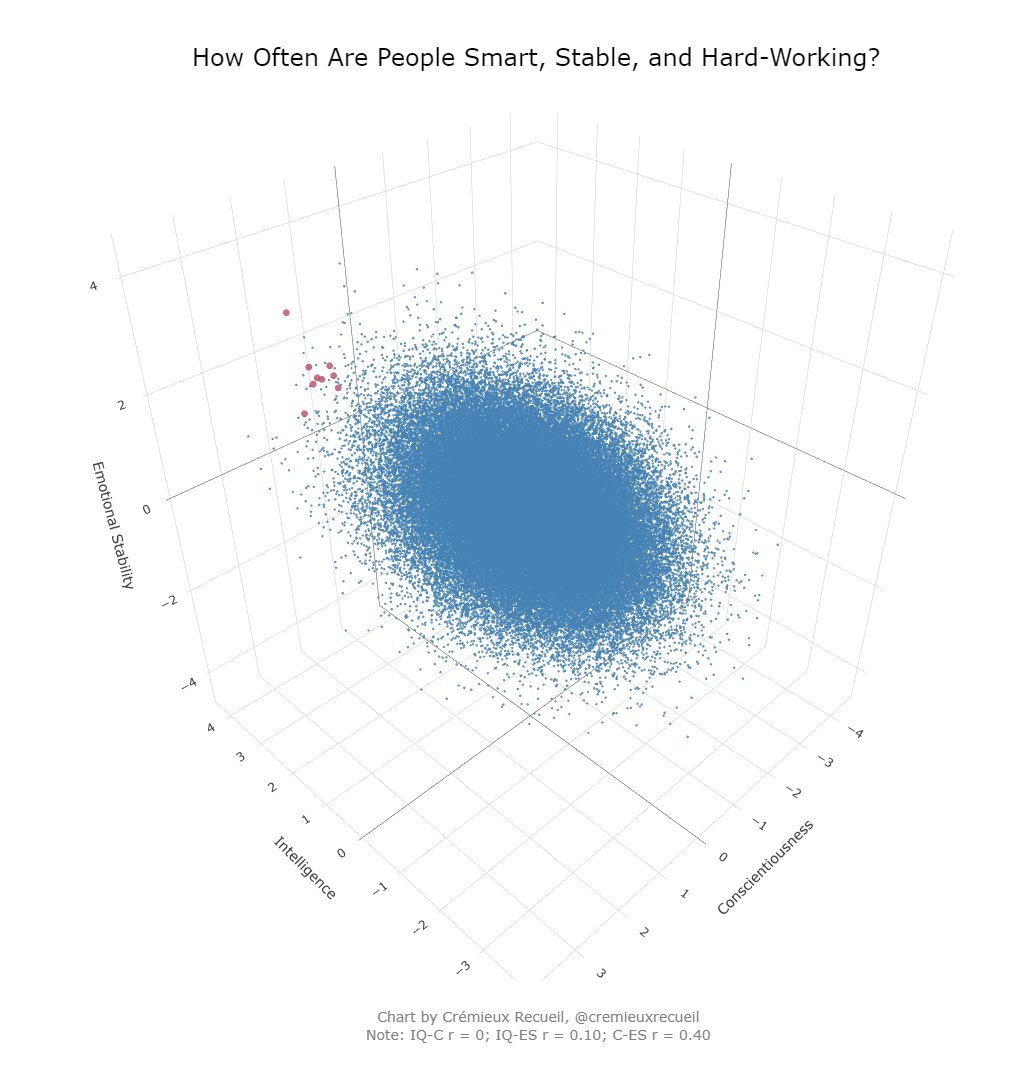
I simulated 100,000 people to show how often people are "thrice-exceptional": Smart, stable, and exceptionally hard-working.
I've highlighted these people in red in this chart:
Now pretty much every team, every member's presentation at @GetDelightAI during weekly standup is created using AI. Every team has built their own AI tools and workflows. It's incredible to see how fast AI is changing how we work. Such a delightful morning! :))
America’s leading health systems, like the Cleveland Clinic, work with @Luminai to eliminate administrative waste.
We’re rapidly deploying to more health systems, and excited to announce Series B, bringing total funding to $60m.
@brian_armstrong Measurable by low agreeableness particularly low in subaspect of politeness (weird term but defined roughly as tendency to respect social norms and authority).
Today, we’re rolling out two new productivity features in Chrome.
With vertical tabs, you’ll now have the option to move your tabs to the side of your browser window by selecting “Show Tabs Vertically.”
We’re also introducing immersive reading mode, a new full-page interface for deep focus.