I am deeply humbled to have been awarded the Presidential Early Career Award for Scientists and Engineers (PECASE) by President Biden. This is the highest recognition by the U.S. government to scientists and engineers.
There's an interesting paradox in academia where students put in tremendous effort, yet professors get all the credit. This honor truly belongs to my students and research collaborators, who have been both teachers and learners alongside me throughout our journey together.
My late mother, who passed away at 48, taught me the straightforward formula for success - maintain your presence and never surrender. This moment would have meant so much to her.
@UofR@UofRDataSci
https://t.co/MovFLiXc2i
Congratulations to Media Lab alum @ehsan_hoque on being inducted into the American Institute for Medical and Biological Engineering (@AIMBE) College of Fellows as part of the 2026 class! https://t.co/1BtjEZyKmI
A thrill to be on @CBSMornings today talking AI and Healthcare (and about my book, "A Giant Leap") with @nateburleson & @DrLaPook. Interview is here:
https://t.co/YJygJk0qh8
Media Lab Prof. @rosalindpicard reflects on the origins of her work in wearable sensing and Affective Computing — technology designed to measure and respond to human emotions.
In January, Professor Picard was named as a recipient of the 2026 IEEE Medal for Innovations in Healthcare Technology, one of @IEEEorg’s highest honors. She was recognized “for pioneering contributions to wearable affective computing for health and wellbeing.”
https://t.co/AxokR3dQhz
"The most dangerous feeds are not the ones that upset us, but the ones that convince us we are always right," says @UofR PhD student Adiba Proma. New #URochesterResearch says slight design tweaks could reduce echo chambers on social media @rochci https://t.co/rtpwI6aWyr
In his new book @Bob_Wachter asks -- "Can AI scale bedside coaching?"
With the SOPHIE work, we demonstrated -- supported by a randomized clinical trial -- that it is, indeed, possible. https://t.co/vqUQLBUra9
Really fun chatting with @EricTopol about my new book on AI and healthcare, "A Giant Leap." What are the big issues that arise as AI enters our world? How should AI change how we train a doctor? How do we decide whether to trust the AI? And much more.
https://t.co/nqhhv8CKn0
Grateful for the shout-out by @SPECNews1ROC on our new paper in Nature Parkinson’s Disease.
What mattered most was the partnership with In-Motion Clinic in Cleveland and, above all, working hand in hand with people living with Parkinson’s throughout development and validation.
Special thanks to -- Karen Jaffe -- diagnosed at 48, whose advocacy and lived experience have been central to this work.
Link to the paper: https://t.co/ciKM6BWhJW
@UofR@ur_engineering
A University of Rochester computer science grad student is collecting data for research that could allow AI to detect the early signs of Parkinson's disease from your home. https://t.co/dDAs1tVFgN
A great look at how @UofR computer scientists are developing #AI tools to expand access to screening for Parkinson's Disease, helping people receive critical early care. #URochesterResearch@ehsan_hoque@rochci
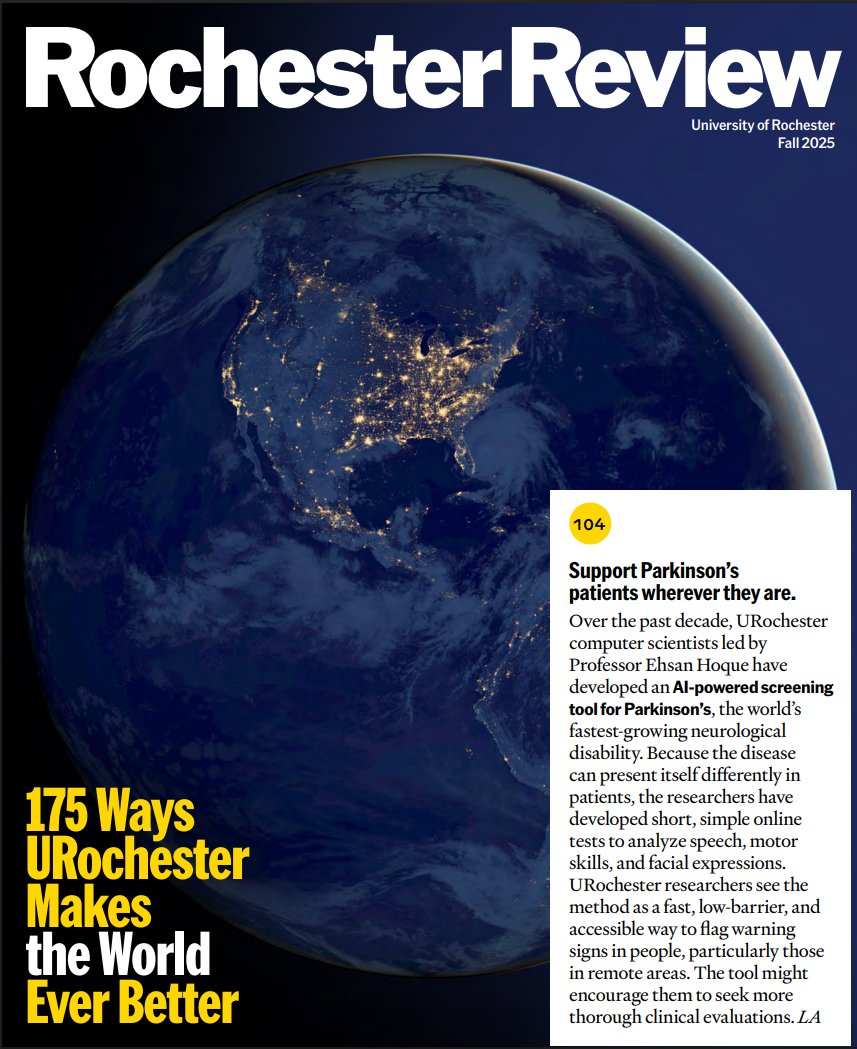
.@UofR is celebrating 175 years by recognizing 175 innovations that shaped science, medicine, and society. Honored that our decade-long work on AI-based Parkinson’s screening made the list.
We began this work in 2016 with no roadmap and many early rejections. But we stayed committed because the problem mattered.
Millions live far from specialists or wait months for a diagnosis. Making screening accessible from anywhere in the world is a real step toward health equity.
Great work takes time, persistence, and belief in a mission. Grateful for everyone who contributed. The work continues.
Read more at https://t.co/Rw1Yl9Jcg0
Congratulations to Media Lab alum @ehsan_hoque, now a professor at @UofR, on being named as a finalist for the 2025 @lettenprize! https://t.co/bAAWFJWsy3
What if Alexa detected Parkinson's?
Grad students at @ur_engineering have outlined a speech-based AI tool to screen for signs of neurodegenerative disease
It's another way Rochester researchers are harnessing AI for the public good https://t.co/ji0nUPV7gU
#URochesterResearch
Could Alexa help people find out if they have Parkinson's disease? Computer scientists at @UofR developed a speech-based AI tool that can screen for a key indicator of the neurodegenerative disease #URochesterResearch Story:https://t.co/pV5IiAd0dZ
Study: https://t.co/rm4VzXDlhc
Why does so much academic innovation come from outside elite circles?
After 2 years, rejections, and a few bruises, our paper is finally out.
It tackles a tough question:
Does working with superstars help or hinder originality in science?
🧵
🧾 NEW in @NEJM_AI:
“Facial Analysis Using AI to Screen for Parkinson’s Disease”
🔗 Paper spotlight: https://t.co/qgb1TYp0IM
👉 Our study (n=1,452) finds AI can detect Parkinson’s from a simple smile with:
• 87.9% accuracy
• AUROC of 89.3
[WHY THIS MATTERS]
Smiling is universal.
AI spots hypomimia—subtle facial muscle changes—before clinicians can, enabling early detection.
[REAL-WORLD VALIDATION]
• 🌍 Locations: North America → Bangladesh via global collaboration with @buetacbd
• Home & clinic settings
• High- and low-resource regions
• Naturally recorded–no special hardware needed
[WHAT MAKES THIS POWERFUL]
With consent, we could screen existing selfie/videos—low-cost AI triage to fast-track at-risk individuals where neurologists are scarce.
[COLLABORATIVE EFFORT]
• @UofR School of Medicine & Dentistry
• @buetacbd
• National Institute of Neurosciences & Hospital, Dhaka
• General Directorate for Health Services, Saudi Arabia
[STUDENT TEAM]
Joint first authors: Tariq Adnan & Md. Saiful Islam
With Sangwu Lee, @Wasifur_Rahman_, Sutapa Dey Tithi, Kazi Noshin, Rayhanul Islam & more.
[COLLABORATORS]
Imran Sarker, M Saifur Rahman, Ruth Schneider, Jamie Adams, @RayDorseyMD
[INTEGRITY NOTE]
We retracted an earlier npj Digital Medicine version after finding a flaw—painful, but necessary.
Our students dug deeper, corrected it, and achieved publication in @NEJM_AI.
Proud of their resilience & rigor.
THANKS TO:
@UofR, @ur_engineering, @UofRCHeT, @NEJM_AI, @NEJM
Funded by @NIH & @MooreFound
#AI #Parkinsons #DigitalHealth #NEJMAI #HealthEquity #ML #globalhealth
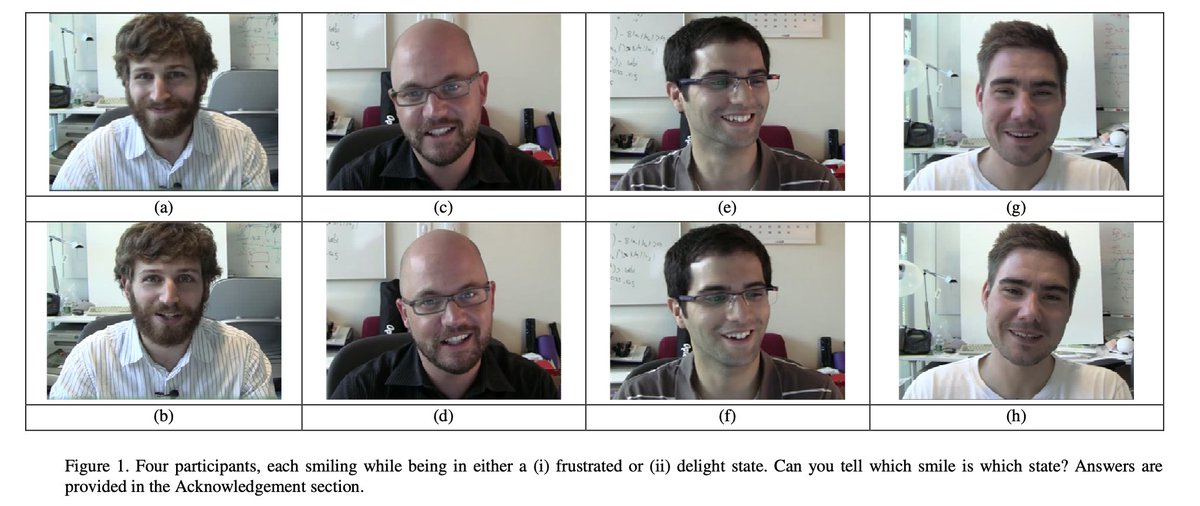
Say cheese to detect Parkinson’s? Can AI see what doctors and healthcare providers miss? What if a simple smile could screen for Parkinson’s disease? A new study just published in NEJM AI by Adnan, Dorsey, Hoque and colleagues shows that artificial intelligence can potentially spot Parkinson’s simply by analyzing facial expressions.
Key Points:
- AI detected Parkinson’s ~88% accuracy.
- The authors analyzed smile videos and used subtle facial cues.
- ~1,400 people participated worldwide.
- All they needed was a phone.
My take: There were 5 points that resonated w/ me about smiling and Parkinson's, and its use as a diagnostic. 1- Smiling is more than emotional, could it be a diagnostic? Parkinson’s frequently hides in the face and AI could pick up subtle changes. 2- Could this bring Parkinson’s screening to every home? Just record a video. 3- I like that it is fast, non-invasive and affordable. 4- Could it help reach the underserved, especially if no or limited access to doctors or specialists. 5- Smile, click, and screen. AI will not replace Parkinson's doctors and healthcare providers, but it may get to one more rapidly.
https://t.co/z1rXVPT9Xl
Nice paper that is a great read by Marsili on bradykinesia in smiling:
https://t.co/jLrxQpovnF
#Parkinsons #Neurology #AIHealth #NEJMAI @RayDorseyMD@FixelInstitute@ParkinsonDotOrg@FixelInstitute@NEJM@NEJM_AI
Perspective: Improving Mental Health Care Access with Technology: Addressing the Screening-to-Referral Bottleneck https://t.co/WEQkXAzTFm
Original Article: AI-Enabled Parkinson’s Disease Screening Using Smile Videos https://t.co/kud4ShTiq0








![ehsan_hoque's tweet photo. 🧾 NEW in @NEJM_AI:
“Facial Analysis Using AI to Screen for Parkinson’s Disease”
🔗 Paper spotlight: https://t.co/qgb1TYp0IM
👉 Our study (n=1,452) finds AI can detect Parkinson’s from a simple smile with:
• 87.9% accuracy
• AUROC of 89.3
[WHY THIS MATTERS]
Smiling is universal.
AI spots hypomimia—subtle facial muscle changes—before clinicians can, enabling early detection.
[REAL-WORLD VALIDATION]
• 🌍 Locations: North America → Bangladesh via global collaboration with @buetacbd
• Home & clinic settings
• High- and low-resource regions
• Naturally recorded–no special hardware needed
[WHAT MAKES THIS POWERFUL]
With consent, we could screen existing selfie/videos—low-cost AI triage to fast-track at-risk individuals where neurologists are scarce.
[COLLABORATIVE EFFORT]
• @UofR School of Medicine & Dentistry
• @buetacbd
• National Institute of Neurosciences & Hospital, Dhaka
• General Directorate for Health Services, Saudi Arabia
[STUDENT TEAM]
Joint first authors: Tariq Adnan & Md. Saiful Islam
With Sangwu Lee, @Wasifur_Rahman_, Sutapa Dey Tithi, Kazi Noshin, Rayhanul Islam & more.
[COLLABORATORS]
Imran Sarker, M Saifur Rahman, Ruth Schneider, Jamie Adams, @RayDorseyMD
[INTEGRITY NOTE]
We retracted an earlier npj Digital Medicine version after finding a flaw—painful, but necessary.
Our students dug deeper, corrected it, and achieved publication in @NEJM_AI.
Proud of their resilience & rigor.
THANKS TO:
@UofR, @ur_engineering, @UofRCHeT, @NEJM_AI, @NEJM
Funded by @NIH & @MooreFound
#AI #Parkinsons #DigitalHealth #NEJMAI #HealthEquity #ML #globalhealth](https://pbs.twimg.com/media/GurYo7UW8AACHbb.png)


