Are mega-funds really taking over seed?
I decided to look at the behavior of the world's largest VC funds ($10B+ AUM) at early stages and answer a simple question: should EMs worry about their structural edge?
So I used @harmonic_ai and looked at all pre-seed, seed, and seed extension rounds across 3 eras:
- SaaS Era (2015–2019): 5 years of a normal market. Cloud, SaaS, fintech were the dominant theses.
- ZIRP Era (2020–2022): 3 years of zero interest rates and free capital.
- AI Era (2023–2026): from ChatGPT to the present day.
We focused on one core metric: average number of early-stage deals per year for each fund in each era.
Here are a few insights we found interesting:
1/ In the SaaS era, a typical mega-fund made 10–20 early-stage deals per year. This was moderate, targeted seed activity – a complement to the core Series A/B and later strategy.
2/ In the ZIRP era, everyone scaled up. Each of the 10 funds increased their early-stage deals/year (some by 2–3x), because capital was free, competition at later stages was fierce, and seed felt like a cheap entry point.
3/ Then came the AI era and it became clear this was no temporary effect. Even as rates rose and capital became more expensive with the end of ZIRP, @a16z and @generalcatalyst posted peak early-stage activity.
> @a16z: 16.6 → 48.7 → 75.3 deals/year. A 4x increase from the SaaS era.
> @generalcatalyst: 15.2 → 31.7 → 61.5 deals/year. Also 4x.
The most interesting finding, though, is 3 distinct behavioral models:
1/ "Accelerators" - deals/year in the AI era exceed ZIRP levels: @a16z (75.3/yr), @generalcatalyst (61.5/yr), @khoslaventures (31.5/yr). These funds didn't just stay active in seed after free money ended – they doubled down.
2/ "Stabilizers" – deals/year in the AI era are slightly below ZIRP peak, but well above SaaS-era levels: @sequoia (19.6 → 49.3 → 50.6), @Accel (15.2 → 43.3 → 34.7), @lightspeedvp (11.6 → 41.7 → 32.1). The ZIRP spike moderated, but activity levels remain sustainably 2–3x above the SaaS era. There's no return to the old normal.
3/ "Disciplined" – steady, gradual growth across all eras: @BessemerVP (9.4 → 23.0 → 20.9), @Lux_Capital (7.2 → 14.3 → 14.7), @IndexVentures (10.0 → 23.3 → 17.6). No ZIRP spikes, no AI explosions – but the baseline has durably shifted upward.
So in the SaaS era, these 10 funds collectively made roughly 140–150 early-stage deals per year. In the AI era – around 370–400. And I think they just set up a new, sustained baseline, not just doubled after a ZIRP-peak era.
For an LP evaluating an emerging seed manager, this is the most important context.
The early-stage market your GP is investing in is one where 10 funds with $10B+ in AUM are doing dozens deals a year.
An emerging manager needs to be able to articulate exactly where, in that market, they have the right to win.
Unsure why everyone is dunking on this girl. Didn't we all do this growing up?
Instead of Pinterest it was a collage of posters on your bedroom wall. The medium has changed but the intention is still the same.
If @Schwarzenegger grew up in the social media era, maybe he would have created a pinterest board of Reg Park instead of all the posters?
Visualisation is a good thing, as long as you do something about it. Visualise and attack.
The fallacy of this is that more creates more. More hours, more hiring, more something.
And it is true in a sense. If you put in more work, more work will happen. But I think for most startups, the leverage is really in how differently you approach the problem, how well you cultivate your team, and the strategy.
Any large company can outspend you on hours. They have thousands or tens of thousands more people, spending more hours. If hours worked were the metric, every large company and government organization would always win and do the best work. More hours, better output.
This thinking is often representative of younger founders, where the startup becomes their identity and life. They have a hard time doing anything else, and cannot understand that your work is not the person that is you. But activities outside of work can grow you as a person too and make you do better work.
I’ve never worked this way. As a designer, I always saw the need to take a step back, to take a break. At times, I might work 12 hours or 16 hours, or whatever amount was needed, but it wasn’t the norm. You just can't grind design, you need inspiration. But taking that step away from the work, would give me more perspective, inspiration and I could approach the problem differently or I could just see the solution.
Grinding is never good for any creative problem, and startups or creating new products are often mostly about creative problem solving. Grinding works ok for email jobs, or where you just executing on very clear playbook.
With Linear, we’ve never worked this way. We work reasonable hours, 5 days a week. All of us founders have families. Many of our employees have families. I personally stop every evening, spend time with the family, cook dinner for the family, eat dinner together, and focus on things outside of work. Sometimes I work in the late evenings or weekends, but to me the pride is that I don’t need to. Company should be succesful without it.
My goal is to build a company that is sustainable in the long term, and doesn’t require heroics or personal sacrifices every single day.
There are times when our team is heroic. Launches, incidents, some other work that just needs to be done. They will work late into the night because they know it is the right thing. But we don’t require that every day or every week, and the more this happens, the more I think it is a failure of our company and leadership. The team and the leaders should always keep a reserve to use when something is needed.
Our thinking was also that quality, which we value, doesn’t emerge from working more or stressing people more. It emerges when you create the conditions for it to emerge. Often it is the appreciation, space, time, and how the person feels. A person who is rested will do better work.
I wouldn’t attribute much of our success to working a lot. The success came from having clear thinking, ideas, and focus to do the right things.
I sometimes wish we could move the culture more toward a Zen master.
Real mastery is not exerting the most effort. It is achieving the outcome with the least necessary effort.
I’m late here (this is March’s issue from @colossus), but what a read. The deep-dives on Cursor and Thrive are particularly good. The writing from @zebriez and @colossusjeremy is excellent.
I thought about what @pmarca said on his barbell reading strategy; “It’s either up-to-the-minute what’s happening right now, or it’s a book that was written 50 years ago that has stood the test of time.”
I studied Classics, so I couldn’t agree more. But Colossus is slowly changing my mind. A print mag sits in this goldilocks zone where there’s just enough breathing room between the event and the writing that ideas can settle and become useful.
.@pmarca breaks down his reading diet:
"I have an almost perfect barbell strategy, which is: I read X and I read old books."
"It's either up-to-the-minute what's happening right now, or it's a book that was written 50 years ago that has stood the test of time."
With @lennysan
I think we are in the process of discovering that humans are bad at mathematics.
A gibbon would scoff at an Olympic climber; the human body is not optimized for climbing. We're getting mounting evidence that our brain may be far from optimal for advanced math.
No disrespect to mathematicians. I was a two-time IMO silver medalist; I'm just smart enough to appreciate that some people are much, much smarter. But it's starting to look like math is somewhere on the midpoint of Moravec’s paradox; between chess (computers surpassed us some time back) and cooking (probably many years to go, for general capabilities). It's fairly hard for us, and so it looks like computers are going to surpass us.
AI math still has important weaknesses. For instance, AI systems have not yet shown any ability to identify interesting research directions, or develop new concepts on which further work can build. But they are starting to look superhuman in some respects. And once AI *starts* to become superhuman in some domain, we all know what happens next.
I think we are in the process of discovering that humans are bad at mathematics.
A gibbon would scoff at an Olympic climber; the human body is not optimized for climbing. We're getting mounting evidence that our brain may be far from optimal for advanced math.
No disrespect to mathematicians. I was a two-time IMO silver medalist; I'm just smart enough to appreciate that some people are much, much smarter. But it's starting to look like math is somewhere on the midpoint of Moravec’s paradox; between chess (computers surpassed us some time back) and cooking (probably many years to go, for general capabilities). It's fairly hard for us, and so it looks like computers are going to surpass us.
AI math still has important weaknesses. For instance, AI systems have not yet shown any ability to identify interesting research directions, or develop new concepts on which further work can build. But they are starting to look superhuman in some respects. And once AI *starts* to become superhuman in some domain, we all know what happens next.
@credistick@buccocapital@alexframegreen Generally true but not a rule. I know many early people at great companies who got the gig out of happenstance. They needed a job and happened to sit next to someone in a co-working space. risk wasn't really an evaluating criteria for them, it was just a job
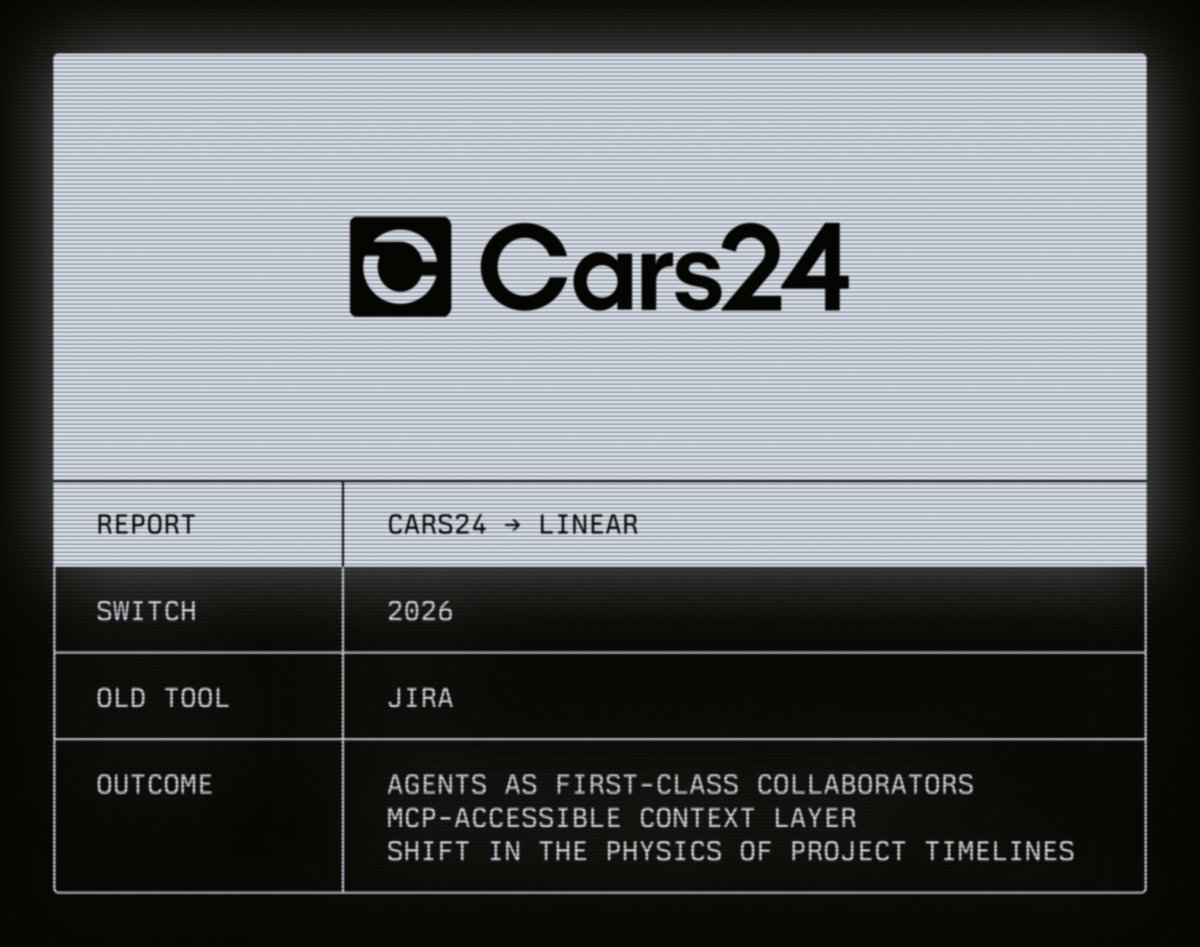
In October of last year, Cars24, while preparing for an IPO, renewed its multi-year Jira license. Within a few weeks, the company would treat that contract as a sunk cost and walk away from it.
Here is why:
https://t.co/RaZzMyW4yh