Exciting special issue on the 'Genetics of Human Origin' edited by Jason Stein, Luis De La Torre-Ubieta, and @brainevodevo.
Check out our contribution on human-specific genetic modifiers of cortical architecture and function: https://t.co/d7bhVtAF1a
I am so excited to share our BioRxiv study led by super talented postdoc Jing Liu. How do human-specific genomic changes shape development? We use mice and primate iPSCs to directly assess functions of a human accelerated region, HARE5. https://t.co/bGvPAA0Mjm
We are at #Sfn23! Come see Hanzhi Teresa Zhao's poster on how human-specific genes modify cortical circuit function and behavior, including some widefield mesoscale data. Tomorrow afternoon, November 11 - EE13/34.14
A new episode of our #NeuroTransmissionsPodcast featuring @ereschmidt is out! Discover how human-specific genes shape the unique biological features of the human brain. Available on YouTube & major podcast platforms.
🎧🌐 #SciencePodcast#Genetics
📺 https://t.co/YrxgRJJHes
I am very excited and looking forward to start my own research team @FGA_lab@VUamsterdam soon to study neuronal mRNA trafficking and axonal translation.
I am looking for a PhD candidate to strengthen this team so get in touch if you are interested!
https://t.co/2rSFnN6UIH
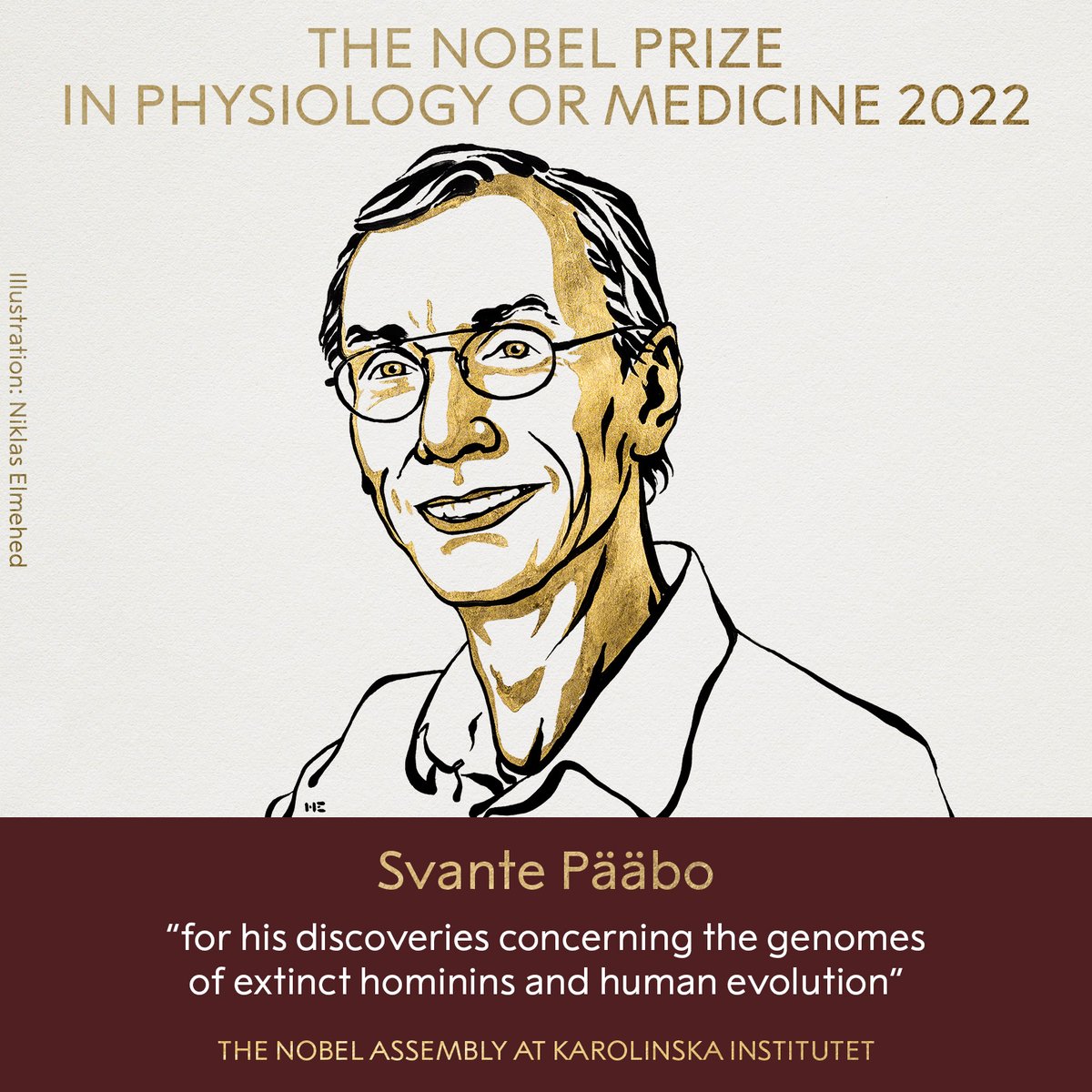
BREAKING NEWS:
The 2022 #NobelPrize in Physiology or Medicine has been awarded to Svante Pääbo “for his discoveries concerning the genomes of extinct hominins and human evolution.”
Was very exciting to have Dr. David Fitzpatrick from @MPFNeuro visit us at @neuro_MUSC where he shared his lab's incredible work on the synaptic level processing of visual information in the ferret cortex. Thank you for visiting!
Review with @fpolleux on the mechanisms underlying evolution of connectivity in the human cortex as part of the Horizons in Neural Circuits research topic: https://t.co/d4Jb0DYU33
Hopefully a good read or at least a worthy addition to the growing ‘must-find-time-to-read’ list.
Happy to share my new paper, out today in @Nature. I developed a single-cell approach to trace inputs and manipulate the activity of individual place cells in CA1, which revealed how neurons are embedded into specific and recurrent subcircuits. https://t.co/shEi4rf0ZI
Work by a fantastic postdoc, Tristan Geiller, @tgeiller. Great collaboration: Sadra Sadeh and Claudia Clopath #ClopathLab, Heike Blockus and Franck Polleux #fpolleux, Andy Murray @andymurray000, and Balazs Rozsa @Femtonics and our lab: Sebi Rolotti, Bert Vancura, Adrian Negrean!
An apical tuft is one of the most prominent features of a pyramidal neuron. What do these mysterious subcellular compartments do during learning? A new study from @Sam_Benezra tracks the activity of the same apical tufts across learning of a behavior. 1/n
Our paper is out! We show how the human-specific modifier SRGAP2C alters the structure and function of cortical circuits and improves behavioral performance.
https://t.co/En4022q9eR
Many thanks to all authors! Especially @fpolleux, it’s been amazing to work for and with such a great scientist. Also very happy to have @teresazhao13 continue some of this work in my lab. And @JneuroPark for the many hours we ran behavior, even in the middle of a pandemic.