time and time again i fall into the trap of designing a big piece of infra with an agent, only to find out that my context window is smaller than the agent's.
i keep forgetting things that were already discussed, while clanker mcclankerface knows all the things.
TLDR
1) Everyone becomes a 7/10 at everything
2) Teams shrink back to three to five people
3) Steering AI is the creative work
4) The hurdles are what kill businesses
5) Build me a business replaces the Turing test
6) Bring a product, AI does the rest
7) Everything feels stagnant because the wonders are invisible
8) The best people go build physical things next
Best part of AI is shattering dev's egos, the worst part of this industry.
You are not special. Your code actually sucked like everybody else's. You were never the smartest person.
The things my sales guy BIL and designer brother are doing is beyond anything I have done.
Some points from @DHH Rails keynote I couldn't agree more:
- WebApps are dead.
- No need for a frameworks like Rails if rust can achieve the same functionality with much less resources.
- Your application needs a CLI. Because agents love command-line tools.
It's pencils down, people. Writing code by hand is no longer an economically viable skill for most programmers at most companies. But the future of making software has never been brighter. Don't you dare black pill this beautiful moment! https://t.co/qaCgfmkW0u
“People are working 12 to 13 hours a day just to press enter.”
We are turning an entire generation of technical experts around the world into the equivalent of retirees pushing a button in front of casino slot machines.
Essentially the brain rot of doom scrolling social media is coming for your development team…
This will have lots of long run implications on companies. Most important of which, is that it will make existing moats even more brittle.
The value of automated software is not making the software faster.
It is understanding your intention and making the software BETTER.
Better edge.
Better design.
Better alpha.
But if you don’t slow down and map out your intention, you will just make your shitty code faster.
We built 8090’s Software Factory to do this: when execution is a costless commodity, what really matters?
Over time, companies will realize that it’s:
1. Intention
2. Governance
3. Verification
4. Evidence
This is what will separate orgs consuming tokens and companies encoding their edge. This generally requires top down leadership from the CEO to the CFO/CIO.
Bottoms up tool adoption only increases costs and accelerates slot machine behaviors.
Good luck to all the players.
7 Quotes on Writing
I hope you enjoy the following gems as much as I have…
“Write to please just one person. If you open a window and make love to the world, so to speak, your story will get pneumonia.” — Kurt Vonnegut
“You must stay drunk on writing so reality cannot destroy you.” — Ray Bradbury
“Be regular and orderly in your life like a bourgeois, so that you may be violent and original in your work.” — Gustave Flaubert
“The writer should never be ashamed of staring. There is nothing that does not require his attention.” — Flannery O’Connor
“A writer is unfair to himself when he is unable to be hard on himself.” — Marianne Moore
“If you intend to write as truthfully as you can, your days as a member of polite society are numbered, anyway.” — Stephen King
“Better to write for yourself and have no public, than to write for the public and have no self.” — Cyril Connolly
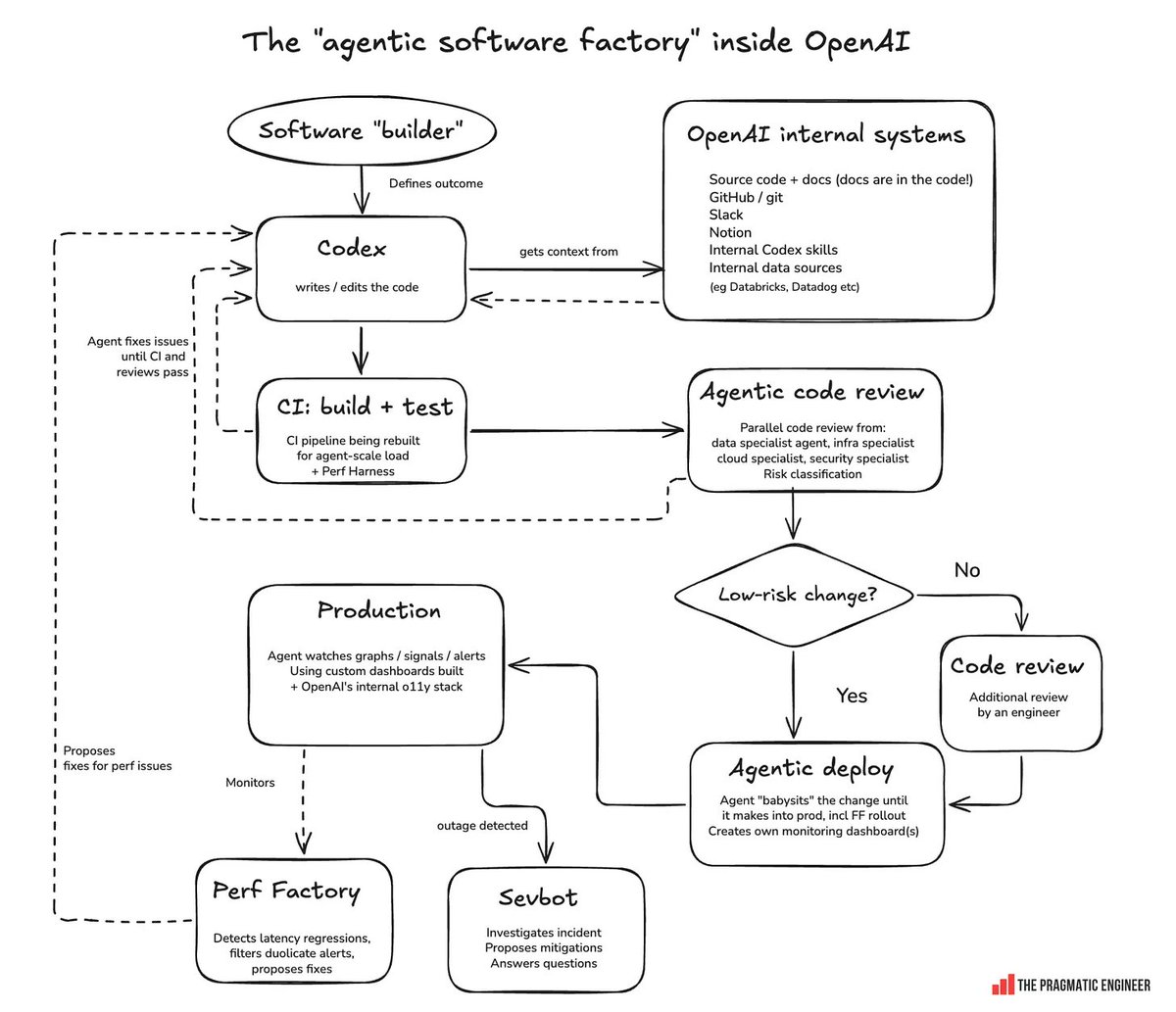
Here's what OpenAI's agentic software factory looks like, today.
Details: https://t.co/UUZufLxG2r
(thanks to all the OpenAI folks who explained how it works! And Perf Factory looks especially interesting to me)
I think @humanlayer_dev has been telling everyone this for close to 9 months now
1. Many folks CORRECTLY understood that LLMs can operate much more effectively in complex (and even bad) codebases than humans can
2. They therefore MISTAKENLY inferred that code quality & complexity and program design no longer matter
3. What they missed was that LLMs can also create much more bad code and much more complex systems faster than humans can.
4. The derivative of (3) is MUCH LARGER than the derivative of (1). Models do get better at working in bad codebases with each new generation. But they get a lot better at running unsupervised for a long time and producing exceptionally complicated programs.
5. The debt associated with (4) compounds superlinearly on large teams
mind-bending things happening in programming lately:
- humans are no longer reading code
- agents are moving from local devices to the cloud
- programming languages are becoming irrelevant in JDs
- agents are deciding what to do instead of being told what to do
- tech stacks are being chosen based on the feedback loops they provide
- agent-friendly libraries (like Effect) are being used without humans learning them
- hardware is becoming a limitation when working with agents
- humans are helping agents set up their environments
- agents are managing other agents
- a single human is working with dozens of agents
- humans are becoming less involved in most areas of software development
- loops are expanding beyond development, pushing toward full autonomy
a few months ago, I'd have laughed hearing some of this.
oh yeah - what you are missing is the “backward pass”
you need a process that don’t just look at one off anecdotes, but instead analyze a large sample of past session transcripts, distill the losses, then do gradient descent on your memory and skill files to fix the losses
this is it https://t.co/DkM9b4TcZ0
All models, no matter how smart, will eventually build systems that they can no longer understand or maintain, if you let them. Fable 5 finally outbuilt itself, and flailed on me for a week. Fable 5.1 looks like it will fix it. For now. But you have to keep an iron grip on system size, or it'll run away from you.
now that the dust is settling around the last wave of model releases, and i've had enough time to use all these models in practice, let me share a more complete set of thoughts
1. grok 4.5 is probably the single most significant event during the last couple of weeks
i've been talking with many heavy users across model families, and it's pretty much a consensus that grok 4.5 is the most "pleasant" frontier model to work with day to day. it's incredible how precisely the team behind it found this perfect sweet spot and created a model that's so fast, efficient and capable
it proved spacexai is now a 3rd real player in addition to anthropic and openai. they have real time data from the biggest public townsquare of humans, they have acquired a popular agent harness, and now they have proven they can build great models. and if you look closely, they are designing their own chips, they have their own data centers, they can send GPUs into the space and create tokens out of sunshine
holy shit
2. speaking of data, human usage over a harness proved to be extremely important for training good models. grok 4.5 was the first model that incorporated cursor's data and it made a massive difference compared to previous generations of grok
this explained why amazon mandates employee usage of kiro, why meta installed mass surveillance over employee devices, why anthropic bans 3rd party harnesses, and why google is still struggling with gemini - because they don't have a popular harness with mass adoption to collect the data
this is part of why i don't think the subsidized LLM subscriptions will end any time soon, because a wide consumer adoption is the best source of data collection. we're paying the subsidized tokens by teaching their models how to get work done
3. opus 5 flopped. almost no one likes it. the only people who like it seem to be using it to one-shot 3d games that look impressive but no one will ever buy
anything that AI can one-shot is just the definition of garbage, because if you can one-shot this thing with a quick prompt, you should know that it means billions of other people can also do it - you will not create anything of value this way
and this is just a symptom of a more fundamental problem that model training is heading down a slippery slope where machine verifiable outcome is dominating over human feedback
the latest training process rewards the agent for running for a long time and finishing a complex project, yet no longer seems to care about how the agent talks to its human
jargons, walls of text, "an honest mistake" - opus 5 showed us that we need AI that's more human friendly. let's not build a world where we end up working with robotic a**holes all day
4. fable 5 remains undefeated as the upperbound
i talked about this in my previous post about wisdom vs diligence. the benchmarks blend both together so it's not easy to see, but fable 5 is the GOAT on the "wisdom" dimension despite it not winning on every benchmark. if you used it meaningfully, you know what i'm talking about
that said, it seems anthropic is extremely paranoid about other players, including open models, reaching the same level of intelligence, which is an indication that the moat is not strong. kimi k3 is just a preview of what it looks like
at the same time, fable is the first time token cost is becoming a very real problem. it's the only model so far that i can't afford to keep using all day. i suspect this will remain true for a while, that we have to pick and choose what tasks to give to fable-tier models, not using them as a daily driver
5. openai is in an interesting position
gpt models have been great at efficiency, but now grok is also very competitive. gpt also haven't quite reached the same wisdom upperbound where fable is yet - although gpt 6 may change that
i think there are two angles for openai to pursue:
- continue to bet on efficiency, and go after enterprise adoption while claude is too expensive and grok has a brand tax to pay there. this is a very viable strategy
- or.. compete head on with fable on wisdom and win against them on the "human friendly" aspect. although traditionally this hasn't been the strength of openai models either, so this feels like a low-ROI option
alright, that's a bit of a long post but the landscape is just becoming increasingly complex. hope these thoughts are helpful in terms of providing a reference for how to rationalize everything happening