Introducing Claude Science, a new app designed with every stage of research in mind.
Artifacts traced to their code, environments managed on demand, and 60+ optional scientific databases that you can connect.
Available now in beta.
Demis Hassabis confirmed every frontier AI lab is working on recursive self-improvement and in the same sentence said the safety risk of removing humans from the loop entirely keeps him up at night.
That combination should stop you.
The CEO of Google DeepMind just confirmed that the thing most people treat as a theoretical future risk is already the active focus of every serious lab on earth right now.
He explained why it works in coding and math. The feedback loop is fast. You can verify whether an answer is correct almost instantly. You can generate synthetic training data from it. The loop closes quickly and cleanly.
Then he said where it breaks down.
In biology, chemistry and physics. Any domain where verifying a hypothesis requires a physical experiment in the real world. The loop does not close in seconds. It closes in weeks or months.
Geoffrey Hinton said in his Nobel lecture that recursive self-improvement is the development he fears most and that once started it may not be possible to stop. Hassabis is not pushing back on that. He is describing the guardrails labs are building around a process they are already running.
Every lab has to think carefully about the safety of a process where no human is in the loop.
He said that as a constraint they are navigating right now.
The question they are sitting with is how much of it to let run without a human watching.
(Watch the full interview on YouTube at @twominutepapers channel)
Ex-MIT researcher Isaak Freeman quits his PhD and drops the 50,000 H100 GPU roadmap to emulate a full human brain.
He mapped the entire path from 302-neuron worm to 86-billion-neuron human with connectomics costs now at 100 dollars per neuron and data acquisition via advanced microscopes as the only blocker left - digital humans just got a realistic timeline.
https://t.co/kGB5hOAQHC
I sequenced my genome at home, on my kitchen table.
I wrote up exactly how I did it - the equipment, protocol, theory, and cost:
https://t.co/Nkjqaho2zm
What comes after LLMs such as ChatGPT, Claude, Perplexity, and similar systems?
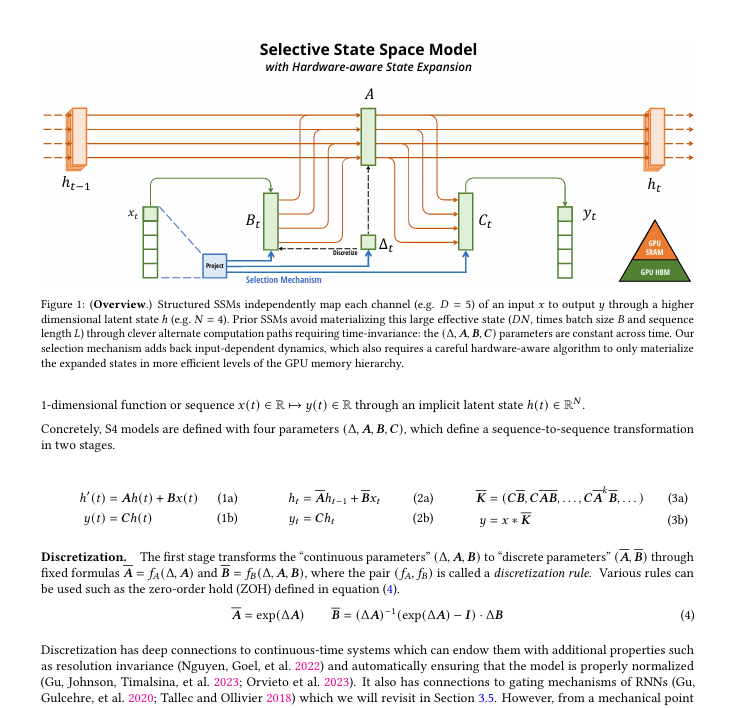
Selective State Space Models (SSMs) propose a different way to think about sequence modeling. In practice, instead of relying on attention (the core mechanism behind Transformer models), they model sequences through a dynamic internal state that evolves over time. Each input updates this state, which acts as a compressed memory of everything seen so far.
The update is selective and the model learns what to retain, what to discard, and how long to keep information, so relevant signals persist while noise fades out. At a high level this may sound similar to Transformers but the mechanism is different: Transformers repeatedly access the past through attention, while SSMs continuously transform it into an evolving state.
A direction worth understanding.
https://t.co/G9OAxQ76nE
Tesla’s Optimus will beat any human surgeons in 3 years at scale.
- "Don’t go into medical school?"
- Elon: “Yes. Pointless.”
And in 5 years, everyone will have access to medical care thats better than what the presidents receives today
~ Elon Musk
Starting today, we’re opening the Flipper One source code repositories step by step.
The first repo is now public: MCU firmware: https://t.co/e5QSpfRtCW
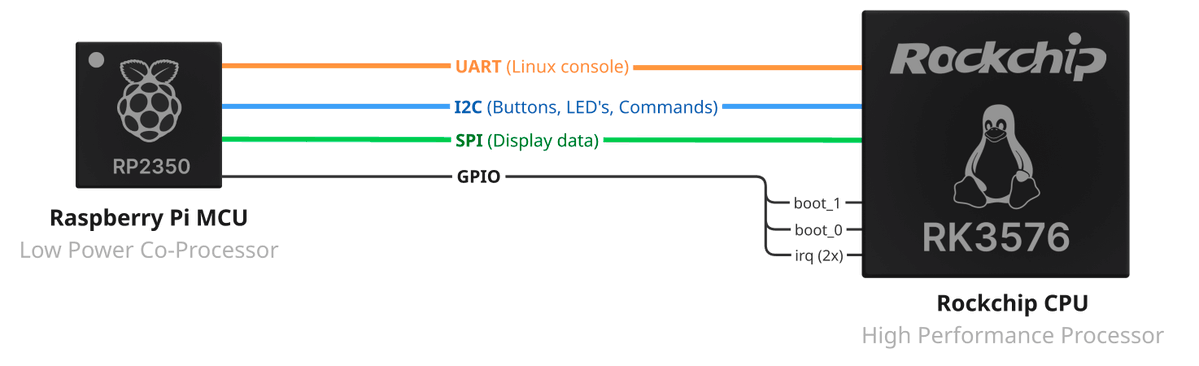
Flipper One uses a dual-processor architecture:
* Low-Power MCU (Raspberry Pi RP2350)
Buttons, LCD display, touchpad, and LEDs are physically connected to the MCU. It also manages battery and power control.
* High-Performance Linux CPU (Rockchip RK3576)
This processor runs Linux, and all high-level peripherals are connected to it: USB, HDMI, M.2, Wi-Fi, Ethernet, and audio.
Any founders interested in pitching my friends at Level Up Ventures?
They invest in tech-enabled, early-stage startups led by founders who have traditionally faced barriers to accessing capital.
💰 Check Size: $100K - $500K
Comment "DM" below. Happy to get you connected.
Differential-robot-wrist
(⬇️ open source code ⬇️)
How to make it?
Step 1
- Source all the parts from the BOM
https://t.co/KhtlLLUNKa
Step 2
- print all the parts in STL folder (Note that some parts need to be printed twice)
https://t.co/lwz0g3QsXp
Step 3
- Assemble the differential and calibrate the drivers
https://t.co/GiC6zPLo6Y
Step 4
- Program and test it! Example code!
https://t.co/O2l0y0vwB9
Step 5
- Enjoy your differential mechanism!
Credit: @SourceRobotics
If you are into robotics:
FOLLOW THEM!!!!
We’re announcing a research collaboration with @CFS_energy, one of the world’s leading nuclear fusion companies.
Together, we’re helping speed up the development of clean, safe, limitless fusion power with AI. ⚛️