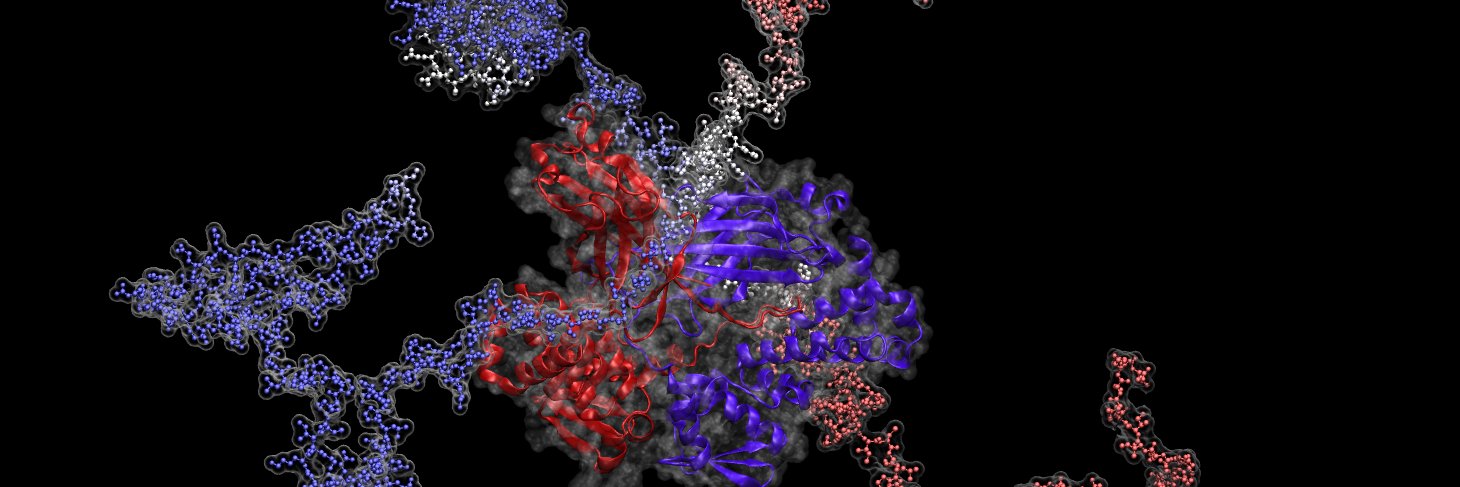
@dewpoint_tx @PappulabWashU @NatureChemistry It is fantastic work! I only played the smallest of supporting roles. It was a massive achievement by my former colleagues Anne Bremer and Wade Borcherds combined with some very cool theory and analysis from Mina Farag in @PappulabWashU 's group.
New work from Erik Martin, Tanja Mittag & collaborators using time-resolved SAXS experiments: A multi-step nucleation process determines the kinetics of prion-like domain phase separation @ewmartin@TanjaMittag@StJudeResearch
https://t.co/ia49DYlCka
@TanjaMittag@AndreaSoranno@jeremiasincicco@advancedphoton We set out to explore the kinetics of phase separation in a simplified system. Particularly, we examined the length scales at which molecular interactions are critical and the scales at which classical nucleation theory explains the kinetics.
@AndreaMusacchi1 Further, this is not new. The efforts by many in the macromolecular crowding field for decades have predicted non-uniform distributions of molecules. Looking at this through the lens of phase separation simply provides a new framework for analysis.
@AndreaMusacchi1 All of these points are integral to how we are approaching the biophysics and physical chemistry of phase separation in a cellular context. None of this is ignored but rather relished in the community.
@TanjaMittag Problematically, this causes a spike in insulin and shuts down fat burning... this isn't sustainable over multiple hours and creates a bit of a paradox.
@TanjaMittag This is a really interesting topic in ultrarunning. We can metabolize only a couple hundred calories/hr but burn far more. The primary in-run food is typically some form of sugar because it's easy to digest...
IDEA: Bede RePortz, an overlay journal consisting of re-tweets of papers I think are rad. Open access, open peer review. No Clubhouse membership/specific cell phone required. Just tweetzzzz
Maybe an unpopular opinion but I would LOVE to see races get rid of finisher medals and TShirts!
Let’s find a more sustainable keepsake from your race, a nice photo perhaps???
This is an important update on the use of EOM with respect to disordered proteins from Pau Bernado and @svergungroup. My experience is that these issues might not be exclusively limited to sequences below 50aa as well...
“scattering form factors (provided in the EOM as an add-on to represent disordered missing loops or domains) may not be appropriate for EOM analyses of scattering data from short (below 50 residues) proteins/peptides.” https://t.co/UeCP7qP0B7
@jenscs83 @YSPTSPS@MustafaMir16@alexholehouse Basically d2p2 is a database, so if you want to predict the disorder in an arbitrary sequence it won’t have any info... looks like you figured that out already though!
@YSPTSPS @jenscs83 @MustafaMir16@alexholehouse I lean on methods that look for agreement among many predictors. D2P2 for annotated proteins or MobiDB lite for everything else.