Football players can tackle, get up, kick and chase a ball in one seamless motion. How could robots master these motor skills? ⚽
We trained AI agents to demonstrate these agile behaviours using end-to-end reinforcement learning.
Find out more: https://t.co/LkYtaMeUEd
Carpenter ants make their nests digging tunnels in wood. The experiments I started just for fun to see how they cooperate to dig tunnels in complete darkness led to a wonderful collaboration with @kaitovaai @fa_gia Jordan @NeuroVenki & @Mahadevan_Lab. 🙂
https://t.co/23qQvkOdxX
New paper just out in *Soft Matter*!
https://t.co/M5FwzsZjUI
We (w/ Salem Al Mosleh and @Mahadevan_Lab) show how a thin stream of polymerizing filament undergoes helical coiling due to ambient fluid drag, using experiments, theory and simulations.
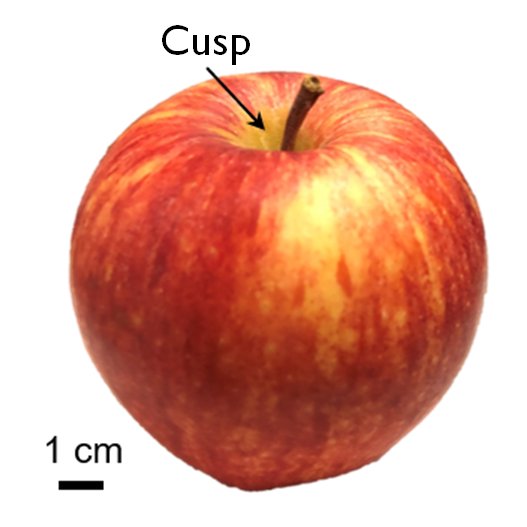
How do cusps of apples get their distinctive shape?
https://t.co/q5pHuWhyMv
Online today https://t.co/52ebN2fBq7
Enjoyable collaboration with Thomas CT Michaels, Sifan Yin, Eric Sun and @Mahadevan_Lab@hseas@harvard
Our new paper with @KMRoBoTa, @BIOROB_EPFL and many more is out in @SciRobotics! We show how undulatory swimming patterns can spontaneously emerge based on local force feedback.
(https://t.co/ju7rQ8M1bP)
Check out our interactive data visualization here:
https://t.co/iqSxh9BxC1
This Tuesday, our Comparative #Biomechanics discussion will be on "Benthic Biomechanics" by @fa_gia and @Mahadevan_Lab (https://t.co/bOreGcoLf3), or "How to model little skates walking bipedally". Join us at Noon MDT on March 23. Sign up for link https://t.co/jRdZBhceMC
An artificial intelligence network developed by Google AI offshoot DeepMind has made a gargantuan leap in solving one of biology’s grandest challenges — determining a protein’s 3D shape from its amino-acid sequence. https://t.co/tzWgwIgRNt
In simple models, the energetic effort of a wheel rolling over obstacles is equivalent to that of a biped walking on flat ground. Is walking nature's invention of the wheel in rugged environments? https://t.co/kgEqJ8wH2b
The total area of solar panels it would take to power the world, Europe, and Germany. This map is from Nadine May’s thesis [source: https://t.co/xXjEoppaUj]
Titanoboa is an extinct genus of snakes that is known to have lived from 58 to 60 million years ago. It could reach 12.8 m (42 ft) in length and weigh about 1,135 kg (2,500 lb) https://t.co/nA8F9Hhn38 [source of the image: https://t.co/95N0Zo48e7]
Excited about our new paper with @georgelauder published in JEB on the turning mechanics of zebrafish. Check it out to see how we used PIV without a laser to estimate the costs of frequently occurring spontaneous turns. (https://t.co/p7jMxLYo11)
Speed reading is any of several techniques used to improve one's ability to read quickly. There are several methods and techniques to achieve it with different results: https://t.co/OpvEdzUyPf [gif: https://t.co/5I6AHjv642]





![Rainmaker1973's tweet photo. The total area of solar panels it would take to power the world, Europe, and Germany. This map is from Nadine May’s thesis [source: https://t.co/xXjEoppaUj] https://t.co/aZl3mYB91D](https://pbs.twimg.com/media/EhTrTj0WsAIgNa0.jpg)
![Rainmaker1973's tweet photo. Titanoboa is an extinct genus of snakes that is known to have lived from 58 to 60 million years ago. It could reach 12.8 m (42 ft) in length and weigh about 1,135 kg (2,500 lb) https://t.co/nA8F9Hhn38 [source of the image: https://t.co/95N0Zo48e7] https://t.co/Px670Fa9Mc](https://pbs.twimg.com/media/EgfiRaWVgAEy-NK.jpg)


