David Schamis: Why $HYPE, Why $PURR, Potential Airdrop and What comes next for Hyperliquid
I sat down with @dschamis, CEO and co-founder of Hyperliquid Strategies (@HypeStrat), to ask the questions you wanted answered.
Why build a public company around $HYPE with Bob Diamond? Why buy $PURR instead of holding $HYPE directly? And when does buying back shares make more sense than buying more tokens?
We also tackled some of the biggest questions in the ecosystem: $HYPE concentration, the OTC transaction, a potential airdrop, and what trade[XYZ] (@tradexyz) and ICE could mean for Hyperliquid’s future.
Full interview below 👇
Timestamps:
00:00 Highlights
00:36 Intro
01:48 David’s background and Hyperliquid Strategies
04:54 How David discovered Hyperliquid
05:41 Paradigm’s role and working with the community
08:27 Why build a public company around HYPE?
12:57 Bob Diamond and the board
15:45 PURR, ETFs and generating yield
20:10 Preferred shares, leverage and risk
22:44 mNAV, share issuance and buybacks
28:15 HYPE concentration and liquidity
32:12 Could concentration weaken the Hyperliquid story?
35:36 A potential Hyperliquid airdrop
40:34 The OTC transaction and transparency
46:49 trade[XYZ], ICE and US markets
53:32 What excites David about the future?
54:57 Closing thoughts
Tokens are five years into a brutal bear market. Many industries have endured bear markets like this only to enter 10+ year secular bull markets. Others have never recovered.
I believe we are in the former camp and about to enter decade-long secular bull market.
after 6 months and hundreds of hours, my Crypto Asset Valuation Framework (CAVF) whitepaper and fundamental investing dashboard are live!
check it out here:
>> https://t.co/oRFU1n3Bo7
the whitepaper is an attempt to standardize crypto valuation, with a focus on tokenholders.
the dashboard applies the framework to 50 tokens, scored across eight dimensions (traction, value accrual, team, competition, market, valuation, supply, and catalysts).
every token gets a rating at four time horizons, a tokenholder economics grade, its dilution-adjusted accrual yield (DAAY), a base-case fair value against today's price, and quality and value scores, which place all 50 tokens on a matrix.
it's an amazing tool for value investors, especially as prices are low.
more on the whitepaper and the dashboard below.
if you have any feedback/questions, or would like me to add a token to the dashboard, pls reply!
🚨 TradingView'e abonelik parası ödemeden kullanabileceğiniz ücretsiz alternatif grafik platformları listesi burada!
Çizimlere bile kota getirdiler, yakında destek/direnç çizmek için de para isteyecekler!
Bizi sürekli kısıtlayıp ücretli paketlere mecbur bırakmaya çalışıyorlar. Ama paranızı kaptırmayın piyasadaki tek seçenek onlar değil. 👇
📊 Ücretsiz Grafik Platformları:
🔹 OpenMarket → https://t.co/xQQZB6v9Ub
🔹 GoCharting → https://t.co/mSRvPETlWA
🔹 ProRealTime → https://t.co/ufhy0N4brr
🔹 https://t.co/nSoSu4oTYt → https://t.co/euVYKmTvzr
Kripto, Forex, BIST ve ABD borsalarını takip etmek, grafik çizmek isteyenler bu listeyi kaydetsin.
Rekabet iyidir kullanıcıyı sömürmek değil, hizmet sunmak kazandırır!
Altcoins are in a full-blown crisis.
Since the October 2025 top:
Polkadot: -83.6%
Cardano: -82.9%
Sui: -80.5%
Dogecoin: -78.3%
Avalanche: -77.3%
Solana: -69.5%
XRP: -69.2%
Ethereum: -61.9%
27 of the top 40 altcoins have lost more than 50% of their value.
Even Bitcoin is down 49%, and alts are bleeding far worse.
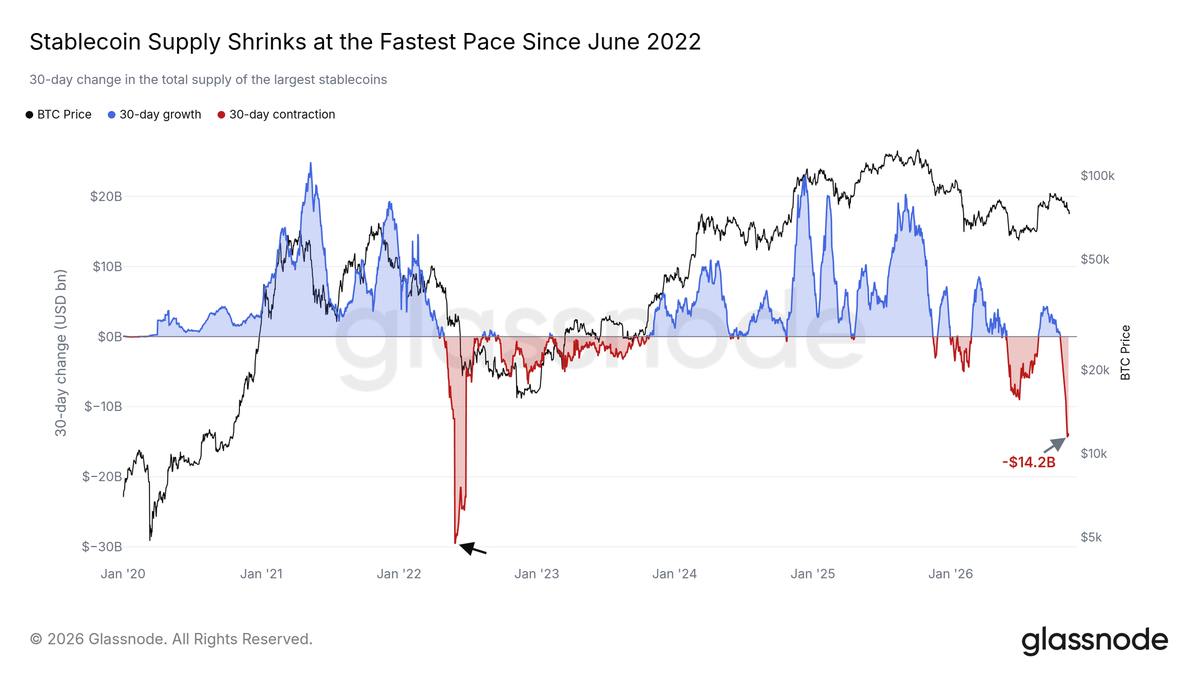
Crypto just had its biggest drop in stablecoin supply since June 2022.
That's $14.2B less in circulation in just 30 days.
So where did all that liquidity go?
I looked into the data, and there's pretty strong evidence of investors cashing out:
→ USDT/USDC supply fell by ~$11B
→ Stablecoin off-ramping doubled in a week (mostly USDT sold for USD)
→ Spot BTC ETFs had $1.6B in net outflows over 20 trading sessions
The recent Binance hack probably didn't help investor confidence either.
Seeing this much liquidity leave circulation while BTC struggles to recover is a bad look rn.
Not a great end of year compared to some previous ones.
Crypto derivatives have scaled around perpetual futures, but onchain options remain one of the market's most underdeveloped segments.
Despite reaching $1.77B in notional open interest, options liquidity and execution remain concentrated across a handful of venues.
As new protocols compete to close this gap, the next phase of growth will depend on how effectively they solve liquidity, execution and capital efficiency.
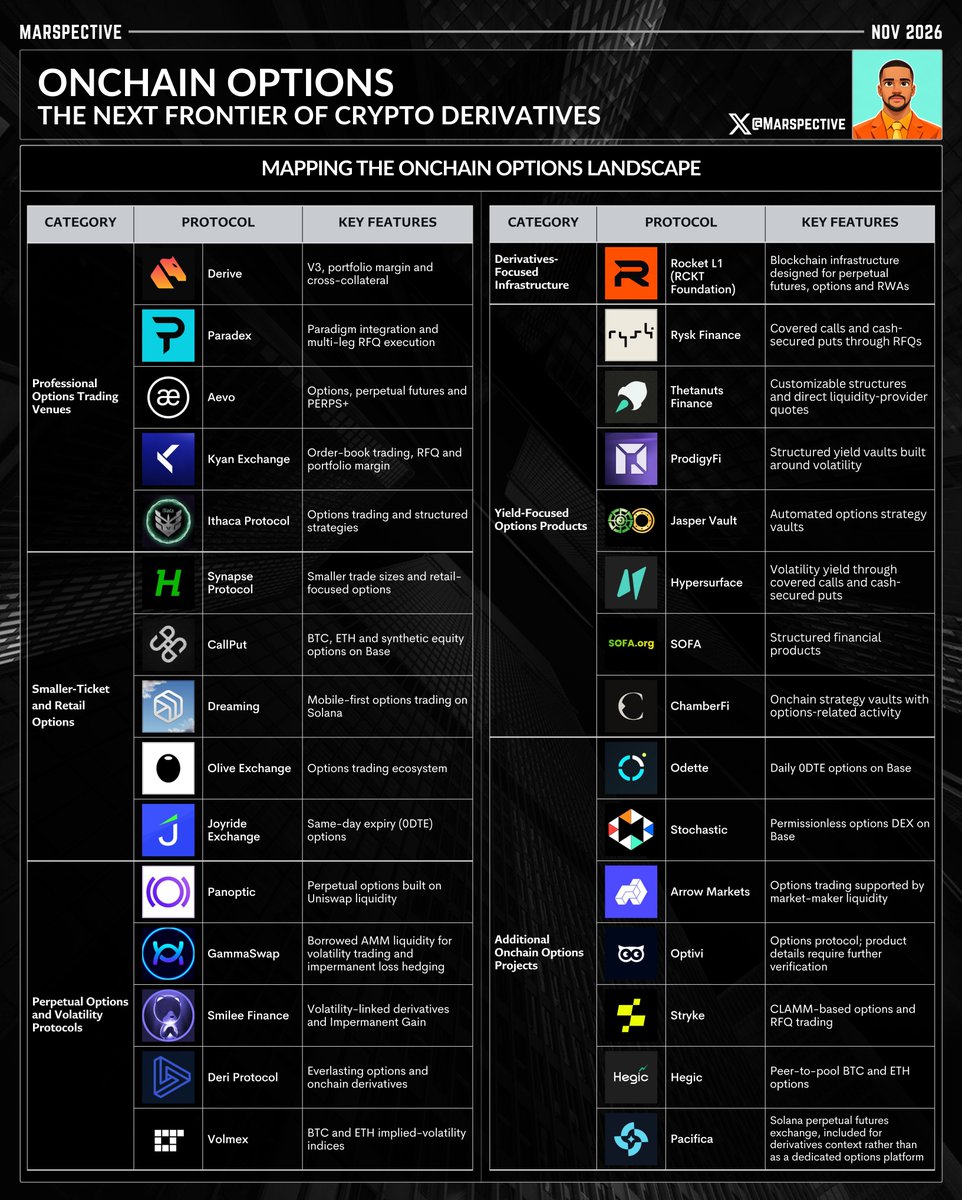
Here's a look at the emerging onchain options landscape.
—
● The Liquidity Gap Between Perpetuals and Options
Perpetual futures have become crypto's dominant derivatives product, while options remain comparatively underdeveloped despite their widespread adoption in traditional finance.
The contrast is significant:
• Traditional finance: Options reportedly trade 3x more contracts than futures.
• Crypto: Perpetual futures reportedly generate 238x more volume than options.
Crypto perpetual futures have recorded $18T in all-time volume, compared with just $75.5B for options.
This gap highlights the potential for options to capture a larger share of derivatives activity. However, unlike perpetuals, options require liquidity across multiple strikes, expiries and contract types.
That fragmentation makes execution and market-making considerably more difficult.
—
● RFQ: Bringing Institutional Liquidity Onchain
One approach to overcoming fragmented options liquidity is Request for Quote (RFQ), which allows traders to source prices directly from professional market makers rather than relying entirely on resting order-book liquidity.
The process:
• A trader requests a quote for a specific options contract.
• Multiple market makers assess the risk and submit competing prices.
• The trader compares available quotes and accepts the preferred execution.
Trader request -> Market makers compete -> Quote accepted -> Trade executed
RFQ is particularly valuable for options because it can aggregate liquidity across market makers without requiring deep order books for every strike and expiry.
Alongside portfolio margin and structured execution, this model is becoming an important component of the emerging onchain options market.
—
● Mapping the Onchain Options Landscape
The ecosystem is developing across several segments, with protocols addressing different aspects of trading, liquidity provision, volatility exposure and structured yield.
● Professional Options Trading Venues
These platforms focus on building the execution infrastructure required for sophisticated options trading.
• @DeriveXYZ: V3, portfolio margin and cross-collateral.
• @paradex: Paradigm integration and multi-leg RFQ execution.
• @aevoxyz: Options and perpetual futures, with PERPS+ linking options strategies to perp positions.
• @KyanExchange: Order-book trading, RFQ and portfolio margin.
• @IthacaProtocol: Options trading and structured strategies.
● Smaller-Ticket and Retail Options
While professional venues prioritize advanced execution, another group of platforms aims to make options accessible to a broader audience through smaller contracts and simplified trading interfaces.
• @SynapseProtocol: Smaller trade sizes and retail-focused options trading.
• @CallPutApp: BTC, ETH and synthetic equity options on Base.
• @dreaming: Mobile-first options trading on Solana.
• @Olive_Exchange: Options trading ecosystem.
• @JoyrideExchange: Same-day expiry options (0DTE).
These products address accessibility, but broader retail adoption will still depend on pricing, liquidity and manageable trading costs.
● Yield-Focused Options Products
Beyond active trading, options can also support structured yield strategies.
These protocols package options exposure into vaults and financial products, allowing users to participate without continuously managing individual positions.
• @ryskfinance: Covered calls and cash-secured puts through RFQs.
• @ThetanutsFi: Customizable options structures and direct liquidity-provider quotes.
• @ProdigyFi: Structured yield vaults built around market volatility.
• @jaspervault: Automated options strategy vaults.
• @hypersurfaceX: Volatility yield through covered calls and cash-secured puts.
• @SOFAorgDAO: Structured financial products.
• @chamberfi: Onchain strategy vaults with options-related activity.
This segment expands the use of options beyond speculation into income generation and automated risk management.
● Perpetual Options and Volatility Protocols
Other protocols are experimenting with alternative derivatives designs that reduce reliance on traditional expiry-based contracts or provide more direct exposure to volatility.
• @Panoptic_xyz: Perpetual options built on Uniswap liquidity.
• @GammaSwapLabs: Perpetual options using borrowed AMM liquidity to trade volatility and hedge impermanent loss.
• @SmileeFinance: Volatility-linked derivatives and Impermanent Gain products.
• @DeriProtocol: Everlasting options and other onchain derivatives.
• @volmexfinance: BTC and ETH implied-volatility indices.
These models introduce new ways to trade volatility, manage risk and access options-like exposure without relying exclusively on conventional options markets.
● Derivatives-Focused Infrastructure
Alongside trading protocols, blockchain infrastructure is also being developed to support more specialized derivatives activity.
• @RCKTFoundation: Rocket L1, designed for onchain perpetual futures, options and RWAs.
● Additional Onchain Options Projects
Several other projects provide, or have previously provided, options-related products through different trading models and blockchain ecosystems.
• @odetteonchain: Daily 0DTE options on Base.
• @stochastic_fin: Permissionless options DEX on Base.
• @ArrowMarkets: Options trading supported by market-maker liquidity.
• @optivixyz: Options protocol, with specific product details requiring further verification.
• @stryke_xyz: CLAMM-based options and RFQ trading.
• @HegicOptions: Peer-to-pool BTC and ETH options.
• @pacifica_fi: Solana-based perpetual futures exchange, included for derivatives ecosystem context rather than as a dedicated options platform.
Together, these projects show how the market is expanding beyond traditional options exchanges into retail trading, structured products, perpetual options and specialized infrastructure.
However, a growing number of platforms does not necessarily translate into deeper or more efficient liquidity.
—
● The Core Challenges Facing Onchain Options
Despite growing experimentation, four structural challenges continue to limit adoption.
• Liquidity fragmentation: Liquidity is distributed across strikes, expiries and contract types, making competitive pricing difficult.
• Multi-leg execution: Executing individual legs separately introduces execution risk and increases transaction costs.
• Capital inefficiency: Isolated margin requirements fail to account for portfolio-level hedging, increasing collateral demands.
• Trading costs: Fees, spreads and slippage make sophisticated options strategies expensive to execute.
RFQ systems, portfolio margin and smaller contracts address different parts of these challenges, but solving them collectively remains essential for sustainable market growth.
—
Perpetual futures established crypto's derivatives market, but options represent a largely underdeveloped layer with significant room for expansion.
Fractional contracts can lower entry barriers, while structured payoffs allow traders to access risk profiles that perpetual futures cannot easily replicate.
The opportunity extends beyond speculation into hedging, volatility trading and structured yield.
However, the next generation of onchain options will not be defined simply by the number of protocols entering the market.
The platforms that win will be those capable of combining competitive liquidity, reliable execution, capital efficiency and accessible risk management.
Ultimately, making options easier to trade and more useful will matter far more than simply making them available onchain.
"Liquidity" sweeps & how to think about the term liquidity the right way
longer post, bookmark
> first let's define liquidity - a simple way to think about it - how much you can trade + how fast and how little it moves price.
a sweep is referred to as a candle pattern where price trades past a prior high or low and then closes back inside. the assumption is that stops are triggered beyond that level and the other side filled against that.
if you're looking at shit from half a year ago you best believe those positions aren't just sitting there for months.
stops get triggered or moved, positions close so not much is just waiting there sitting to be "swept" or is left behind.
old levels can still matter which is why some of this shit works.
price doesn't give a flying f but people do because of price history and candle stick charts.
i.e. there's psychology established around highs and lows that stand out on a chart or also depending on how price traded around them.
so when price gets close to previous areas that's where the new positioning come from. everyone sees the same crap, so new stops, new breakout positions.
candles shows price traded (the advertisement)
you can confirm some of the other stuff with open interest, liquidation, trapped positioning, aggression piling in or (lack thereof) etc.
on more recent price action, especially if price is hanging out around certain areas for longer periods of time or chopping, there's a recency bias i.e. positioning is starting to build up at the range extremes, price will continue to revert until there's new information which is the excuse for one side going "yeah f this" = reflexivity/decisive break in that direction.
the mechanics of a sweep:
> liquidation - stops getting triggered in the same area which unravels price (think trail of gasoline lit on fire), which is why price moves fast.
> exhaustion - positioning stopped out, inventory cleaned up.
> forced stops cause temporary mispricing and leaves behind a vacuum in the books = mechanical reversion (easy to take the other side and push price in the other direction since thin).
this is also magnified by new positioning that piled in aggressively (breakout/breakdown) on the quick move (bottom shorts/top longs) and stops are now in the immediate vicinity in the other direction.
> on the back of this reversion, if there is no follow through on aggression in the same direction price will typically probe back to clean up the "large wick" left behind on this temporary reversion.
* some of the definitions and terminology in the visual was paraphrased using the reference - Albert Kyle, “Continuous Auctions and Insider Trading,” Econometrica, 1985
Elysium goes live on November 9 as a fast L2 for Hyperliquid, with half of sequencer fees and a growing list of apps buying back and burning KNTQ. Here is how it works, where the value goes and how to position for launch. https://t.co/MhtBKJwI86