Le pedí a Claude Opus 5.5 que resumiera varias de mis presentaciones sobre el presente y futuro del sistema se salud de Colombia en dos minutos. Este fue el resultado después de varias iteraciones:
Durante años nos vendieron la idea de que el pasamontañas era la prenda preferida de nuestra juventud. Que su lenguaje era el odio de clases —los de arriba, los de abajo, los ricos, los pobres—. Que su destino era bloquear, destruir, arriesgar la vida por la rabia. Muchos llegamos a pensar que era una generación perdida.
Qué equivocados estábamos.
Hoy los veo poniendo las manos no para destruir, sino para construir. No para bloquear, sino para abrir los caminos que conducen a la recuperación de Colombia.
Cambiaron el pasamontañas por la camiseta de la Selección. Llegan con su estilo, con su look, con eso que los identifica… y con una energía que nos devuelve la fe.
Nuestros jóvenes nos acaban de dar la mejor noticia: este país tiene presente y tiene futuro. Que seguiremos cantando el himno con orgullo. Y que la patria que soñamos ya la están construyendo unas manos jóvenes que nunca estuvieron perdidas.
Qué orgullo ser colombiano.
Qué orgullo tener estos jóvenes.
#Colombia #FuerzaColombia #JuventudQueConstruye #Solidaridad #Reconstrucción #LiderazgoConPropósito #Barranquilla
Just spoke to Colombian President-Elect @ABDELAESPRIELLA to congratulate him on his electoral victory.
The Trump Administration looks forward to working closely with your incoming administration to advance regional security cooperation, end illegal immigration to the United States, and strengthen our economic ties.
Colombia's best days are ahead.
LIVE: Watch with us as the Artemis II astronauts make their closest approach to the Moon, traveling farther from Earth than ever before. https://t.co/Zpy7GdTqA8
Ojo: los flojos resultados de la oposición en la encuesta de hoy no son exclusiva ni principalmente por las divisiones y rivalidades que hay entre ellos. Hay algo más de fondo, algo que no se resuelve “deponiendo los egos”. Una ausencia de propuestas y relatos que entusiasmen.
We're partnering with @Snowflake to bring you hands-on talks and concrete patterns you can implement immediately.
Join us at our Amsterdam meetup on July 31st where we'll show you exactly how teams are building high-quality data agents in production. Build production-ready agents that work with real enterprise data:
💠 Taming complex paperwork with document agents using LlamaCloud's parsing tools and our open-source agent framework
💠 Building data agents that access both structured and unstructured data from multiple sources
💠 Systematically evaluating agents and identifying common failure modes using structured evals
💠 Real engineering patterns and live code demos - no sales pitches, just practical solutions
Register for the Amsterdam Data Agent Builders Meetup: https://t.co/wk2Y8CfBy0
President Donald J. Trump, @POTUS
Elon Musk @elonmusk
CESAR REYES, the "judge" who jailed me, was a contractor to USAID in service of Santos' amnesty deal to narco terrorist farc. Mr Reyes was also contractor in Santos’ government for the agreement with FARC while I was one of the leaders in opposition to this accord. Remember that we won the plebiscite with the NO vote that Santos disregarded in clear violation of our Constitution.
The agreement with FARC legalized Narco trafficking and Colombia lost Plan Colombia, 14 billion dollars contributed by the United States.
Gustavo Rugeles (@GustavoRugeles):
“The magistrate César Reyes, the same one who built the case against Álvaro Uribe, and the wife of Iván Cepeda, Mrs. Pilar Rueda, were also consultants for USAID in Colombia. That is where the taxpayers’ money from your country went.
@USEmbassyBogota @USAID_Colombia”
Gustavo Rugeles – October 9, 2019:
“ATTENTION: Judge of @AlvaroUribeVel and wife of @IvanCepedaCast—old friends?
Magistrate César Augusto Reyes was a consultant for @USAID when Pilar Rueda coordinated that justice access program within the framework of the post-conflict. They worked closely together during the Santos government.”
I had a great 2-hour podcast conversation with Javier Milei (@JMilei), President of Argentina 🇦🇷. It'll be out tomorrow & available in both English and Spanish.
Tremenda conversación de 2 horas con el Presidente @JMilei 🇦🇷 Sale mañana en inglés y español 🔥
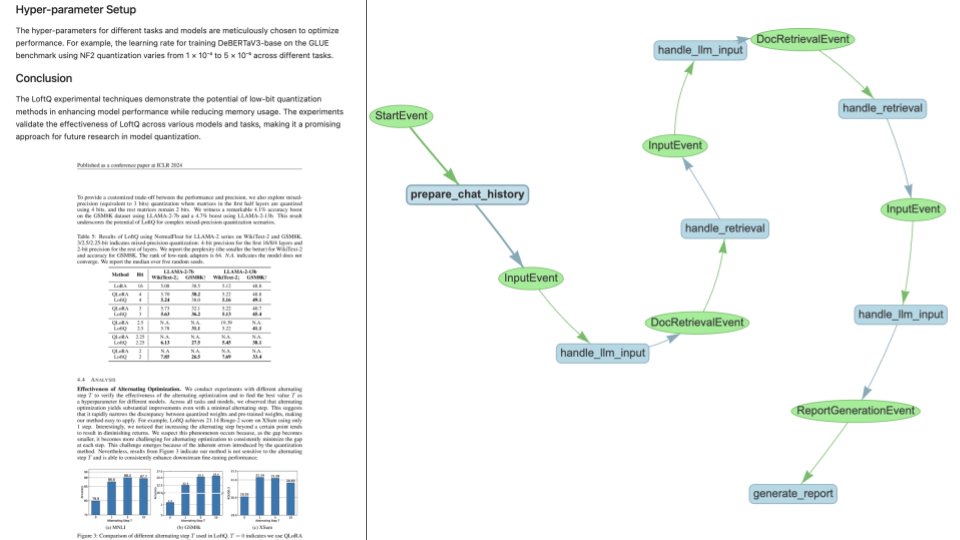
Building a Multimodal Report Generation Agent 🤖✍️🎨
Come learn how to automatically produce a multi-agent system that can do research over a multimodal RAG, compile into a knowledge bank, and generate a multimodal report containing interleaving text and images based on an existing complex data source.
This is one of our most comprehensive tutorials in terms of both technical depth and practical utility. It uses a blend of advanced capabilities across parsing, retrieval, agentic workflows, and structured outputs.
💡 Uses LlamaParse to index both text and image chunks.
💡 Dynamically does chunk-level and document-level retrieval depending on the nature of the question
💡 Uses @llama_index workflows to orchestrate a fully async, event-driven, multi-step agentic system
💡Uses our structured output capabilities (along with multimodal indexing/RAG) to generate a report containing interleaving images and text.
Check it out: https://t.co/7lw2KYbHqT
Signup here: https://t.co/yQGTiRSNvj
LLM model size competition is intensifying… backwards!
My bet is that we'll see models that "think" very well and reliably that are very very small. There is most likely a setting even of GPT-2 parameters for which most people will consider GPT-2 "smart". The reason current models are so large is because we're still being very wasteful during training - we're asking them to memorize the internet and, remarkably, they do and can e.g. recite SHA hashes of common numbers, or recall really esoteric facts. (Actually LLMs are really good at memorization, qualitatively a lot better than humans, sometimes needing just a single update to remember a lot of detail for a long time). But imagine if you were going to be tested, closed book, on reciting arbitrary passages of the internet given the first few words. This is the standard (pre)training objective for models today. The reason doing better is hard is because demonstrations of thinking are "entangled" with knowledge, in the training data.
Therefore, the models have to first get larger before they can get smaller, because we need their (automated) help to refactor and mold the training data into ideal, synthetic formats.
It's a staircase of improvement - of one model helping to generate the training data for next, until we're left with "perfect training set". When you train GPT-2 on it, it will be a really strong / smart model by today's standards. Maybe the MMLU will be a bit lower because it won't remember all of its chemistry perfectly. Maybe it needs to look something up once in a while to make sure.
Good to see the 'bigger is better' trend changing, cheaper, smaller models are the way to go!
Open models like LLaMA and Mistral have driven this change in my opinion.
The cost per token of GPT-4o mini has dropped by 99% since text-davinci-003, a less capable model introduced
towards intelligence too cheap to meter:
https://t.co/76GEqATfws
15 cents per million input tokens, 60 cents per million output tokens, MMLU of 82%, and fast.
most importantly, we think people will really, really like using the new model.