The people who offshored our petrochemical and refining capacity are the same people who offshored our industrial base.
They are the people who imagined that Australia could prosper in an asset-inflated, debt-driven economy, where we sold houses to one another, served coffee to one another, and called it prosperity.
They are the people who built vast domestic schemes while allowing the productive base that funds them to decay.
They are the central bankers who treated consumption as the measure of success, while the goods we consumed, the machines we needed, and the materials we depended upon were increasingly sourced from China.
They are the people who speak solemnly of “net zero” while ignoring the fact that much of our carbon burden has simply been exported, manufactured elsewhere, and then consumed here with clean hands and dirty supply chains.
They are the people who insist that Australian workers must have rights, protections, safety standards, and wages, while accepting that those same rights are extinguished for the workers who make our goods overseas.
That is the modern colonial mind. It no longer arrives with a flag and a gunboat. It arrives with ideology, moral absolutism, and a lecture.
It tells us what to think. It tells us what words to use. It tells us what industries we may have, what energy we may use, what history we must despise, and what future we must accept.
And it did all this without ever asking the Australian people the central question:
Do we wish to remain a serious country, capable of making, refining, building, repairing and defending itself?
Or are we content to become a nation of consumers, administrators and moralists, living off assets we don’t build, supply chains we do not control, and energy systems we no longer understand?
JUST IN: The most powerful navy in human history just admitted it cannot safely escort a single oil tanker through a 33-kilometre strait.
Reuters reported on 10 March that the US Navy has refused near-daily requests from the oil and shipping industries for military escorts through the Strait of Hormuz since Operation Epic Fury began on 28 February, citing the risk of Iranian attack as too high. Not once. Not occasionally. Near-daily. Every day for eleven days, the shipping industry has asked the US Navy for help, and every day the answer has been no.
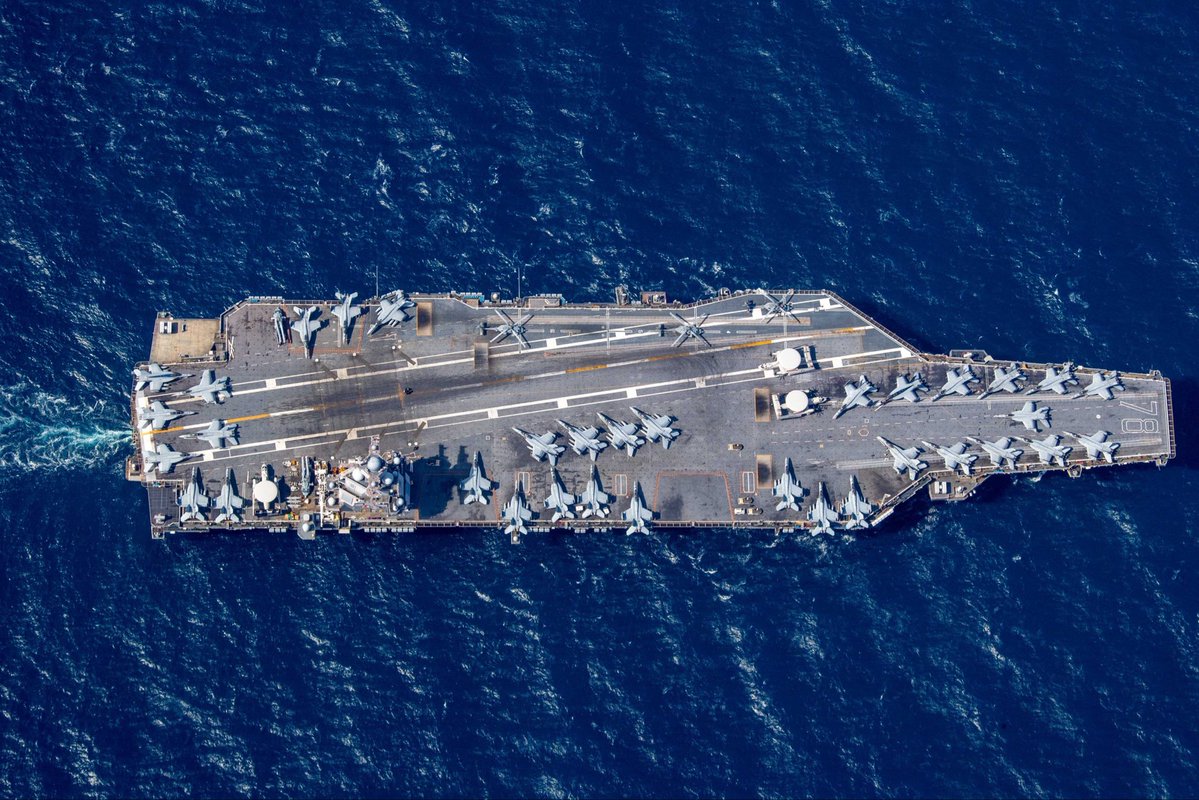
Consider what is deployed in the region. The USS Abraham Lincoln carrier strike group operates in the Arabian Sea. The USS Gerald R. Ford is in the Red Sea. The USS George H.W. Bush is en route or preparing for deployment. Three nuclear-powered supercarriers, each displacing 100,000 tons, carrying 75 aircraft, escorted by Aegis cruisers and guided-missile destroyers with the most advanced radar and missile defence systems ever built. France deployed the Charles de Gaulle carrier group to the Eastern Mediterranean and Red Sea. Britain sent HMS Dragon, a Type 45 air-defence destroyer, to defend RAF Akrotiri in Cyprus. Combined allied naval firepower in theatre exceeds the total military capacity of most nations on Earth.
None of it can get a tanker through Hormuz.
The strait is 33 kilometres wide at its narrowest point. Navigable shipping lanes compress to approximately 3 kilometres in each direction. Through this corridor, 138 tankers per day transited before the war. The corridor is now defended by 31 autonomous IRGC provincial commands with independent firing authority, pre-delegated orders from a dead Supreme Leader, coastal anti-ship cruise missiles, kamikaze drones, fast-attack boats, and a mine stockpile of 2,000 to 6,000 weapons, of which a few dozen are confirmed in the water with 80 to 90% of delivery platforms intact.
The US Navy’s refusal is not cowardice. It is arithmetic. A carrier strike group is designed for blue-water power projection, not littoral escort through a corridor where a $500 contact mine can cripple a $4 billion destroyer. An Aegis cruiser’s radar can track hundreds of targets at 400 kilometres but cannot detect a mine sitting three metres below the surface. An F-35 can deliver precision strikes at Mach 1.6 but cannot sweep a shipping lane. The assets are wrong for the mission. The world’s most expensive hammer has been asked to thread a needle.
Trump told CBS escorts would begin “as soon as possible” and “when reasonable.” His Energy Secretary posted that an escorted transit had already occurred, then deleted it when the White House confirmed none had. Iran’s Parliament Speaker mocked the claim as PlayStation. The IEA proposed the largest reserve release in history because the strait the Navy cannot escort through remains functionally closed.
Ghalibaf was not wrong. The escorts do not exist. Not because America lacks the will. Because the Mosaic Doctrine created a threat environment where the cost of escort failure exceeds the cost of escort refusal. One mine striking one escorted tanker would produce a casualty event, an insurance catastrophe, and a strategic humiliation that three carrier strike groups cannot absorb. The Navy is not refusing to help. It is refusing to lose.
Seven hundred tankers wait. Three carriers watch. And the 33-kilometre corridor between them remains the most expensive gap in the world.
Full analysis here.
https://t.co/eMrt5qYYst
@AvidCommentator If you spent the same amount of time actually working or building a business instead of years of posting this repetitive crap on twitter, you could have had a home by now
@AvidCommentator RBA 1 ppt cut:
Mortgagors + housing wealth +0.10-0.15 % GDP – allowing for ~10 % of borrowers reducing repayment
Retirees’ lost interest income -0.02 % GDP
Bus capex +0.03-0.06 % (kicks in year 2-3) 
Housing channel still king 👑