

Top Tweets for #Fragmented

@Durjoy___das @RialoHQ The current system is far too fragmented and expensive. Sending money globally should be as seamless as sending a message.

What fraction of the required ground truth already exists in fragmented form inside hospitals and labs, versus what must still be prospectively generated to reach decision-grade depth?

As AI Gets More General, Drug Development Gets More Vertical
The question for AI in drug development is shifting from speed to probability of success. IQVIA’s 2026 R&D report shows the gains are uneven: in its latest three-year window, AI-enabled programs at emerging biopharmas posted a 75% Phase I success rate, yet only matched non-AI programs in Phase II.
The reasoning starts with where value is decided. Phase II proof of concept, where asset value inflects, turns not only on the molecule but on its match with the patients receiving it.
AI has made hypotheses cheaper. It has not made proof cheaper. One lever is well established: in BIO’s 2011–2020 analysis, programs using biomarkers to select patients reached approval about twice as often.
That match also shifts with the population, and in cardiology some differences surfaced on drug labels only after approval. Asian patients show about twice the exposure to rosuvastatin, prompting a lower starting dose on its FDA label in 2005. Since 2010, clopidogrel has carried a boxed warning for CYP2C19 poor metabolizers, about one in seven Chinese patients but one in fifty Caucasians. Yet as of 2025, fewer than one in fifteen GWAS Catalog participants were of Asian ancestry.
Intelligence is portable; ground truth is not.
Today’s approaches each solve for a different variable: general-purpose models for breadth, AI-native discovery firms for the molecule, platforms such as Epic’s Cosmos for volume, mostly from U.S. health systems.
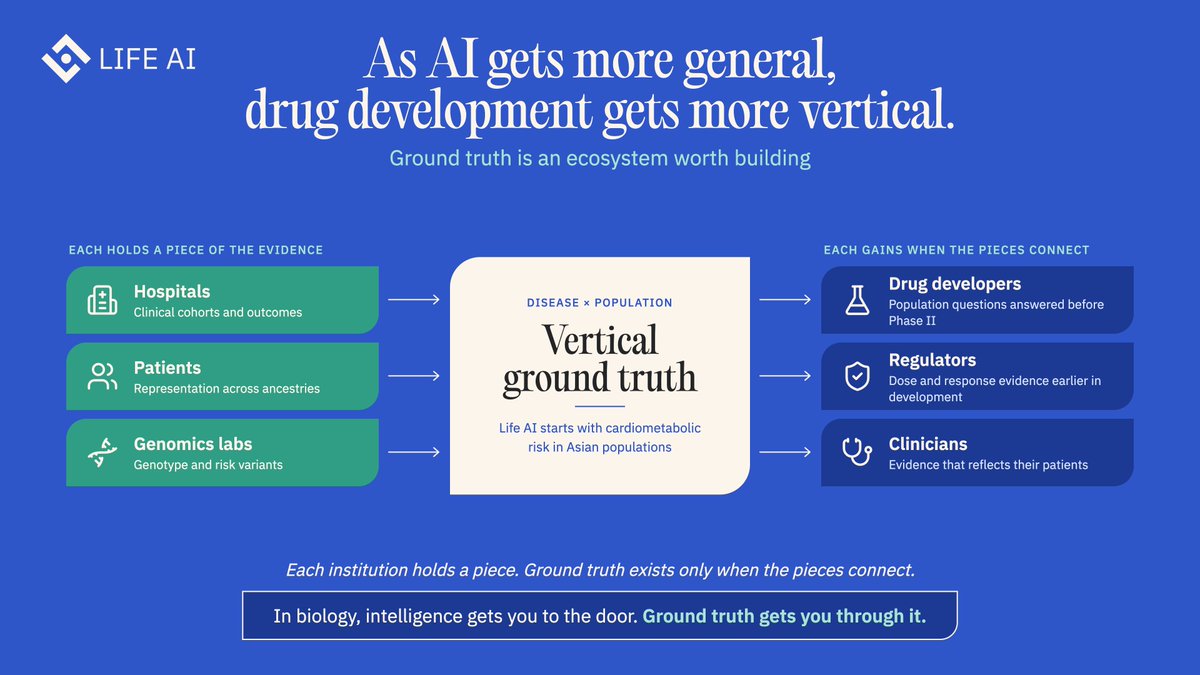
Phase II depends on one more, and no single player holds it: depth of evidence in a specific population. It sits across hospitals, genomics labs, sponsors and regulators, and becomes ground truth only when connected around one disease and one population.
If ground truth is population-specific and distributed, advantage is vertical, and vertical depth is built as an ecosystem.
That is Life AI’s premise. As Dr. Tuan Cao, Co-Founder and CEO of Life AI, has put it: “Many AI companies go horizontal and spread very wide. We go vertical, deep into the diseases that still weigh most on Asian patients, like diabetes and cardiovascular disease.”
Life AI works disease by disease, population by population: starting with cardiometabolic genetic risk in Asian populations, bringing intelligence into partner hospitals, where care happens, and extending it toward drug R&D through a purpose-built world model on connected infrastructure.
When models become a shared input, advantage increasingly moves to the evidence beneath them: which patients respond, at what dose and why, established before approval.
That evidence cannot simply be licensed. It is built institution by institution, cohort by cohort, and each institution that contributes can make it more valuable to the rest.
In biology, intelligence gets you to the door. Ground truth gets you through it.

Fragmented liquidity is a hidden tax on every trade.
Isolated pools. High slippage. Broken user experiences.
Solana's unified state creates a single, global order book.
Deep liquidity isn't just a feature.
It is the gravity that attracts serious capital.
Efficiency is the ultimate magnet. ❄️


@fragmentedrose1 wait this could help w my need to feel like. empty/cleansed? of my food

Beyond Execution: Rialo’s Full-Stack Architecture Is Redefining How Developers Build Onchain
Building onchain applications often means connecting multiple independent systems for data access, identity, privacy, communication, and execution. This fragmented architecture creates additional integration overhead, increases dependencies, and can slow down development.
Rialo takes a different approach: instead of providing execution alone, it brings core blockchain infrastructure into one integrated ecosystem where data, communication, privacy, and execution work together natively.
From Fragmented Infrastructure to Full-Stack Integration
Traditional blockchain development often requires developers to stitch together external services, middleware, and additional infrastructure.
Rialo aims to simplify this architecture by integrating essential capabilities at the protocol level.
The result is less integration complexity, fewer external dependencies, and a more streamlined environment for building onchain applications.
Four Core Advantages for Builders
Less Integration Overhead
Developers can reduce reliance on multiple external providers and middleware layers, allowing them to focus more on application logic rather than infrastructure coordination.
Better Efficiency & Speed
When execution, communication, and data access operate within the same ecosystem, applications can benefit from smoother workflows and reduced integration friction.
Native Privacy
Confidential computation is built into the infrastructure, protecting sensitive information during execution while preserving the ability to verify outcomes.
Real-World Connectivity
Rialo introduces infrastructure components such as:
-> Rialo Edge
-> Rialo Stream
-> Rialo IPC
-> Reactive Transactions
Together, these capabilities support applications that interact with external data, communication systems, and real-world events.
Composability: Where the Real Value Emerges
Rialo's architecture is not simply a collection of independent features.
Its core advantage comes from how these primitives reinforce one another:
-> Data access gives execution access to information beyond the blockchain.
-> Native privacy enables sensitive data to be processed securely.
-> Communication connects different components and systems.
-> Reactive Transactions allow applications to respond automatically when predefined conditions are met.
Instead of relying on isolated tools, developers can compose these capabilities into more connected and sophisticated applications.
Infrastructure That Works Together
Rialo is pursuing a full-stack blockchain model where critical infrastructure is integrated rather than fragmented across external services.
This approach aims to reduce middleware overhead, improve development efficiency, and expand the possibilities for real-world applications.
The key shift is simple: developers should spend less time connecting infrastructure and more time building products.
Rialo is moving beyond blockchain execution toward an integrated ecosystem where Data + Communication + Privacy + Execution work together to power the next generation of onchain applications.
Less Integration. More Composability. Stronger Infrastructure.
@RialoHQ


🌐 CRYPTO IS CONNECTED. BUT LIQUIDITY IS STILL FRAGMENTED.
Different chains.
Different assets.
Different liquidity sources.
That creates friction for users.
KUVI's integration with SimpleSwap aims to expand access across:
🔹 2,800+ assets
🔹 200+ blockchains
🔹 20+ liquidity sources
⚡ One strategy layer. A wider execution landscape.
That's a practical problem worth solving.
@KuviLabs
🔗 https://t.co/TRFFotpUyb

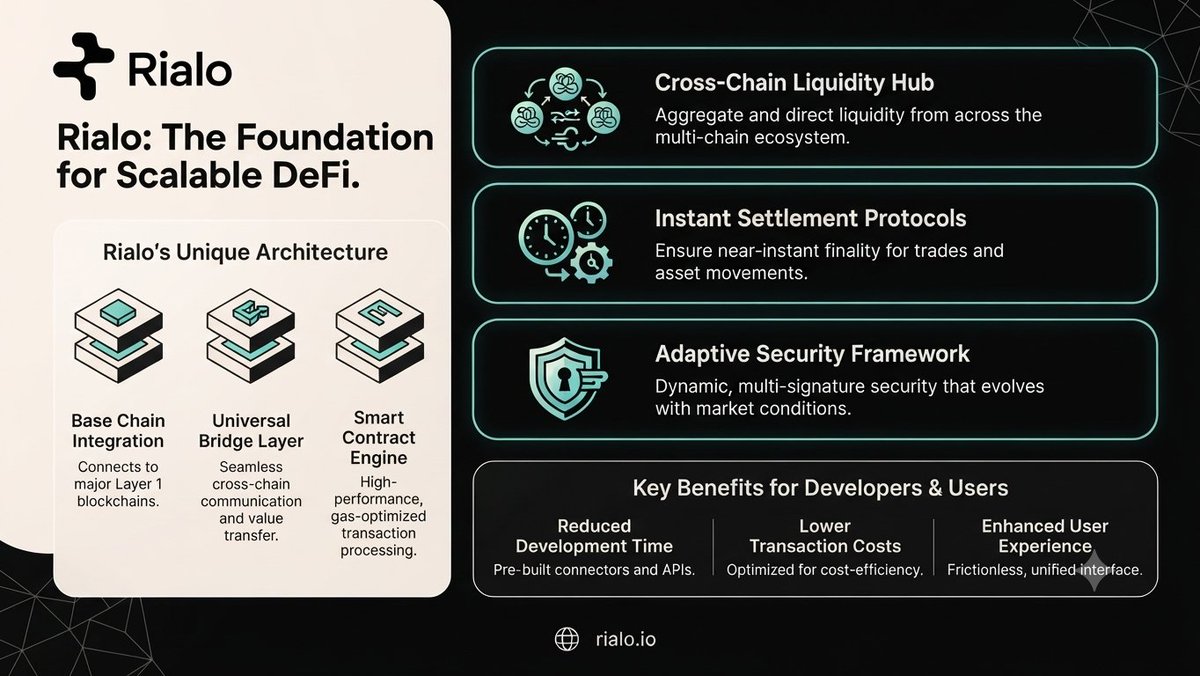
𝗥𝗶𝗮𝗹𝗼 𝗜𝘀 𝗕𝘂𝗶𝗹𝗱𝗶𝗻𝗴 𝗠𝗼𝗿𝗲 𝗧𝗵𝗮𝗻 𝗖𝗼𝗻𝗻𝗲𝗰𝘁𝗶𝘃𝗶𝘁𝘆 — 𝗜𝘁'𝘀 𝗕𝘂𝗶𝗹𝗱𝗶𝗻𝗴 𝘁𝗵𝗲 𝗙𝗼𝘂𝗻𝗱𝗮𝘁𝗶𝗼𝗻 𝗳𝗼𝗿 𝗦𝗰𝗮𝗹𝗮𝗯𝗹𝗲 𝗗𝗲𝗙𝗶.
One of the biggest challenges in DeFi isn't simply the number of chains, but how fragmented the infrastructure behind them can be.
Liquidity is scattered, cross-chain interactions can be complicated, and developers often have to deal with multiple layers just to make an application work efficiently.
Rialo approaches this differently, bringing together base-chain integration, a universal bridge layer, and a smart contract engine into a unified architecture.
Add cross-chain liquidity coordination, settlement protocols, and an adaptive security framework, and the vision becomes clearer: infrastructure that reduces complexity instead of passing it on to developers and users.
Scaling DeFi shouldn't mean adding more friction. It should mean making the underlying infrastructure work better together.
@RialoHQ

Solid take. Hypesium’s one-workflow approach for Elysium makes sense given how fragmented the chain still is. The early numbers look promising, but you’re right — the real test will be reliability when liquidity dries up and things get chaotic. Watching this one.

I’ve been looking at @Hypesium not as another sniping tool, but as an attempt to build a more complete trading workflow for Elysium.
Most tools focus on one part of the process. Hypesium is trying to cover more of it.
Discover → Bridge → Buy/Sell → Track P/L → Monitor positions → Plan exits.
That’s the real friction active traders deal with daily.
Early numbers they’re putting out:
• 230 users in the first week
• Bridging support across 7 chains
• Access to 19 launchpads
• 14 tokens in one activity snapshot
• $59,420 in reported 24h volume
These suggest some early traction. Still, I haven’t independently verified the full flow or the metrics yet.
What stands out is the problem they’re targeting
Elysium trading is fragmented. Different tools for discovery, bridging, execution, and position management. Switching between them creates delays and missed opportunities.
If Hypesium can reduce that friction without adding new complexity, it’s solving something real.
But direction alone isn’t enough.
Liquidity, slippage, smart contract risk, bridge failures, and sudden volatility will test any system hard. Especially on a chain that’s still finding its footing.
The real test isn’t feature lists. It’s how the product holds up when conditions get messy.
My current view:
Hypesium has a clear thesis, make Elysium trading less fragmented. That’s a solid starting point.
Long term credibility will come from consistent execution under pressure, not announcements.
Can it stay reliable when liquidity thins out and markets move fast?
That’s the question worth watching.


1/ Rialo is not a Layer 1. It is a real world blockchain.
Instead of forcing users and businesses to come to a fragmented, complex ecosystem, @RialoHQ brings Web3 to where users actually are


@PrismaXai Eliminating Weak Security Links
4) Isolated validator sets create fragmented trust assumptions that attackers exploit. By pooling staked capital across a unified validator network, @PrismaXai enforces uniform security guarantees across every oracle, sequencer, and bridge.

In crypto, the search for significance has become fragmented into smaller and smaller pieces.
You may find many points of interest, many places where paths cross... but there is only one point of origin, and one place where all paths cross.
Come back home, to the source. Farther back than Bitcoin. Further upstream in the cosmic stream.
There you will find the genesis narrative. The name that encompasses everyone, and everything. The singularity. The universe.
All that we are. Who we are all.
ethereum:0xcbf4d5efa82e32a9187385480a7c74cb062b956c



@PrismaXai Unified Cross-Rollup Composability
5) DeFi protocols can now read real-time collateral ratios, liquidity depths, and governance votes across multiple rollups natively. @PrismaXai turns fragmented L2 ecosystems into a single, synchronously readable state machine.

The Hohenzollern core territory was fragmented, scat erred and thinly populated, but they also boasted fertile Westphalia and industrial centers like Krefeld. Four threads: dynasty, religion, language, and imperial membership held them together


@ROBINonbreak Reducing fragmented dependencies could help builders capture more value from the applications they create

Building custom execution environments usually means dealing with massive infrastructure overhead and fragmented liquidity.
What @ZenithFdn is doing with the Zenith Stack takes a much more pragmatic approach for developers.
Instead of spinning up an isolated chain from scratch, teams can launch customizable virtual blockchains anchored directly to the Canton Network. You keep standard EVM compatibility (Solidity, Foundry, Hardhat) while inheriting Canton's Global Synchronizer out of the box.
Why this architecture makes sense for builders:
- Custom Execution: Dedicated throughput (100k+ TPS and sub-second finality) without managing physical validator infra.
- Native Composability: Atomic settlement across the broader Canton ecosystem without relying on fragile cross-chain bridges.
- Sustainable Alignment: Apps earn $CC rewards based directly on the transaction volume and real utility they generate.
- Multi-VM Roadmap: Full EVM support today, with Zenith SVM on the horizon for Solana developers.
Real infrastructure upgrades happen when complex enterprise networks become accessible to everyday Web3 devs.


5/ One Application, One Coherent Experience
Rialo's broader opportunity is to rethink how applications coordinate across infrastructure. The goal: make fragmented environments feel like one system.
Follow @RialoHQ
🌐 THE HIDDEN COST OF FRAGMENTED STATE
1/ When Applications Lose Context
An application may operate across multiple blockchains, but each environment holds different states. Without coordination, the application struggles to maintain one consistent view.


@yusufmarafaby @Ask_ORO Cross-chain visibility separates fragmented lending from unified capital architecture.
1) Fragmented rollups fracture liquidity and drive up settlement costs.
Isolated verification layers force dApps to maintain custom bridges, creating massive security risks and UX friction
Modular ecosystems need unified settlement.
@RialoHQ


As Web3 becomes more fragmented, verifiable trust becomes even more important.
https://t.co/rQjtrIaCcF

there was a time when Ethereum was the primary network that allowed Layer 2 solutions to strengthen scalability, speed up block verification, and improve overall performance.
as technology has evolved, many new innovations, developments, sovereign chains, layers, and protocols have emerged across the ecosystem.
with huge global adoption and new users onboarding into the Web3 ecosystem, getting started with decentralization now comes with multiple options. but these opportunities also come with risks and require caution.
trusting a platform with your financial decisions can be tricky due to multiple factors, particularly those related to ownership and verification.
@primus_labs, with its attestor nodes specifically designed for the financial sector, uses zkTLS for on-chain and off-chain verification without unnecessarily exposing users' data and privacy on public ledgers.
the Web3 ecosystem works with contract addresses that perform roles such as agents, verifiers, authenticators, and validators to generate successful transactions.
cournot protocol is an AI-native oracle that interprets reality and proves it. It recently partnered with Primus Labs to strengthen off-chain verification before AI systems reason over the data.
AI has advanced to the point where traditional practices in the financial verification sector, which were often slow and reportedly had a consistent 35% error rate, are becoming outdated. faster, integrated AI agents can now complete these processes in just a few clicks rather than making users wait for days.
using the Primus Web API provides data authentication from legitimate sources for ready to use verification processes powered by zkTLS.
this integration is pivotal in many sectors, including prediction markets, DEX authorizations, RWAs, and even private credit in decentralized wallets.
Privacy, security, and trust in data handling have reached an unprecedented level of importance, where trusting every click can contribute to safer and more informed financial decisions.
if you're exploring Primus, don't forget to check out the points tasks too:
Primus Points: https://t.co/LCEA8aSfb7
you can also join Kaito through my referral:
Kaito: https://t.co/h6Yaw2AYoR
#Primus #Kaito #zkTLS #FHE #BASEChain #DeFi #Privacy #Web3

1) Delayed liquidations create massive bad debt in DeFi.
Slow oracle updates and fragmented collateral leave protocols exposed during volatile market crashes.
Lending engines need real-time solvency protection.
@RialoHQ

As Web3 becomes more fragmented, trustworthy data verification becomes essential.
https://t.co/rAG9xjgJJS
there was a time when Ethereum was the primary network that allowed Layer 2 solutions to strengthen scalability, speed up block verification, and improve overall performance.
as technology has evolved, many new innovations, developments, sovereign chains, layers, and protocols have emerged across the ecosystem.
with huge global adoption and new users onboarding into the Web3 ecosystem, getting started with decentralization now comes with multiple options. but these opportunities also come with risks and require caution.
trusting a platform with your financial decisions can be tricky due to multiple factors, particularly those related to ownership and verification.
@primus_labs, with its attestor nodes specifically designed for the financial sector, uses zkTLS for on-chain and off-chain verification without unnecessarily exposing users' data and privacy on public ledgers.
the Web3 ecosystem works with contract addresses that perform roles such as agents, verifiers, authenticators, and validators to generate successful transactions.
cournot protocol is an AI-native oracle that interprets reality and proves it. It recently partnered with Primus Labs to strengthen off-chain verification before AI systems reason over the data.
AI has advanced to the point where traditional practices in the financial verification sector, which were often slow and reportedly had a consistent 35% error rate, are becoming outdated. faster, integrated AI agents can now complete these processes in just a few clicks rather than making users wait for days.
using the Primus Web API provides data authentication from legitimate sources for ready to use verification processes powered by zkTLS.
this integration is pivotal in many sectors, including prediction markets, DEX authorizations, RWAs, and even private credit in decentralized wallets.
Privacy, security, and trust in data handling have reached an unprecedented level of importance, where trusting every click can contribute to safer and more informed financial decisions.
if you're exploring Primus, don't forget to check out the points tasks too:
Primus Points: https://t.co/LCEA8aSfb7
you can also join Kaito through my referral:
Kaito: https://t.co/h6Yaw2AYoR
#Primus #Kaito #zkTLS #FHE #BASEChain #DeFi #Privacy #Web3
As the ecosystem becomes more fragmented, reliable verification matters more than ever.
https://t.co/tigiw4fUUA
there was a time when Ethereum was the primary network that allowed Layer 2 solutions to strengthen scalability, speed up block verification, and improve overall performance.
as technology has evolved, many new innovations, developments, sovereign chains, layers, and protocols have emerged across the ecosystem.
with huge global adoption and new users onboarding into the Web3 ecosystem, getting started with decentralization now comes with multiple options. but these opportunities also come with risks and require caution.
trusting a platform with your financial decisions can be tricky due to multiple factors, particularly those related to ownership and verification.
@primus_labs, with its attestor nodes specifically designed for the financial sector, uses zkTLS for on-chain and off-chain verification without unnecessarily exposing users' data and privacy on public ledgers.
the Web3 ecosystem works with contract addresses that perform roles such as agents, verifiers, authenticators, and validators to generate successful transactions.
cournot protocol is an AI-native oracle that interprets reality and proves it. It recently partnered with Primus Labs to strengthen off-chain verification before AI systems reason over the data.
AI has advanced to the point where traditional practices in the financial verification sector, which were often slow and reportedly had a consistent 35% error rate, are becoming outdated. faster, integrated AI agents can now complete these processes in just a few clicks rather than making users wait for days.
using the Primus Web API provides data authentication from legitimate sources for ready to use verification processes powered by zkTLS.
this integration is pivotal in many sectors, including prediction markets, DEX authorizations, RWAs, and even private credit in decentralized wallets.
Privacy, security, and trust in data handling have reached an unprecedented level of importance, where trusting every click can contribute to safer and more informed financial decisions.
if you're exploring Primus, don't forget to check out the points tasks too:
Primus Points: https://t.co/LCEA8aSfb7
you can also join Kaito through my referral:
Kaito: https://t.co/h6Yaw2AYoR
#Primus #Kaito #zkTLS #FHE #BASEChain #DeFi #Privacy #Web3

This is the reconstruction of the cross symbol on the fragmented page of the Bruce Codex — the image frequently referenced by scholars.

1) Cross-chain arbitrage leaks massive value to external bots.
Fragmented rollups create price discrepancies, leaving protocols exposed to non-atomic execution risks and value extraction.
Multi-chain liquidity needs internalized MEV capture.
@RialoHQ

Last Seen Hashtags on Sotwe
Trends for you
Most Popular Users

Elon Musk 
@elonmusk
239.8M followers

Barack Obama
@barackobama
118.6M followers

Cristiano Ronaldo
@cristiano
114.3M followers

Donald J. Trump
@realdonaldtrump
111.7M followers

Narendra Modi
@narendramodi
106.9M followers

Rihanna
@rihanna
98.6M followers

NASA
@nasa
92.1M followers

Justin Bieber
@justinbieber
91.7M followers

KATY PERRY
@katyperry
89.9M followers

Taylor Swift
@taylorswift13
83.9M followers

Lady Gaga
@ladygaga
75.4M followers

Virat Kohli
@imvkohli
73.3M followers

Kim Kardashian
@kimkardashian
70.8M followers

YouTube
@youtube
68.6M followers

Neymar Jr
@neymarjr
66.3M followers

Bill Gates
@billgates
65.1M followers

Selena Gomez
@selenagomez
63M followers

The Ellen Show
@theellenshow
62.1M followers

CNN
@cnn
61.7M followers

X
@x
60.6M followers