New technologies revolutionize our understanding of the animal world: @3satnano reports on the exciting new method on how to observe animals with drones + computer vision by @BlairRCostelloe@ben_koger@icouzin and @JTKerby. Watch the report (from 22:12):
https://t.co/LllvMlkHPh
Finally, as discussed in the paper, make sure to always ensure animals and local communities aren’t negatively impacted by drone based research. Understand and follow all local regulations and guidelines. @CollectiveBehav@MPI_animalbehav@UniKonstanz@CBehav@herdhover
We also get additional information about the landscape. For example, we trained a model to extract the locations of animal trails which may guide animals’ future movement decisions. But could similarly also look at important features like streams, fences or ground cover.
After animals have been detected, we can use keypoint detection models to quantify the pose of each individual. Great existing tools like @DeepLabCut, #SLEAP (@talmop) and DeepPoseKit (@jgraving) let us look at things like body orientation, head movement, and tail wags.
The result is lat long coords. for all individuals at submeter spatial resolution and a temporal resolution set by the framerate of the camera (many times a second). This approach works even in hilly and uneven landscapes. And there is still so much more!
From the same recording, we extract many views of the background landscape to build a 3D model of the exact habitat the animals are observed in. It also tells us where the drone was in that habitat so we can project the location of each animal into this georeferenced 3D world.
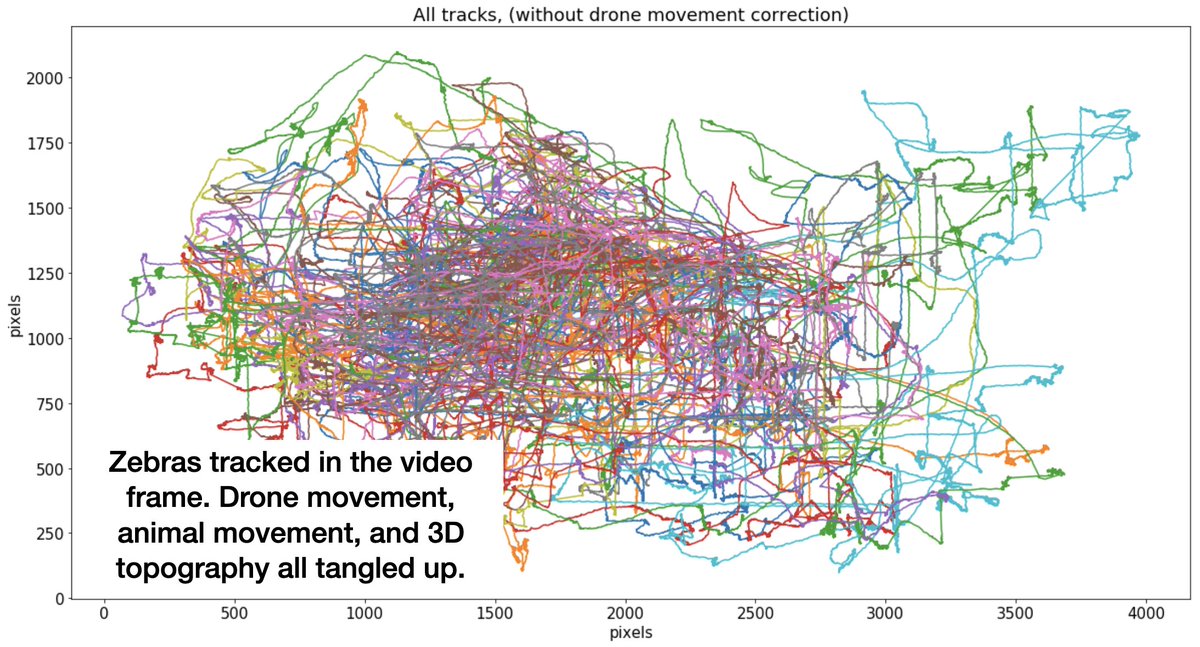
But that’s not enough! The animals move, the drone moves, the ground isn’t flat. All this movement is tangled together when we track animals in the video frame. What we actually care about is animal movement on the real earth!
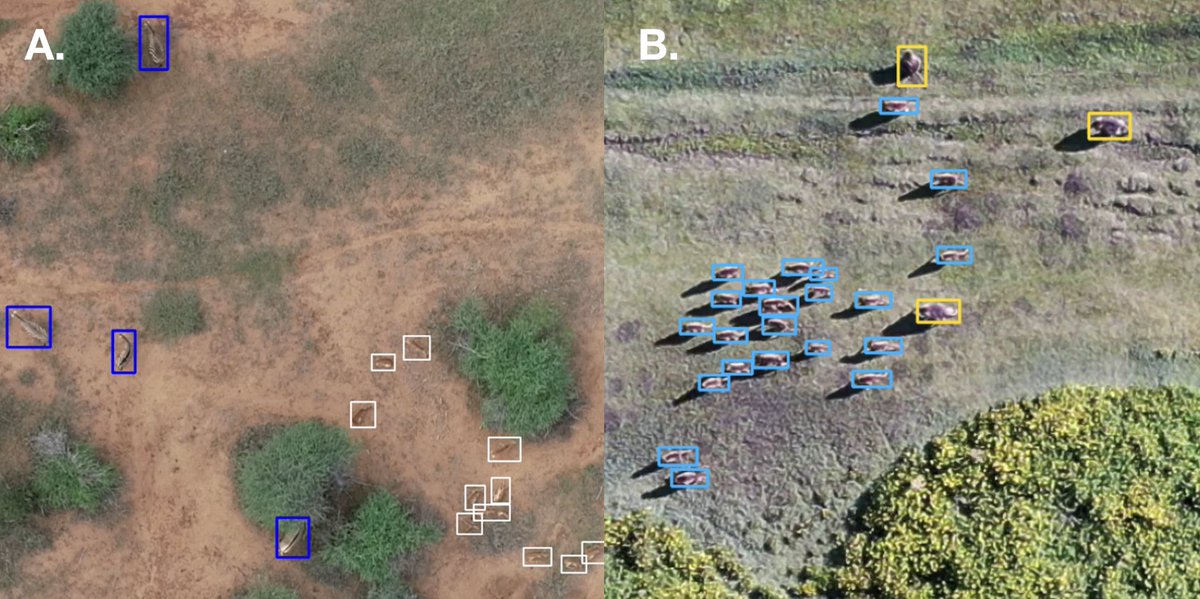
We automatically detect and track individuals using deep learning. These models allow us to detect and distinguish zebras, impalas, buffalo, and waterbuck in one example, and gelada monkeys (adult males versus all others) and humans in another.
Out now in @AnimalEcology! A general approach for using drones to study animal behavior in the wild. Record the location and posture of many animals simultaneously at sub-second sub-meter resolution, plus reconstruct their 3D landscape: https://t.co/2u4jtEzha2
I am very happy to have this method out in @AnimalEcology! Congrats to @Ben_Koger and all our co-authors! We developed this approach to facilitate studies of #collectivebehavior in wild populations, for systems & questions that are hard to address using existing methods.
A reminder of these 12 PhD positions through the WildDrone project!
We are looking for applicants from a wide range of disciplinary backgrounds! Ecology, animal behavior, computer science, aerial robotics - join our network and contribute and expand your expertise!
Come join our team as one of 12 PhD students in the new #WildDrone network! Visit https://t.co/UZVQLrJeNr for project descriptions and application information
12 PhD positions: We are looking for 12 Doctoral Candidates to join the WildDrone MSDN, which aims to revolutionize wildlife conservation practices across European and African countries using aerial robotics, computer vision, and wildlife ecology. See https://t.co/wdPRjFqq9g