@thsottiaux Been running GPT-5.6 Sol for a bit now and it's genuinely changed my workflow. First-try accuracy is noticeably better, especially on multi-step tasks. Debugging sessions that used to take forever now wrap up fast. No more re-prompting three times to get what I actually meant.
Crypto will die without privacy.
So I studied the entire history of onchain privacy to make sure it doesn't happen.
The 44-page report covers everything from early day mixers to more recent solutions.
Download it - link in comments
OpenSea has evolved.
Beta complete. Full token universe unlocked.
New rewards program live. Welcome to the new OpenSea — the best place to discover, own, and trade anything onchain.
💸 Got #BinanceWallet ? This is for you!
We're having a $300,000 campaign with Binance Wallet @BinanceWallet in anticipation for #Avalon#TGE — INSIDER INFORMATION JUST LEAKED BELOW!
1. Open your Binance Wallet
2 .Swap minimum 10 USDT to USDa
3. Complete social media tasks for additional rewards
4. Total reward pool: worth of $300,000
🟡 Don’t just sit there - You are already pre-rich.
👉 < https://t.co/SSOK7pO1oW >
₿avalon/acc
Yap early, yap only, yap often.
@_kaitoai is connecting AI, attention and capital with Yaps.
Just claimed my social card and I'm accumulating Yap points in real-time.
Claim yours 👉 https://t.co/i9eRdZ9va9
The Ultimate Runes Glossary
Rune: A fungible token on Bitcoin (for example a memecoin or a utility token)
Etch: How a Rune comes into existence (once set these properties are immutable)
Rune Name: The unique ticker for a Rune that can consists of the letters A through Z and must be between 1 and 28 characters long (at first only 13+ character Names are available when etching but every 3 months the character count requirement drops by 1 until in 4 years all Names are available)
Spacer: An optional bullet that can be added to a Rune Name when etching to make it more readable however the uniqueness of a name does not depend on spacers (for example the name UNCOMMON•GOODS has a spacer)
Rune Number: A unique number that is automatically assigned to every Rune that indicates when it was created relative to all other Runes (for example the first Rune to be etched is referred to as “Rune 0”, the second Rune to be etched is referred to as “Rune 1”, and so on)
Rune ID: A unique ID that is generated for every Rune based on the block of the etch transaction and the location of the etch transaction in the block (for example if a Rune was etched in the 20th transaction of the 500th block its ID would be “500:20”)
Rune Symbol: The currency symbol of a specific Rune which does not need to be unique (for example 100🔥 or 200⧉)
Divisibility: A Rune's divisibility is how finely it may be divided (a Rune with a divisibility of 0 may not be divided, a Rune with a divisibility of 1 may be divided into tenths like 0.1, a Rune with a divisibility of 2 may be divided into hundredths, like 0.01, and so on)
Premine: The etcher of a rune may optionally allocate to themselves units of the rune being etched (for example “10% was premined”)
Mint: While a rune's mint is open, anyone may create a mint transaction to create and receive a fixed amount of new units of that rune (the only cost associated with minting are the fees that go to Bitcoin miners)
Mint Terms: The rules that determine when a mint opens or closes (for example a mint could be open from block height 840,000 to block height 841,000 and however many mints occur during that period determines the supply or perhaps a supply cap of 21,000,000 is used and a mint is open until the supply is minted out)
Runestone: Rune protocol messages which are stored in the “OP_RETURN” area of a Bitcoin transaction
Edict: A message inside of a Runestone that that lets you customize which output a Rune will go to and the amount of the Rune that will go to an output during a transfer transaction (this allows you to craft custom transactions that for example send runes from one address to 10 other addresses all in the same transaction)
Cenotaph: When a Runestone is malformed for whatever reason it is called a Cenotaph and in the event there is a Cenotaph all Runes in the transaction are burned
Burn: You can destroy runes you hold by transferring them to the OP_RETURN output of a Bitcoin transaction
Runes Mint Guide
The halving comes closer and closer...
And RUNES, Bitcoin's new fungible token standard by @rodarmor and the ordinals core devs, will hit the market after the fourth Bitcoin halving
I cover the two key runes mint schemes:
fixed supply and block-locked supply
Bookmark & read this ultimate runes mint guide
Share it with your frens who still hope to be able to mint the most sought-after runes for $2
1⃣ Fixed supply
Same manner as the BRC-20 protocol
I show the mechanism in equations (1) to (3):
Equ. (1)
In the etching transaction, the issuer specifies the total supply and the maximum number of tokens per mint transaction (max_mint)
Dividing the total supply by the maximum mint number gives you the number of mint transactions to mint out the runes token (n_mint)
Equ. (2)
Dividing the expected market capitalization of the runes token (E[mcap]) by the number of required mint transactions (n_mint) provides the expected token value per mint transaction (E[value_mint])
In an efficient market, the expected token value per mint transaction should equal the cost to mint (E[fee_mint]) such a batch of rune tokens
Equ. (3)
The expected price per token (E[p]) equals the expected token value per mint transaction (E[value_mint]) divided by the maximum number of tokens per mint transaction (max_mint)
🔸Example 1 (high fees)
Consider an expected market capitalization of $1 billion
Total supply of 1 billion tokens and a maximum mint number of 1,000
The number of mint transactions equals 1 million and the expected fee per mint is $1,000
The expected price per rune token is $1
It will take three and a half days to mint out such a token if you assume 2,000 mint transactions per block
🔸Example 2 (moderate fees)
Assume all numbers as above but with a total supply of 100 billion rune tokens
The number of mint transactions equals 100 million, the expected fee per mint goes down to $10, while the expected token price is $0.01
It will take around a year to mint out such a token if you assume 2,000 mint transactions per block
2⃣ Block-locked supply
You can also specify a certain block until users can mint a rune token
This adds another layer of complexity because we need to estimate the total supply as well
Equ. (4) is the key difference compared to the fixed supply scheme:
The expected number of mint transactions to mint out the rune tokens (E[n_mint]) is given by the number of blocks the rune token can be minted (n_blocks) multiplied by the expected number of mint transactions per block (E[n_mint_block])
The other two equations are as above
🔸Example
Consider 5,000 blocks (34 days) until the mint closes
The expected number of mint transactions per block equals 2,000
Hence, the expected number of transactions to mint out the total supply is 10 million
Considering an expected market capitalization of $1 billion, the expected value per mint transaction and the expected fee are $100
The expected price per rune token is $0.1
Transaction fees play an even more important role in the block-locked model:
- Lower fees would increase the number of mint transactions
- The increased supply would dilute the existing supply and decrease the price
- The opposite applies (higher fees, fewer mints, increased price)
🔸Conclusions
The fee levels will skyrocket depending on the chosen parameters, and runes minting may not be a retail market
Retail may be forced to pick up runes on secondary markets if fees prohibit minting and transacting on L1
Pre-rune ordinal projects (like Runestone) are another way to join the rune ecosystem early
Runestone vs. RSIC
Both projects are runes-related
But they are fundamentally different
Bookmark this (long) post and share it with your frens
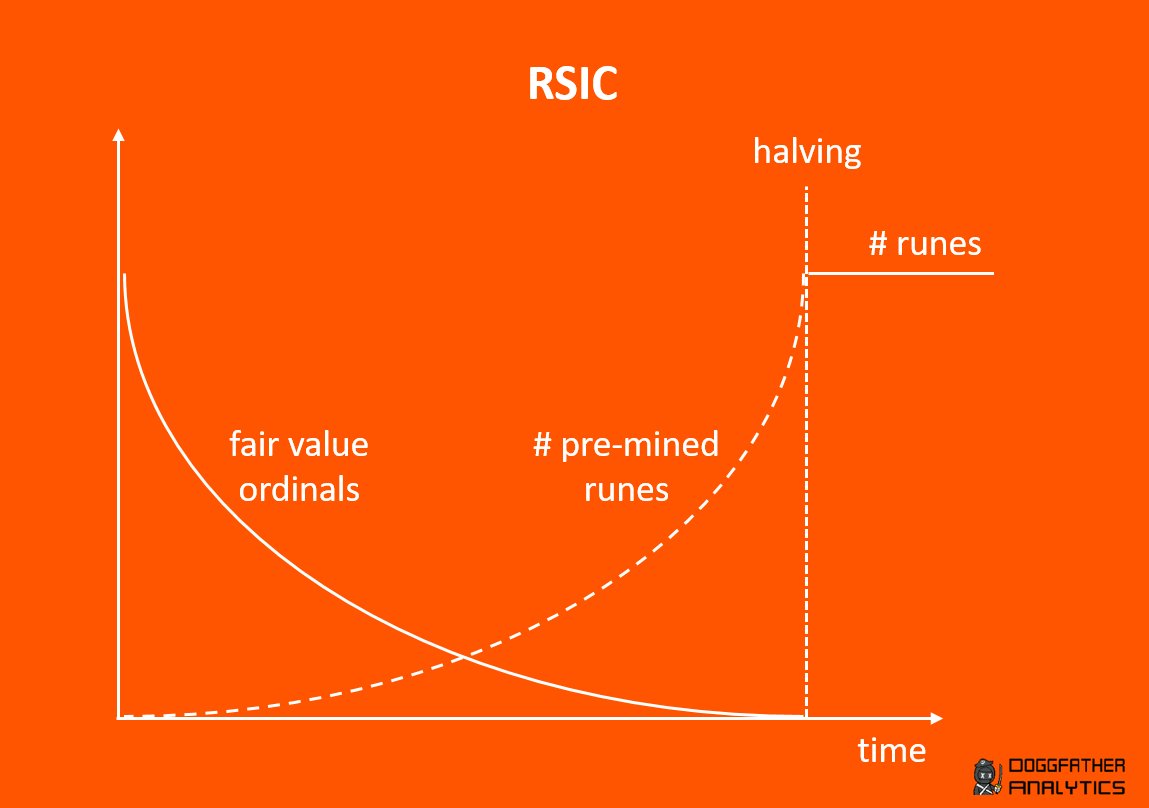
🟧RSIC
RSIC ordinals were airdropped to holders of various ordinals collections
RSIC ordinal holders (after activation) virtually mine a yet-to-be-issued runes token
The holders pre-mine more rune tokens, the longer they hold their RSIC.
The RSIC ordinal should lose its value until the halving
It's like the wear and tear of hardware miners
(Assumptions:
- no further rounds of RSIC mining
- no airdrops to RSIC ordinals holders post halving)
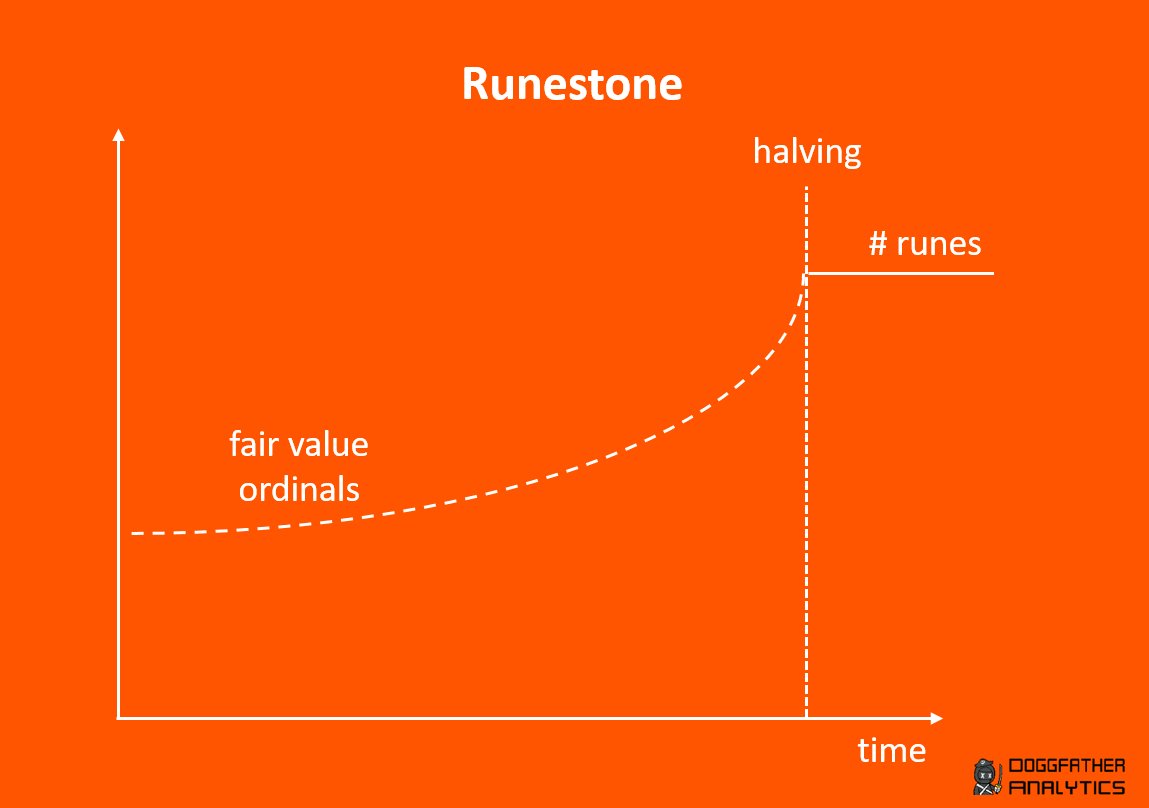
🟧 Runestone
112k Runestones were airdropped to eligible addresses (h/t to @LeonidasNFT)
After the halving, a yet-to-be-issued runes token will be distributed to Runestone holders
In contrast to RSIC, there is no financial value to hold Runestone ordinals early (besides price goes up speculation)
Opportunity costs and cost of capital make owning a Runestone early on less attractive
Their value is maximized right before the rune token distribution
🟧Conclusion
Both mechanisms have their pros and cons
But it's important to understand the differences before any investments
The infographics are no value predictions, but only illustrate the financial incentives and mechanisms (like time value of money)


![andreguettler's tweet photo. Runes Mint Guide
The halving comes closer and closer...
And RUNES, Bitcoin's new fungible token standard by @rodarmor and the ordinals core devs, will hit the market after the fourth Bitcoin halving
I cover the two key runes mint schemes:
fixed supply and block-locked supply
Bookmark & read this ultimate runes mint guide
Share it with your frens who still hope to be able to mint the most sought-after runes for $2
1⃣ Fixed supply
Same manner as the BRC-20 protocol
I show the mechanism in equations (1) to (3):
Equ. (1)
In the etching transaction, the issuer specifies the total supply and the maximum number of tokens per mint transaction (max_mint)
Dividing the total supply by the maximum mint number gives you the number of mint transactions to mint out the runes token (n_mint)
Equ. (2)
Dividing the expected market capitalization of the runes token (E[mcap]) by the number of required mint transactions (n_mint) provides the expected token value per mint transaction (E[value_mint])
In an efficient market, the expected token value per mint transaction should equal the cost to mint (E[fee_mint]) such a batch of rune tokens
Equ. (3)
The expected price per token (E[p]) equals the expected token value per mint transaction (E[value_mint]) divided by the maximum number of tokens per mint transaction (max_mint)
🔸Example 1 (high fees)
Consider an expected market capitalization of $1 billion
Total supply of 1 billion tokens and a maximum mint number of 1,000
The number of mint transactions equals 1 million and the expected fee per mint is $1,000
The expected price per rune token is $1
It will take three and a half days to mint out such a token if you assume 2,000 mint transactions per block
🔸Example 2 (moderate fees)
Assume all numbers as above but with a total supply of 100 billion rune tokens
The number of mint transactions equals 100 million, the expected fee per mint goes down to $10, while the expected token price is $0.01
It will take around a year to mint out such a token if you assume 2,000 mint transactions per block
2⃣ Block-locked supply
You can also specify a certain block until users can mint a rune token
This adds another layer of complexity because we need to estimate the total supply as well
Equ. (4) is the key difference compared to the fixed supply scheme:
The expected number of mint transactions to mint out the rune tokens (E[n_mint]) is given by the number of blocks the rune token can be minted (n_blocks) multiplied by the expected number of mint transactions per block (E[n_mint_block])
The other two equations are as above
🔸Example
Consider 5,000 blocks (34 days) until the mint closes
The expected number of mint transactions per block equals 2,000
Hence, the expected number of transactions to mint out the total supply is 10 million
Considering an expected market capitalization of $1 billion, the expected value per mint transaction and the expected fee are $100
The expected price per rune token is $0.1
Transaction fees play an even more important role in the block-locked model:
- Lower fees would increase the number of mint transactions
- The increased supply would dilute the existing supply and decrease the price
- The opposite applies (higher fees, fewer mints, increased price)
🔸Conclusions
The fee levels will skyrocket depending on the chosen parameters, and runes minting may not be a retail market
Retail may be forced to pick up runes on secondary markets if fees prohibit minting and transacting on L1
Pre-rune ordinal projects (like Runestone) are another way to join the rune ecosystem early](https://pbs.twimg.com/media/GJwE14pXQAAaL4W.png)



![andreguettler's tweet photo. Runes Mint Guide
The halving comes closer and closer...
And RUNES, Bitcoin's new fungible token standard by @rodarmor and the ordinals core devs, will hit the market after the fourth Bitcoin halving
I cover the two key runes mint schemes:
fixed supply and block-locked supply
Bookmark & read this ultimate runes mint guide
Share it with your frens who still hope to be able to mint the most sought-after runes for $2
1⃣ Fixed supply
Same manner as the BRC-20 protocol
I show the mechanism in equations (1) to (3):
Equ. (1)
In the etching transaction, the issuer specifies the total supply and the maximum number of tokens per mint transaction (max_mint)
Dividing the total supply by the maximum mint number gives you the number of mint transactions to mint out the runes token (n_mint)
Equ. (2)
Dividing the expected market capitalization of the runes token (E[mcap]) by the number of required mint transactions (n_mint) provides the expected token value per mint transaction (E[value_mint])
In an efficient market, the expected token value per mint transaction should equal the cost to mint (E[fee_mint]) such a batch of rune tokens
Equ. (3)
The expected price per token (E[p]) equals the expected token value per mint transaction (E[value_mint]) divided by the maximum number of tokens per mint transaction (max_mint)
🔸Example 1 (high fees)
Consider an expected market capitalization of $1 billion
Total supply of 1 billion tokens and a maximum mint number of 1,000
The number of mint transactions equals 1 million and the expected fee per mint is $1,000
The expected price per rune token is $1
It will take three and a half days to mint out such a token if you assume 2,000 mint transactions per block
🔸Example 2 (moderate fees)
Assume all numbers as above but with a total supply of 100 billion rune tokens
The number of mint transactions equals 100 million, the expected fee per mint goes down to $10, while the expected token price is $0.01
It will take around a year to mint out such a token if you assume 2,000 mint transactions per block
2⃣ Block-locked supply
You can also specify a certain block until users can mint a rune token
This adds another layer of complexity because we need to estimate the total supply as well
Equ. (4) is the key difference compared to the fixed supply scheme:
The expected number of mint transactions to mint out the rune tokens (E[n_mint]) is given by the number of blocks the rune token can be minted (n_blocks) multiplied by the expected number of mint transactions per block (E[n_mint_block])
The other two equations are as above
🔸Example
Consider 5,000 blocks (34 days) until the mint closes
The expected number of mint transactions per block equals 2,000
Hence, the expected number of transactions to mint out the total supply is 10 million
Considering an expected market capitalization of $1 billion, the expected value per mint transaction and the expected fee are $100
The expected price per rune token is $0.1
Transaction fees play an even more important role in the block-locked model:
- Lower fees would increase the number of mint transactions
- The increased supply would dilute the existing supply and decrease the price
- The opposite applies (higher fees, fewer mints, increased price)
🔸Conclusions
The fee levels will skyrocket depending on the chosen parameters, and runes minting may not be a retail market
Retail may be forced to pick up runes on secondary markets if fees prohibit minting and transacting on L1
Pre-rune ordinal projects (like Runestone) are another way to join the rune ecosystem early](https://pbs.twimg.com/media/GJwv1t3X0AAOPSp.png)