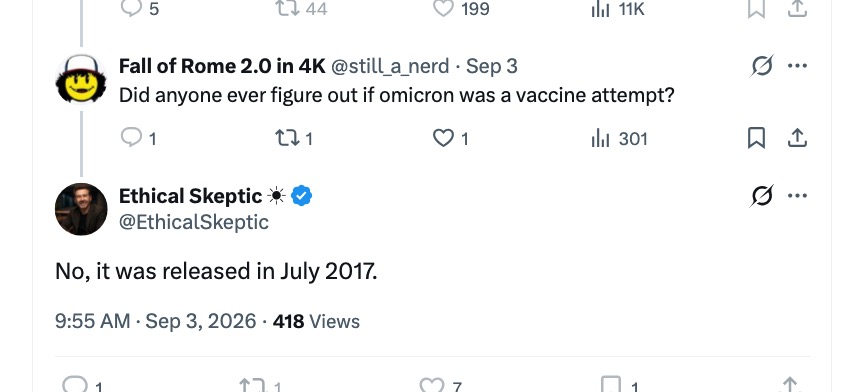
ME: the fact that you can't see Kilimanjaro from the Serengeti suggests that Toto knew nothing about Africa
TACO BELL CASHIER: look buddy, Toto's Africa is a Jungian dreamscape, a state of mind,
HARBAUGH: Jameis we’re going to need you to start the last 15 games of the season. you spent the offseason preparing for this right
JAMEIS: of course coach
JAMEIS THIS OFFSEASON:
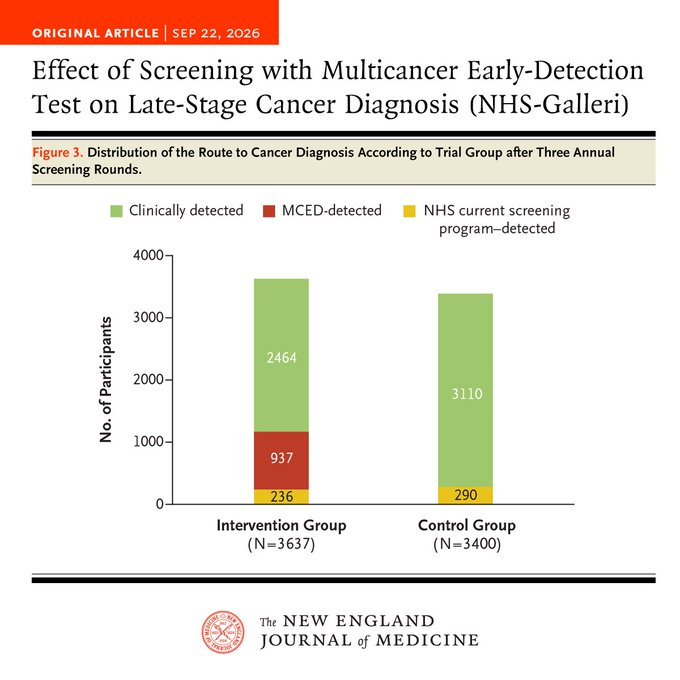
A negative cancer blood test does not mean you are cancer-free. The company behind the $949 @GrailBio test says a negative result “does not rule out cancer,” and its largest trial missed most cancers diagnosed within a year.
The test looks for bits of DNA tumors shed into the blood. In England, 142,000 people aged 50 to 77 were split so half were offered it yearly for three years.
A positive result was cancer about half the time. The rest had hospital checks that found no cancer at the time.
The trials were built for people 50 and over, so nobody knows how well it works at 30 or 40.
Most cancers it found were types with no routine screening, and more were caught early. But the trial missed its main goal, fewer people being diagnosed late, and nobody knows yet if it saves lives.
@FDA advisers vote today on whether to approve it for adults 50 and older, alongside mammograms and colonoscopies.
Interesting.
A national cohort study of 28 million individuals found:
No increased risk of 4-year all-cause mortality in individuals aged 18 to 59 years in persons vaccinated against COVID-19.
It's almost like antivaxers are liars and had no evidence...
https://t.co/QDVoxRKloj
This is the Republican nominee for statewide office. Are other Republican elected officials going to condemn the intolerance and racism, or look the other way while it becomes normalized. This is how great political parties self-destruct. Sad.
Teams were 0-223 when trailing by 17-plus points vs. an AP No. 1 team since 2003.
Texas just went up 24-23 with 25 seconds left after trailing by 20 earlier this half.
"The veterans of the war on terrorism never got their parade. We are not perceived as victors. I’m grateful for the way in which the vast majority of Americans respect veterans and appreciate our service. But on the 25th anniversary of Sept. 11, it’s necessary to acknowledge what my brothers and sisters accomplished in our nation’s longest war.
You fought with honor. You did your best to defend the innocent. Time and again you confronted and defeated an opponent that could be every bit as evil as the Nazis your grandfathers vanquished. And you accomplished the one mission that is core to your identity as a soldier, sailor, airman or Marine — you kept America safe." https://t.co/Gfv14OovvM
For all thise who thought it was exaggerated to say that Trump is in office to solve Putin's problems.
Ask why they are going so public right now with their submission to Putin. What are the Russian problems to be solved, what are the Trump & Kushner problems that could be exposed.
A company in Riga, Latvia is paying a 300,000 dollar monthly budget to overseas contractors, told explicitly to hide their location with US proxy servers, to post clips designed to look like ordinary Americans spontaneously praising the GOP. The campaign's own instructions state the goal in writing: so that republican win in USA. No disclosure that the poster was paid, no disclosure it is coordinated. The money trail traces to Blake Wynn, 26, nephew of mega donor Steve Wynn, whose company's employees uploaded the campaign's source videos.
Wynn has said he regularly talks to FBI Director Kash Patel, sat next to Trump on Election Night 2024, and was close with Charlie Kirk. The campaign's own banned topics list is its own tell, no Jan 6 videos, no Trump family crypto, no RFK Jr, careful image management dressed up as spontaneous grassroots enthusiasm. When the Atlantic's reporter contacted everyone involved, the campaign folders and Discord listings started disappearing within a day.
Hi all,
The Lp(a) HORIZON trial has released topline data and, quite shockingly, missed its primary endpoint.
In other words, lowering Lp(a) in patients with prior MI, stroke or peripheral arterial disease, who were otherwise very well treated for LDL-C, blood pressure, diabetes and other risk factors, did not reduce the primary cardiovascular endpoint.
We obviously need to see the full data before making firm conclusions, and I don’t want to speculate too much without the details.
But this is a big enough result that it is worth summarizing what we know, what we don’t know, and what this may mean for our patients after 20+ years of trying to test the “Lp(a) hypothesis.”
What we know:
1-There are hundreds if not thousands of genetic, epidemiologic and Mendelian-randomization studies showing that elevated Lp(a) is associated with MI, stroke, peripheral arterial disease and aortic stenosis. That body of evidence is very strong.
2-However, much of those data come from community-based populations, often before the era of intensive LDL-C lowering and modern secondary prevention.
3-There has been much less information about how much residual risk Lp(a) carries in someone who has already had an event and is then treated very aggressively.
4-HORIZON may have had some of the best-treated patients of any recent cardiovascular outcomes trial.
Baseline LDL-C was about 65 mg/dL, a measured LDL-C contains the cholesterol carried on Lp(a), so in reality, 15-20 points lower.
5-In patients with very high Lp(a), if you correct LDL-C for Lp(a)-cholesterol, the actual LDL-C carried by LDL particles may have been closer to 45–50 mg/dL, perhaps even lower in some patients.
6-This raises a very basic question:
Can you still demonstrate a major incremental benefit from lowering another apoB-containing particle when the underlying LDL burden has already been driven this low?
What we don’t know:
1-What was the actual corrected LDL-C in these patients? I think it would be extremely informative to directly measure Lp(a)-C and calculate corrected LDL-C. This may tell us a lot about the biological setting in which pelacarsen was being tested.
2- What was the OxPL status? Our prior work has suggested that much of the pro-inflammatory biology associated with Lp(a) is related to its enrichment in oxidized phospholipids. Did OxPL fall? Did patients with higher OxPL derive more benefit? Was Lp(a) concentration actually identifying the patients with the most pathogenic particles?
3- Did we measure the right component of Lp(a) for trial inclusion? We generally measure molar particle concentration. But is molar concentration itself the main driver of risk, or is it partly a surrogate for what the particle carries? Cholesterol? Triglycerides? Oxidized phospholipids? Other proteins? Could two patients with the same Lp(a) concentration have very different Lp(a)-mediated risk? I think this question deserves much more attention.
3- Were the genetic data telling us exactly what we thought they were telling us? The genetic data are extremely compelling, but genetics reflect lifelong exposure. A clinical trial treats patients late in life, often after decades of arterial injury and after an event has already occurred. Those are not necessarily the same experiment. Could there also be some unrecognized biology linked to the LPA locus that we have not completely accounted for? That possibility should at least be considered.
3- Does very low LDL-C modify the Lp(a) risk relationship? Maybe Lp(a) is particularly important when LDL-C is higher, but its contribution becomes smaller once LDL-C is driven to very low levels. Again, we need the data.
4- Does aspirin or other antiplatelet therapy reduce part of the risk associated with Lp(a)? Lp(a) has potentially important prothrombotic effects. Almost everyone in a trial like HORIZON is receiving contemporary antiplatelet therapy. Could that blunt one component of the risk associated with Lp(a)?
5- Why are these patients still having events? This may be one of the most interesting questions of all. These are patients with LDL-C around 65 mg/dL, and perhaps corrected LDL-C substantially lower, yet cardiovascular events continue to occur. What is driving that residual risk? Inflammation? Thrombosis? Plaque burden that is already too advanced? Other lipoprotein characteristics? Something we are not measuring?
6- Do we need to re-examine some basic assumptions about atherosclerosis? We have spent decades focusing heavily on the quantity of circulating lipoproteins. But perhaps lipoproteins are relatively benign until they undergo biological modification in the artery wall. Oxidation may be one of those key modifications. For some patients, the answer may be to remove more particles from the circulation. For others, perhaps the better approach is to prevent their oxidation or block the downstream biological effects of oxidized lipids. The recent difficulties with anti-inflammatory approaches, including IL-6 inhibition, make these mechanistic questions even more interesting.
7- Was there something specific about pelacarsen, the degree or timing of Lp(a) lowering, advanced disease, trial duration, background therapy or patient selection that mitigated a potential benefit? We simply don’t know yet. That is why the detailed results will be so important.
What does this mean for patients today?
If you have already had an MI, stroke or PAD, the immediate lesson is very clear:
1- Get all of your established risk factors treated aggressively.
2- Get LDL-C/apoB very low.
3- Control blood pressure.
4- Control diabetes.
5- Don’t smoke.
6- Use appropriate antiplatelet and other guideline-directed therapies.
HORIZON shows us what modern secondary prevention should look like.
If you have elevated Lp(a) but have never had an event, the genetic and epidemiologic data still suggest increased lifetime risk.
Until the other 4 outcome trials read out, I would continue to treat every modifiable risk factor aggressively.
We should wait for those trials before drawing broad conclusions about the entire field.
I think the story of Lp(a) therapy is beginning, not ending.
We also need to show tremendous respect and gratitude to the patients who participated in HORIZON and to the investigators and companies that invested enormous resources to actually test the Lp(a) hypothesis, to the ultimate benefit to peole with elevated Lp(a) to best guide how to manage risk.
More to come as we go forward.
This is a big bust, folks
The first large scale (N>8000 participants) for lowering Lp(a) did not meet its primary endpoint for reducing adverse cardiovascular outcomes (vs placebo) https://t.co/dNV6RHXtJb
6/10
The dose is a major limitation.
The mice received 12 mg/kg of LNP, which roughly on the order of 1,000x higher per kilogram than the lipid exposure from a human mRNA vaccine dose.
High doses can be useful for uncovering potential mechanisms at action.
But it is well known that showing that something can happen at a very high experimental dose does not establish that ordinary human vaccine exposure is sufficient to produce the same clinically meaningful effect.
Many thanks for all your support on the recent uptick in smear campaigns against me & family. This happened in 2024 around this same time ahead of the elections, possibly a repeat but honestly I have no idea, maybe a coincidence. Trying to stay off social media platforms as a mental health break, focusing on the lab meetings, my lectures, and revisions of my new book with @mitpress on Texas history which I’m totally loving